
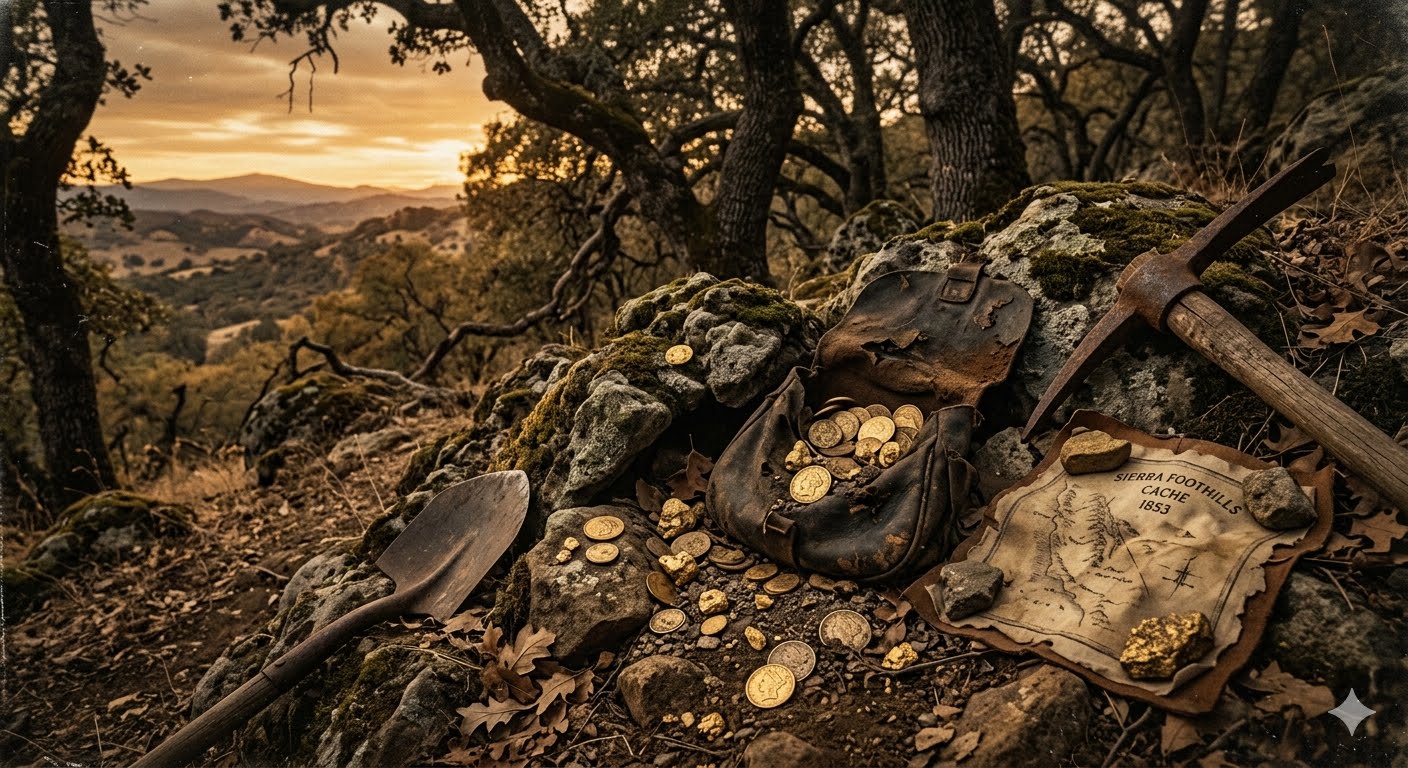
Somewhere beneath California's sunburned hills, hidden among ancient oak trees, forgotten trails, and abandoned mining camps, a cache of gold may still be waiting.
Not because it was buried with elaborate clues.
Not because it was protected by secret maps.
Not because it was hidden in some dramatic cave known only to outlaws.
But because the man who hid it understood something modern treasure hunters often forget.
The best place to hide something valuable is not where nobody can find it.
It's where nobody would think to look.
More than 170 years have passed since the death of Joaquin Murrieta. In that time, California has transformed from a rugged frontier into one of the most populated places on Earth. Entire mountain ranges have been mapped. Millions of people have explored the Sierra Nevada. Prospectors have searched canyons, caves, and abandoned mines from one end of the state to the other.
Yet despite all that effort, stories of Murrieta's hidden gold refuse to die.
Perhaps there is a reason for that.
Because when we stop thinking like treasure hunters and start thinking like Joaquin Murrieta, a different picture begins to emerge.
The California Murrieta Knew
The California Murrieta knew no longer exists.
In the early 1850s, the state was exploding with activity. Gold discoveries had drawn people from every corner of the world. Mining camps appeared almost overnight. Wagons moved constantly between settlements. Pack trains carried supplies through the foothills. Stagecoaches transported payrolls, gold dust, and passengers across hundreds of miles of rough country.
The landscape itself was chaotic.
Thousands of men were digging holes, diverting streams, cutting roads, building cabins, and abandoning them months later. Entire towns would spring up and disappear before a mapmaker could properly document them.
To modern eyes it seems primitive.
To an outlaw, it was paradise.
There were countless places to disappear.
Countless places to hide.
And countless places that nobody would ever revisit.
The Outlaw's Problem
If Murrieta accumulated significant wealth—and many historians believe he did—he faced a problem that every outlaw throughout history has faced.
Gold is valuable.
But gold is also heavy.
A single twenty-dollar gold coin weighs roughly one ounce.
A thousand such coins weighs more than sixty pounds.
A truly substantial fortune would require pack animals, trusted associates, and constant movement.
That creates risk.
Every additional mile increases the chance of betrayal.
Every additional companion increases the chance someone talks.
Every additional day increases the chance of capture.
A smart outlaw doesn't carry all of his wealth.
A smart outlaw hides it.
The Legend Becomes Interesting
Most treasure hunters imagine Murrieta burying gold immediately after a robbery. They picture moonlit nights, secret caves, and hastily dug holes.
The reality was likely far less dramatic.
If Murrieta hid gold, he probably wasn't hiding it from the law.
He was hiding it from everyone.
Including his own men.
Throughout history, successful outlaw leaders rarely trusted large fortunes to a single location. They created caches. Temporary storage points. Places where wealth could remain hidden until conditions became favorable.
The question is not whether Murrieta could have hidden gold.
The question is where a man who understood California better than most people alive would choose to hide it.
The answer may not be deep in the Sierra Nevada.
It may not even be particularly remote.
The Psychology of Hiding Treasure
Human beings consistently overestimate how far criminals travel to conceal valuables.
Think about your own life.
If you needed to hide something important and planned to retrieve it later, would you carry it fifty miles into an unfamiliar wilderness?
Or would you place it somewhere you could easily return to?
History suggests the latter.
Most recovered treasure caches are found surprisingly close to familiar routes, water sources, campsites, or landmarks.
Not because the owners were careless.
Because they expected to come back.
Murrieta was no different.
He operated throughout the Mother Lode and the foothills stretching along California's eastern valleys. He knew the terrain intimately. He understood which routes were heavily traveled and which were rarely used. He knew where water could be found during dry summers. He knew where horses could be hidden.
Most importantly, he knew where people weren't paying attention.
The Perfect Hiding Place
Modern treasure hunters often search for extraordinary locations.
The better question may be whether Murrieta chose an ordinary one.
Imagine standing on a foothill ridge in 1852.
Below you, a seasonal creek cuts through oak woodland. Nearby, a wagon trail winds toward a mining camp that no longer exists. A cluster of boulders overlooks a shallow draw. Nothing about the scene appears remarkable.
Yet to Murrieta, that location might have been perfect.
Visible enough to relocate.
Hidden enough to avoid discovery.
Close enough to retrieve quickly.
Far enough from settlements to avoid unwanted attention.
The beauty of such a location is that it would become increasingly difficult to identify over time.
Trees grow.
Trails disappear.
Creeks change course.
Entire landscapes evolve.
A landmark obvious in 1852 may be invisible today.
This may explain why treasure hunters have struggled for generations.
They are searching for the California of today.
Murrieta hid his gold in the California of 1852.
Those are not the same place.
Looking for What We Expect
Perhaps the most thought-provoking possibility is that the treasure still exists because nobody has searched for it correctly.
Modern explorers often focus on the dramatic.
Caves.
Mine shafts.
Rock formations.
Remote peaks.
Yet if Murrieta truly intended to recover the gold himself, those locations make surprisingly little sense.
A man planning to return does not create unnecessary difficulty.
He chooses efficiency.
The ideal hiding place would likely be somewhere accessible, familiar, and forgettable.
A place that blends into the landscape.
A place that nobody would photograph.
A place that nobody would write books about.
A place that hundreds of people might walk past without noticing.
In other words, exactly the type of place where treasure survives.
Hidden in Plain Sight
The longer one studies California history, the more another possibility emerges.
Perhaps the greatest challenge is not finding the treasure.
Perhaps it is recognizing it.
The foothills of California are littered with forgotten history. Old homesteads. Mining camps. Wells. Stone foundations. Wagon roads. Water ditches. Fence lines. Campsites.
Most are ignored.
Most appear insignificant.
Yet every one of them once mattered deeply to someone.
And somewhere among those forgotten pieces of California's past, a man named Joaquin Murrieta may have left behind a secret.
Not in a spectacular cave.
Not at the end of a cryptic map.
But hidden in plain sight.
Waiting for someone willing to stop thinking like a treasure hunter and start thinking like an outlaw.
Because if Joaquin Murrieta truly hid a fortune in gold, the most remarkable part of the story may not be that it remains lost.
The most remarkable part may be that generations of people have spent 170 years searching for it while asking the wrong question.
Not "Where is the gold?"
But rather:
"If I were Joaquin Murrieta, where would I expect to find it when I came back?"