The gold prospecting app that strikes gold.

AI terrain analysis, LiDAR mapping, historic topo maps back to 1879, and instant coin and relic ID — built for gold prospectors and metal detectorists who'd rather spend the day in the field than figuring out where to go.

Download on the App Store

7 days free, every feature unlocked. Then $8.99/mo or $89.99/yr.

A look inside

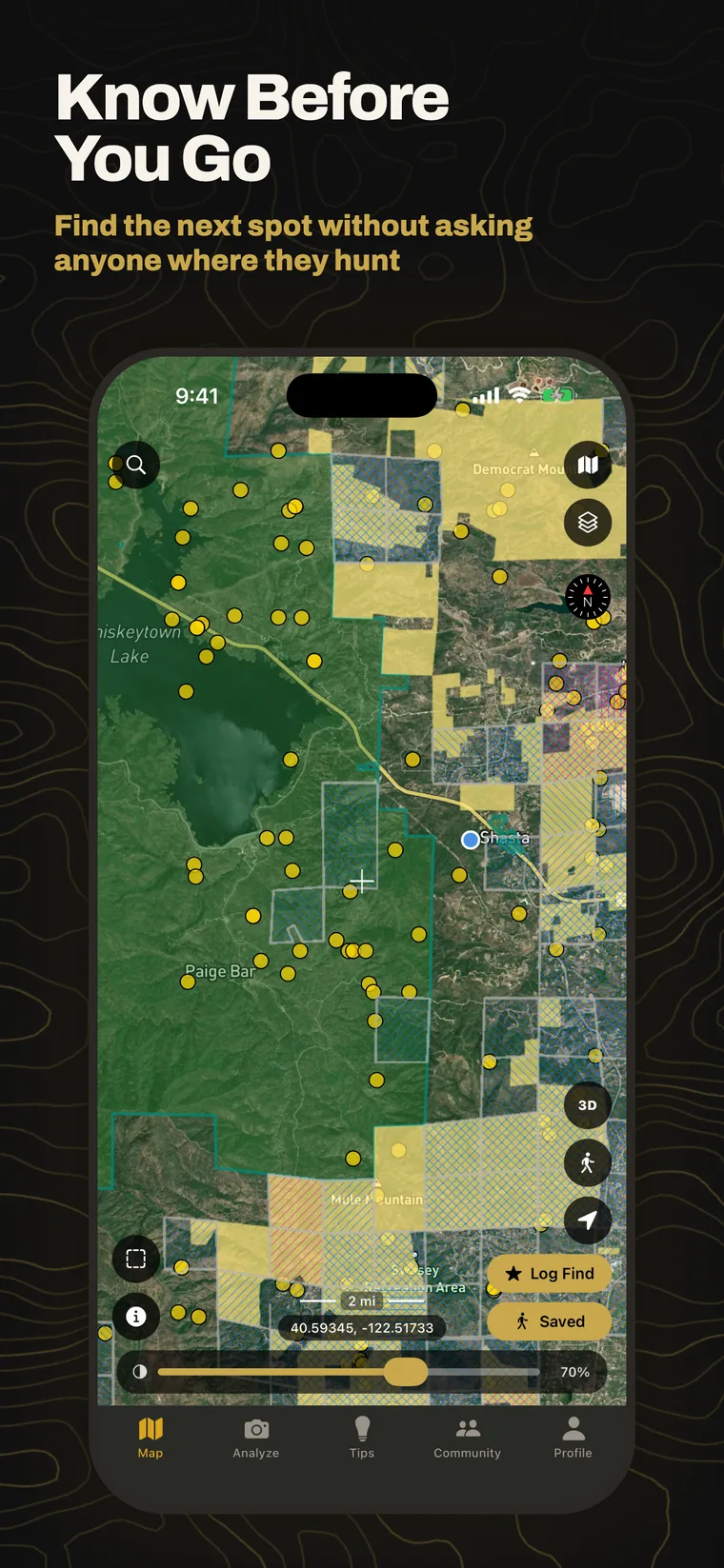
Know before you go: map with mining claims, public land, and historic mine points
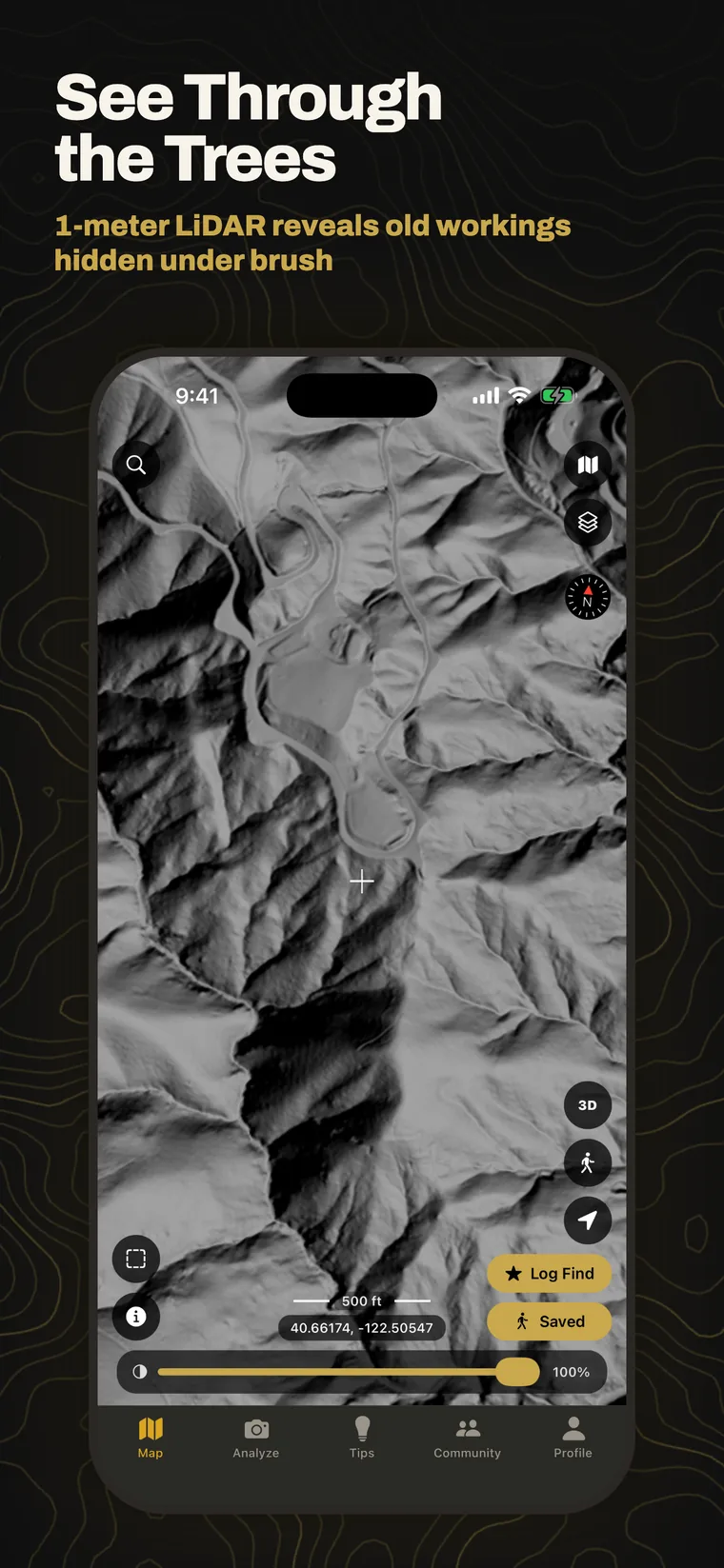
See through the trees: 1-meter LiDAR reveals old workings hidden under brush
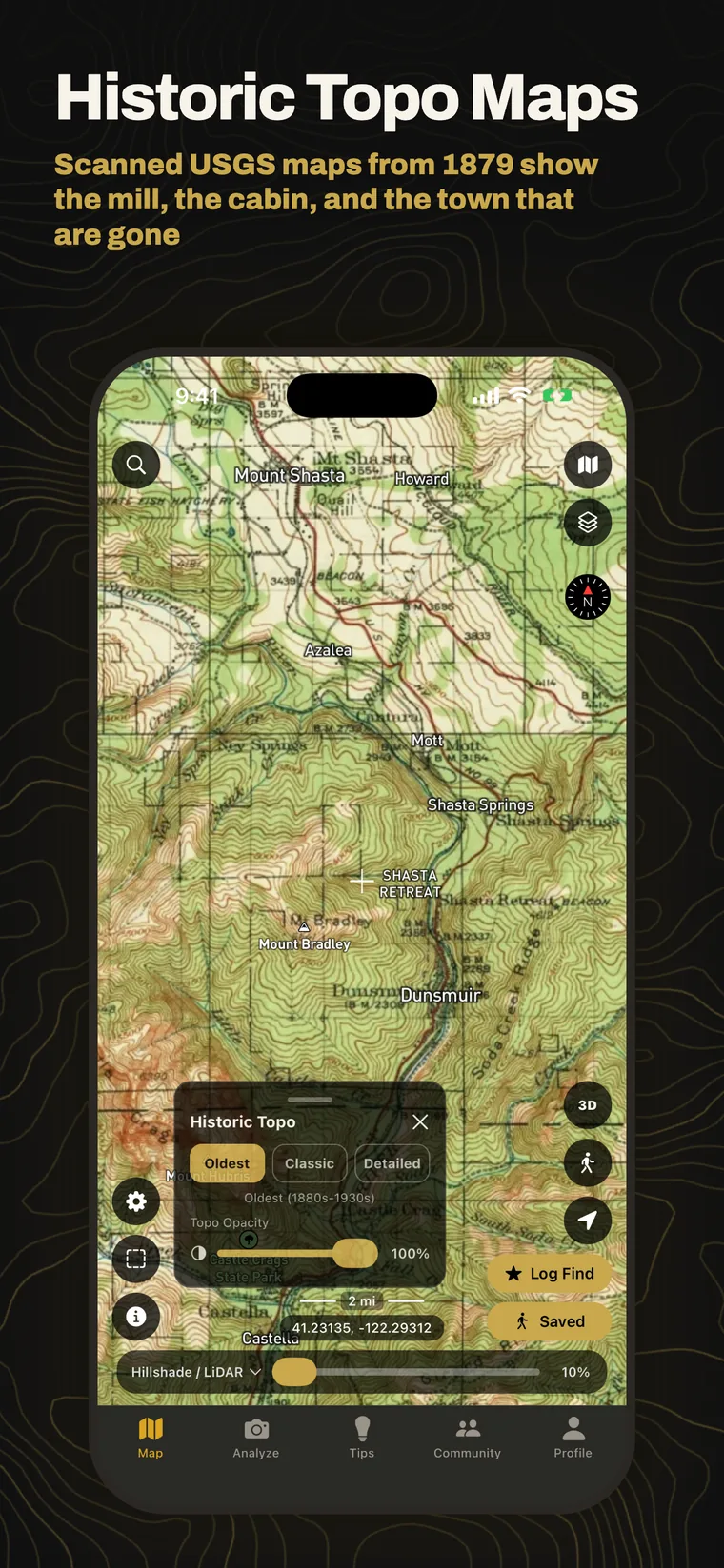
Historic topo maps: scanned USGS maps from 1879 show the mill, the cabin, and the town that are gone
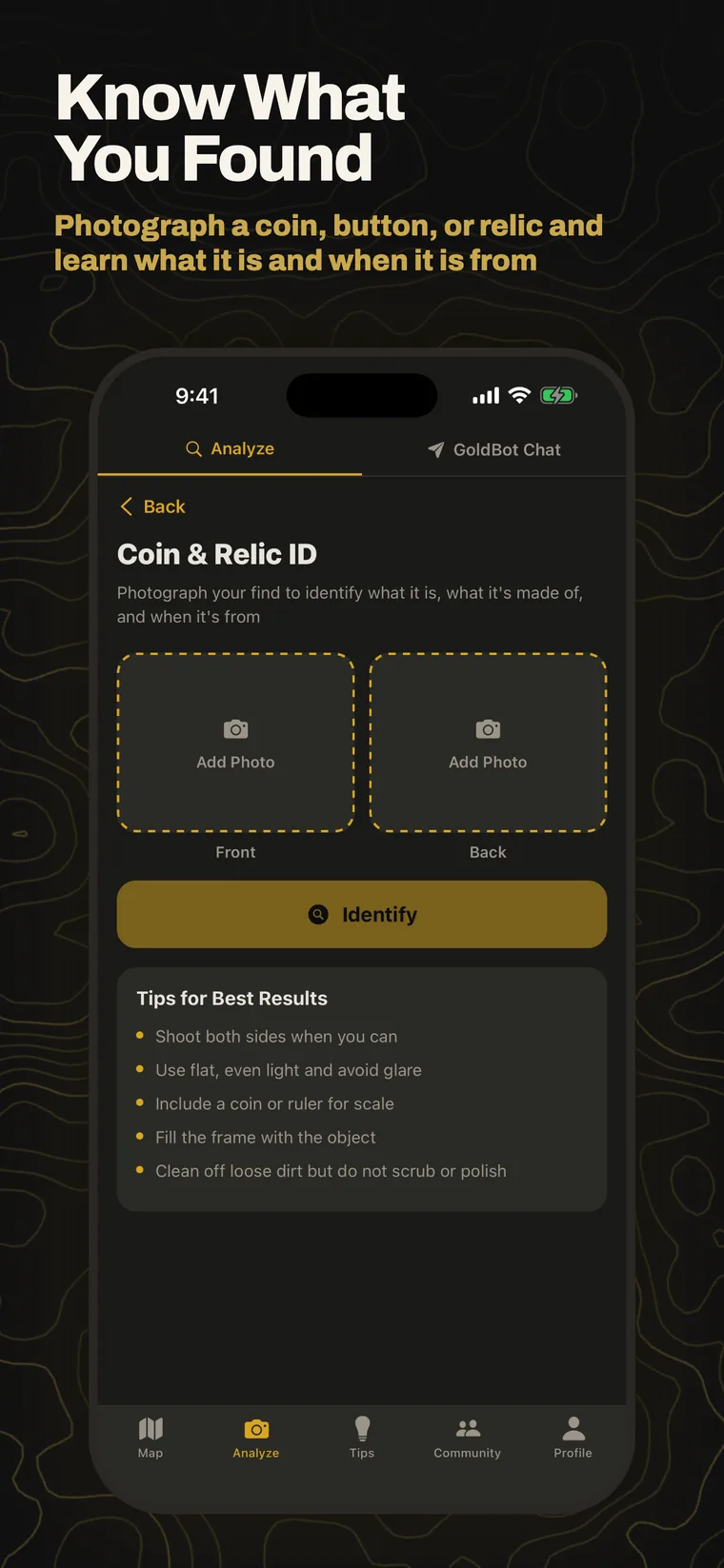
Know what you found: photograph a coin, button, or relic and learn what it is and when it is from
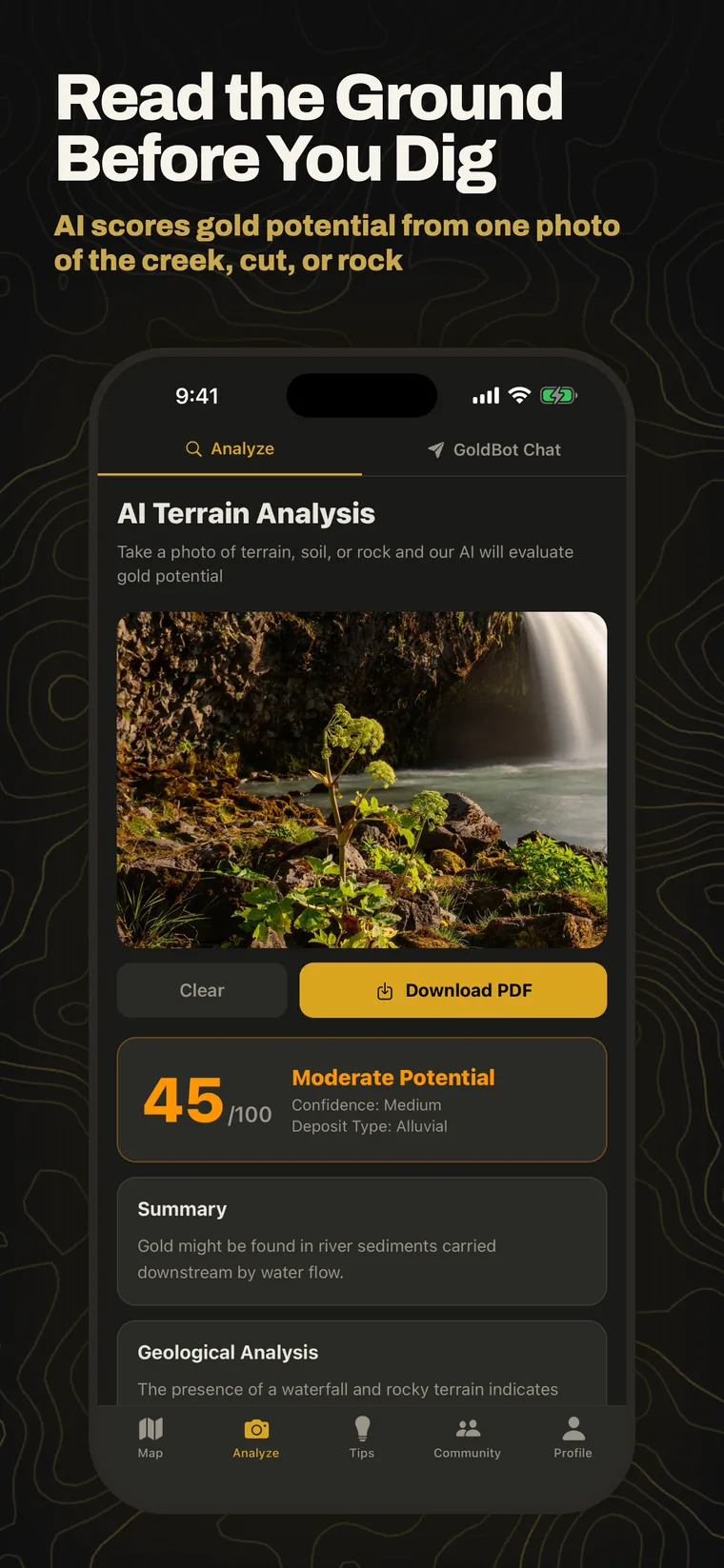
Read the ground before you dig: AI scores gold potential from one photo of the creek, cut, or rock
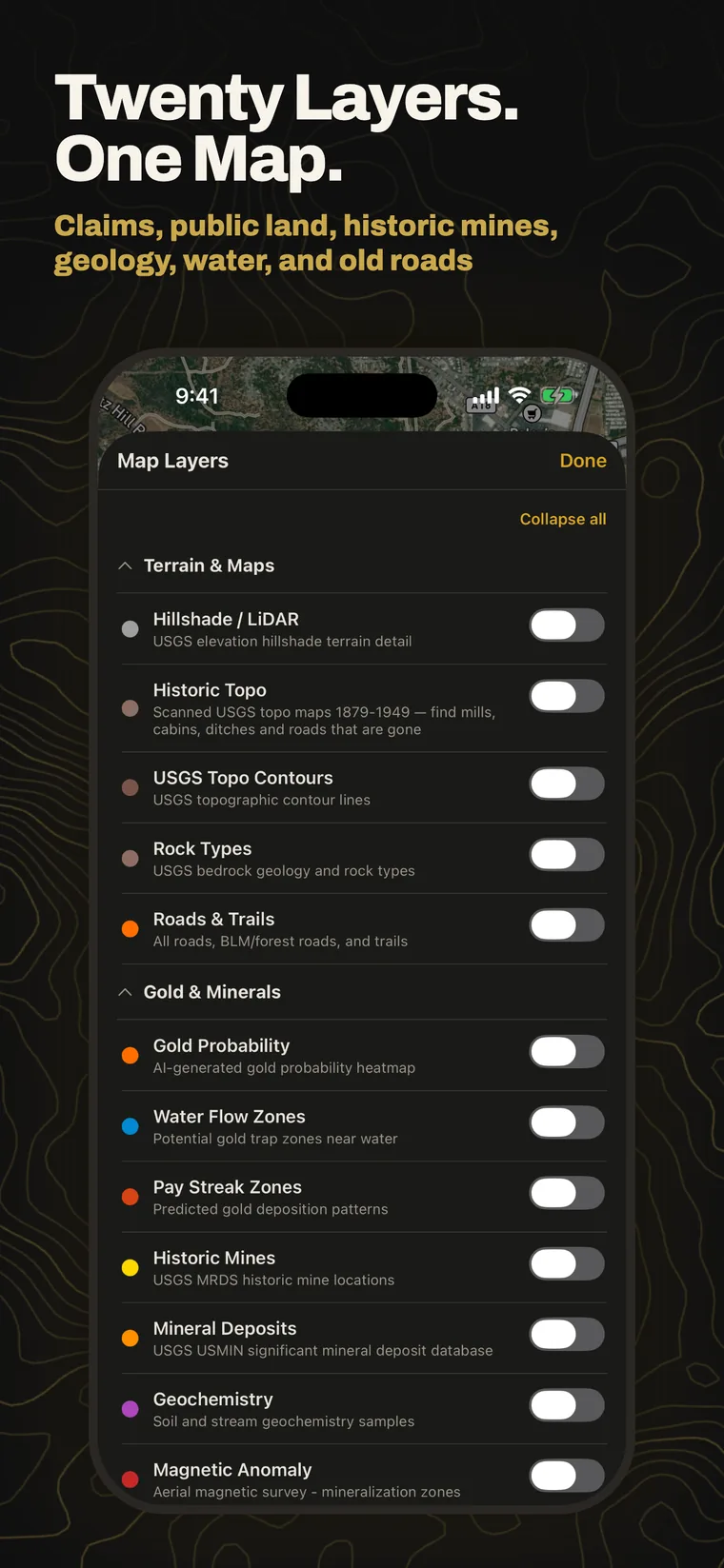
Every layer on one map: claims, public land, historic mines, geology, water, and old roads
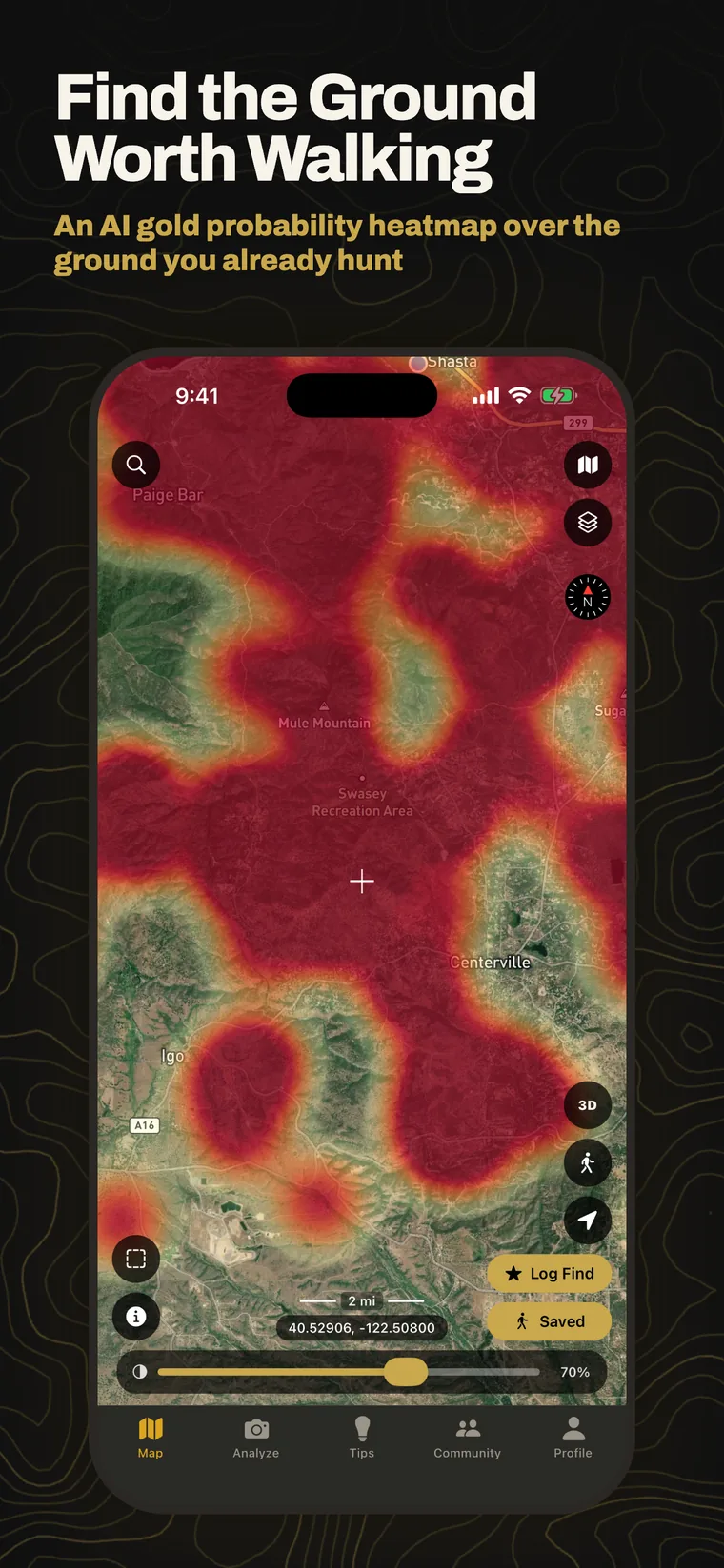
Find the ground worth walking: an AI gold probability heatmap over the ground you already hunt
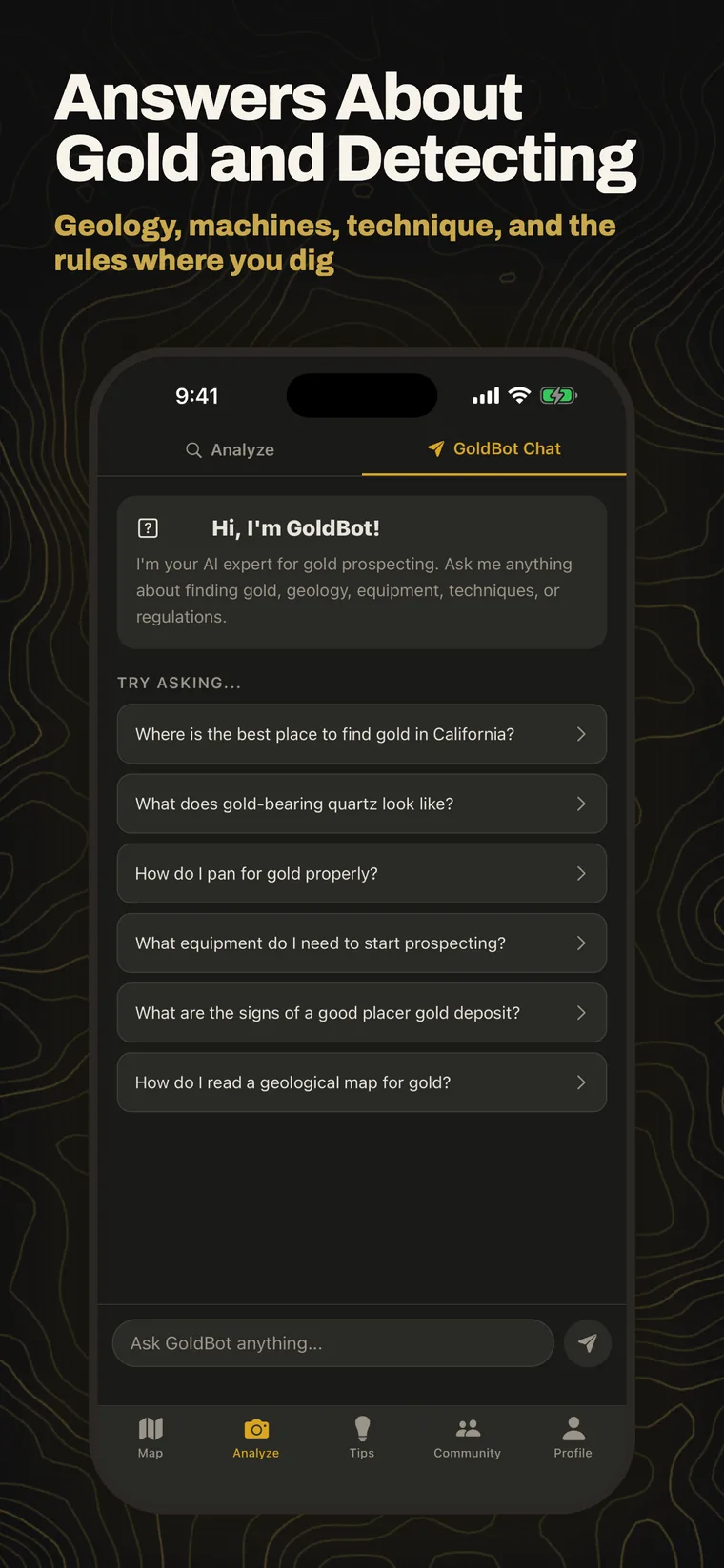
Answers about gold and detecting: geology, machines, technique, and the rules where you dig
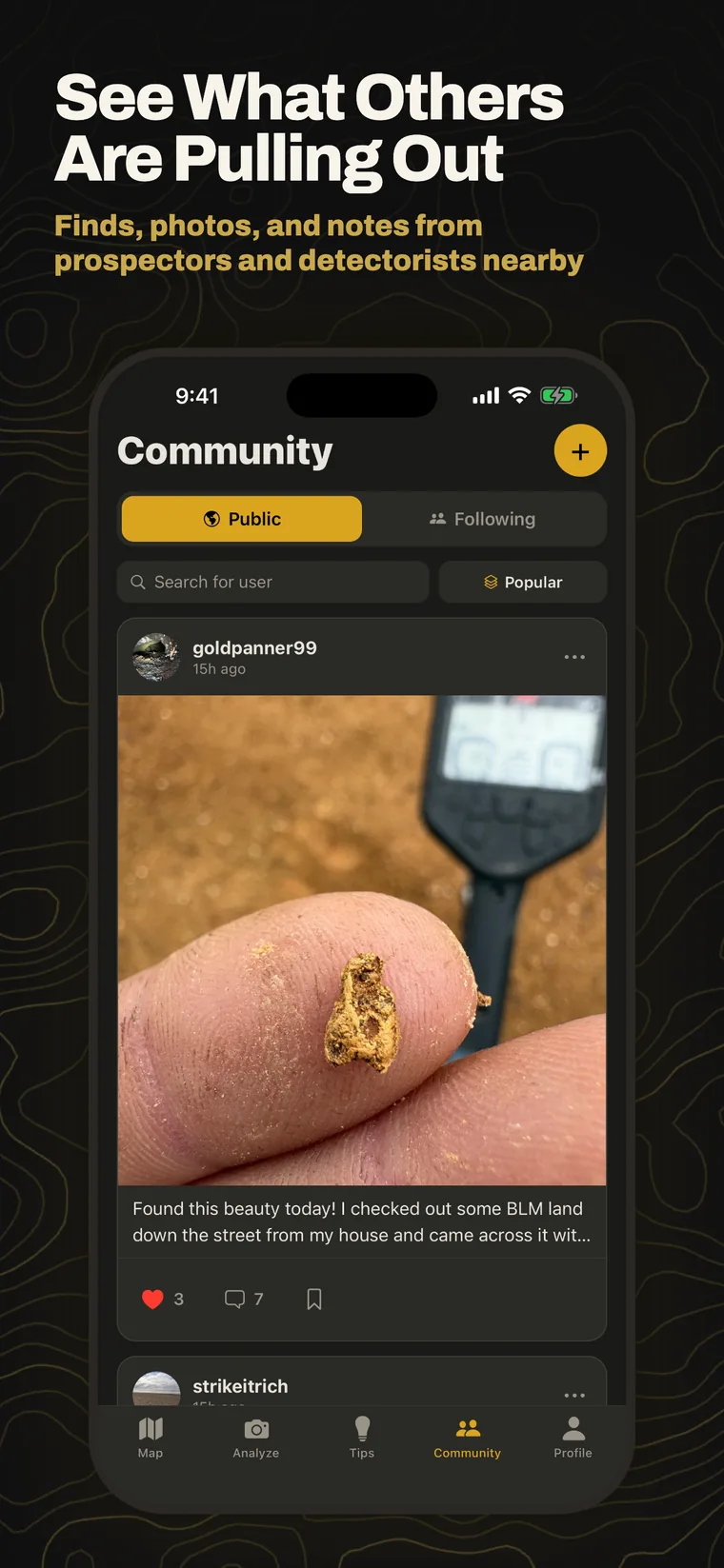
See what others are pulling out: finds, photos, and notes from prospectors and detectorists nearby
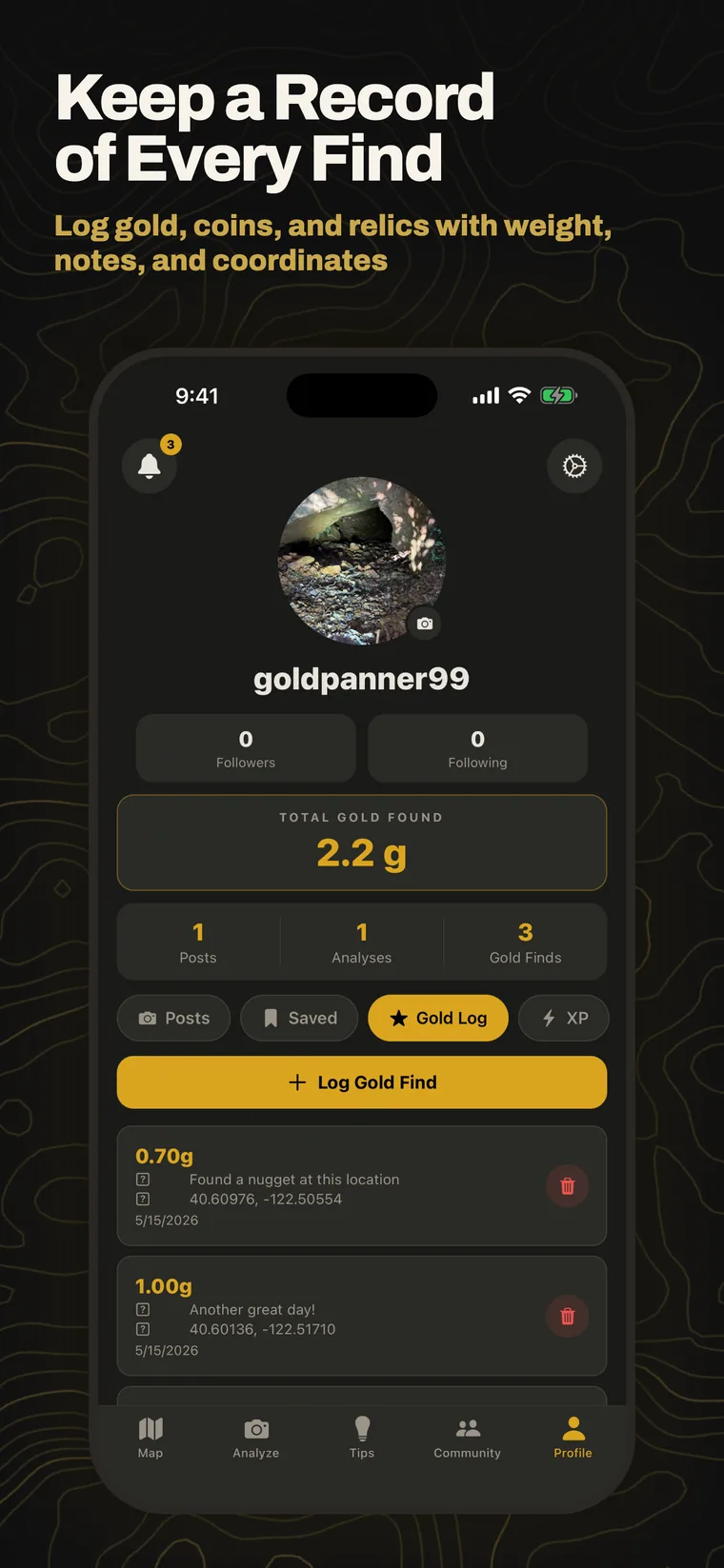
Keep a record of every find: log gold, coins, and relics with weight, notes, and coordinates

Built for prospectors and detectorists

AI Terrain Analysis

Trained strictly for gold prospecting. Snap a photo of a creek, cut bank, or hillside — get a 0–100 score with confidence level. The model identifies rock types, calls out mineral indicators (iron staining, quartz veins, black sand), reads water flow for gold trap potential, names the deposit type (placer, alluvial, hardrock, eluvial), and tells you where in the frame to start sampling. Plain-English explanations included.

Coin & Relic ID

Photograph a coin, button, buckle, nail, or anything else you pull out of the ground and get an identification: what it is, the years it was made, what it's made of, and the history behind it. Built to be honest about uncertainty — when a date isn't legible in the photo, it says so and tells you where to look instead of guessing. It never gives a dollar value or an appraisal. Every result saves to your device, so the finds add up into a record of what you've dug.

GoldBot

Your AI prospecting buddy. Ask about geology, gear, technique, panning, sluicing, or whether that black sand is worth a second look. Trained on 30+ years of placer and lode prospecting knowledge — not search engines.

LiDAR Layer

See what satellite imagery misses. High-resolution 1-meter USGS 3DEP LiDAR hillshade reveals the ground's history: old placer cuts, hydraulic pits, tailings piles, ditch lines, and water races invisible from the surface. Instant load across California, Oregon and Nevada, rendered on demand everywhere else in the US. Multi-directional shading keeps linear features like ditch lines visible no matter which way they run.

How to read LiDAR for gold

Historic Topo Maps

Scanned USGS topographic maps going back to 1879, laid over the modern world with an opacity slider so you can fade between then and now. Find the mill, the cabin, the wagon road, and the townsite that vanished a century ago. Three era layers: Oldest (1880s–1930s), Classic (1900s–1940s), and Detailed (1930s–1940s). Covers California, Nevada, Oregon, Washington, and Arizona today, with more states on the way.

Maps Built for Finders

Mapbox satellite, topo, geology, and public-lands layers. See claims, property lines, and access. Drop pins on cuts, riffles, foundations, and old workings.

Track Every Trip & Find

Record routes, mark finds, log your hours. Plus a private gold log: every find with weight (grams or ounces), location, and notes — pinned on your map, never public. Watch your totals grow over time. XP tracks your posts, analyses, and gold logged.

Tips & News

Curated guides for beginners, deeper field technique for veterans, and news from the prospecting world. Hand-picked, no algorithmic clutter.

A Community That Gets It

Share finds, follow people who've been working their patches for decades, swap technique. Prospectors and detectorists welcome. Moderated to keep it useful.

Yours to Keep

Locations and finds are private by default. Share what you want, hide what you don't. Honey holes and permission spots stay yours.


20+ map layers, with more coming

LiDAR, historic topo, mining claims, parcels and land status, all on one map.

  • LiDAR Hillshade

    Bare earth relief that strips the tree canopy off and shows old workings as shapes in the ground.

  • Historic USGS Topo

    Scanned sheets back to 1879, carrying mines, ditches and camps that no modern map shows.

  • Mining Claims

    Active and closed claims drawn as boundaries, refreshed every night.

  • Property Lines

    Parcel boundaries, so the edge between public and private ground is a line you can see.

  • Historic Mines

    Documented mine sites with the commodity, the deposit type and how far each one was developed.

  • Public Lands

    Federal, state and local ground drawn unit by unit, with the restrictions that sit on top.

  • Geochemistry

    Soil and sediment sample results, including gold, silver and copper values.

  • Geology

    Surface geology units: the contacts, faults and intrusives that decide where gold sits.

  • Streams and Rivers

    Tap any waterway for whether it runs year round, its size class and its average annual flow.

  • Lakes and Ponds

    Name, surface acreage and water body type, with river channels drawn through reservoirs.

  • and 13 more

See all layers

The map works where there's no service

Canyons, back roads, the last ten miles of dirt before the creek. Download the ground you plan to work while you still have signal, and in the field the map runs off your phone with no service at all. Every layer comes with it, not just the basemap.

  • Satellite imagery
  • Both LiDAR hillshades
  • All three historic topo bands
  • Property lines
  • Active and closed claims
  • Public lands
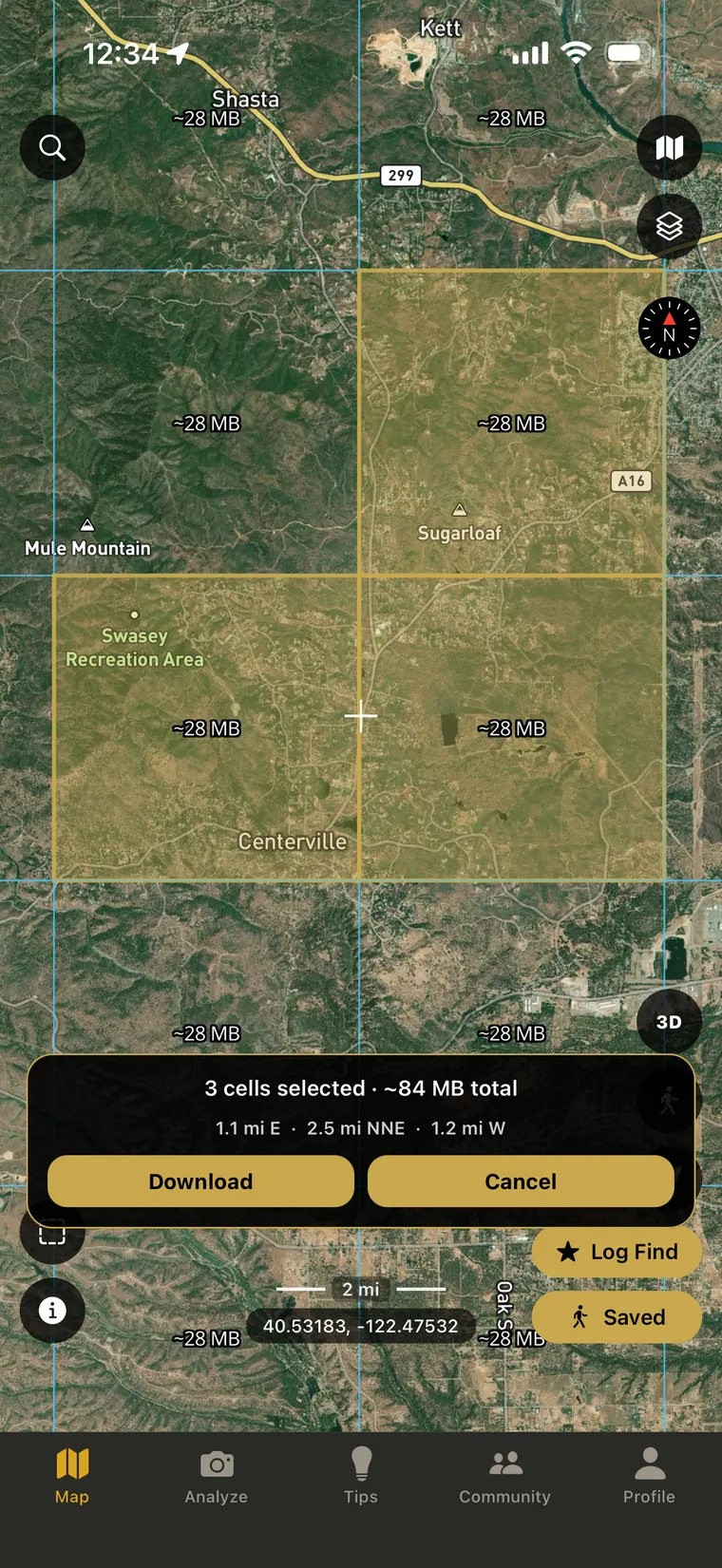
The download grid over satellite imagery with three cells highlighted, the panel showing three cells selected and about 84 MB total
Select the cells covering the ground you plan to work and hit the download button.

Read the offline maps guide

How it works

  1. 1

    Scout

    Browse the map, find a creek, an old homestead, or a likely site. Save the area for offline.

  2. 2

    Read

    At the spot, snap a photo of the terrain. Get a 0–100 score and reasoning you can actually learn from.

  3. 3

    Find

    Work the spot. Pan, sluice, dig, or swing the coil — the reason you came out.

  4. 4

    Log

    Mark finds, track your route, share what you want with the community.

Try the whole thing free for 7 days.

Every feature unlocked. AI analysis, GoldBot, LiDAR, offline maps — full access, no limits. No charges until day 8. Cancel anytime through your Apple ID with one tap.

$8.99/month or $89.99/year
Save $17.89 with annual

Subscription auto-renews unless cancelled at least 24 hours before the trial ends. Manage in your Apple ID settings.

About Gold Prospector

Built by a prospector for prospectors. Three decades of weekends working creeks with a pan, eight years swinging a detector, and a stubborn belief that the prospecting community deserves better tools and a real place to share what they find.

Read the full story

FAQ

How does the free trial work?

All features unlocked for 7 days. Payment method required up front (Apple ID handles the billing) — billing starts on day 8 if you keep it. Cancel anytime in your Apple ID subscription settings, no questions.

What does it cost after the trial?

$8.99 per month or $89.99 per year. The annual saves you $17.89.

What devices does it run on?

iPhone (iOS 16+). Android is on the roadmap.

Does it work without cell service?

Yes. Download the area before you head out, then tap the saved map in Offline Maps to activate it. A banner shows which area is live, and the map draws only from what you downloaded. Tracking and logging work offline too. Full instructions here.

Will it tell me where to find gold or relics?

No app can do that. We give you better tools to read the land — actually making the find is still on you.

What about the coin or relic I just found?

Coin & Relic ID identifies what you found, what it's made of, and roughly when it's from, right from a photo. It won't tell you where to dig, but once you've got something out of the ground, it'll tell you what it is.

Where can I prospect or detect?

Prospecting: public lands open to mineral entry, and any claim you legally hold. Detecting: lands where you have permission. Rules vary by state — never on federal park land, often restricted on archaeological sites. Always know the local rules.