
Every prospector dreams about finding untouched ground.
It's the fantasy that drives people into remote canyons, up steep mountain slopes, and deep into forgotten mining districts. Somewhere out there, many believe, is a hidden patch of gold that nobody else has discovered. A place where nuggets lie just beneath the surface waiting to be recovered.
The reality is both simpler and far more interesting.
Most gold isn't hidden because nobody knows where it is.
It's hidden because most people don't understand how gold behaves.
Every year, prospectors walk across productive ground without ever realizing it. They swing their detectors over promising-looking terrain, dig countless targets, and pan creek after creek while unknowingly passing within feet of gold-bearing deposits.
The difference between successful prospectors and unsuccessful ones often comes down to a single skill:
Understanding why gold ended up where it did.
Gold prospecting is often portrayed as a treasure hunt, but the most successful prospectors approach it more like a crime scene investigation. Every nugget, every flake, and every concentration of black sand tells a story. The challenge is learning how to read the clues.
Gold Begins Its Journey in the Mountains
Before a prospector can understand where gold is found, they must first understand where gold comes from.
Most placer gold originally began deep underground within quartz veins and mineralized rock formations. These deposits formed millions of years ago through geological processes involving heat, pressure, and mineral-rich fluids moving through fractures in the earth.
Over time, weathering began breaking these formations apart.
Rain, freezing temperatures, earthquakes, landslides, and erosion slowly attacked the surrounding rock. As the host material decomposed, gold particles were released and carried downhill by gravity and water.
This process continues today.
Every winter storm, every spring runoff, and every flood event contributes to the movement of gold through a watershed. While gold itself does not dissolve or disappear, it constantly migrates through the landscape until it encounters conditions that cause it to settle.
Understanding that journey is the foundation of successful prospecting.
Water Is the Ultimate Gold Sorter
If there is one force responsible for creating placer deposits, it is water.
Creeks and rivers operate as enormous natural sorting machines. During flood events, water picks up rocks, gravel, sand, clay, and gold and carries them downstream.
As water velocity increases, larger and heavier materials can be transported.
As velocity decreases, those materials begin dropping out.
This is where gold behaves differently than almost everything around it.
Gold is incredibly dense. A gold nugget can weigh nearly twice as much as a similar-sized piece of lead and many times more than ordinary rock. Because of this, gold settles much sooner than most materials being carried by a stream.
Imagine tossing a bowling ball and a basketball into a moving river.
The basketball may float downstream for miles.
The bowling ball sinks almost immediately.
Gold behaves like the bowling ball.
This simple fact explains why gold accumulates in specific locations while vast stretches of creek remain barren.
The Places Gold Loves to Hide
Many beginners focus on where water is currently flowing.
Experienced prospectors focus on where water slows down.
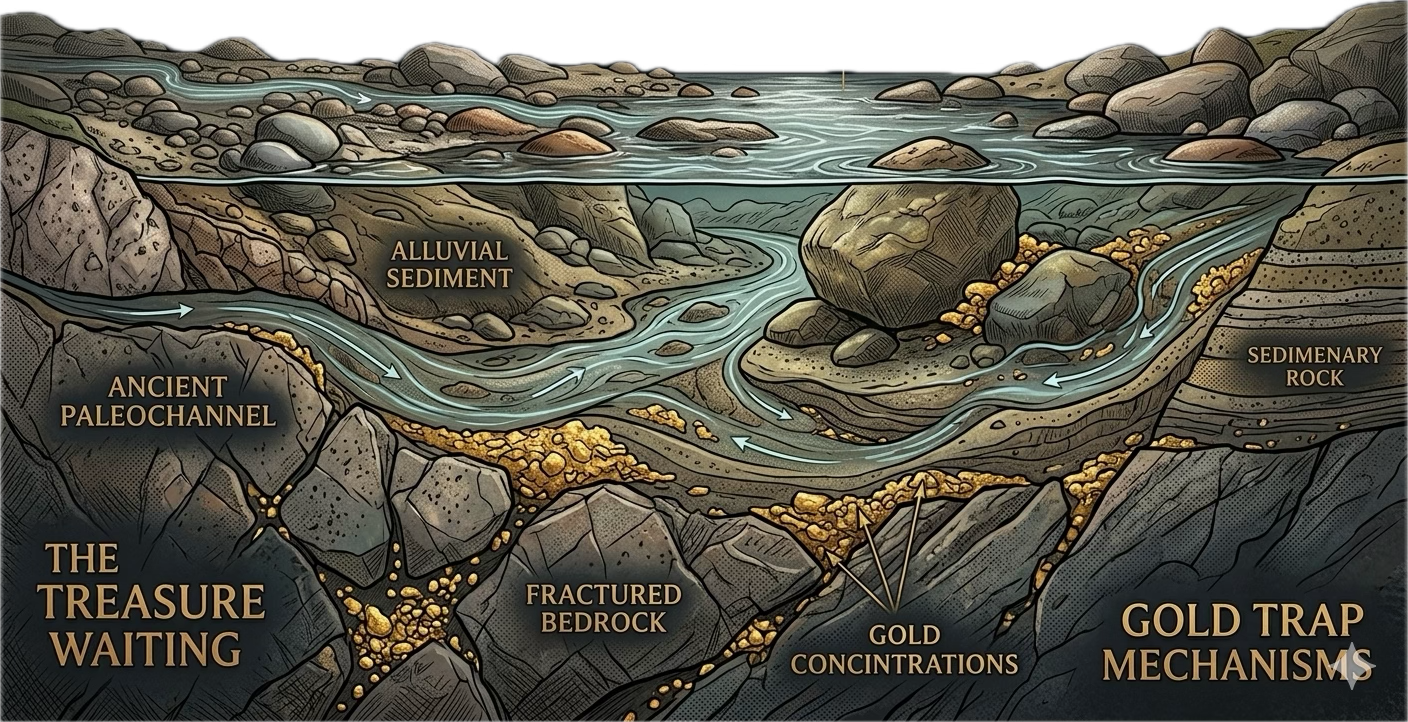
Whenever a creek changes direction, widens, narrows, encounters an obstacle, or loses velocity, gold has an opportunity to settle.
Inside bends of rivers are classic examples. As water rounds a bend, heavier materials often accumulate along the inside edge where flow slows.
Large boulders create another opportunity. During floods, water rushing around a boulder creates low-pressure zones behind it. Gold frequently settles in these protected areas.
Bedrock is perhaps the most important feature of all.
When gold reaches exposed bedrock, it can no longer sink deeper into loose sediments. Cracks, fractures, crevices, and potholes become natural collection points where gold may accumulate for hundreds or even thousands of years.
Many of California's largest placer nuggets were recovered from bedrock traps.
Not because prospectors were lucky.
Because they understood how gold moves.
Why Old-Timers Didn't Find It All
One of the biggest misconceptions in prospecting is the belief that historic miners recovered all the valuable gold.
The evidence suggests otherwise.
The miners of the 1850s were remarkably effective, but they were also limited by the technology available at the time.
They focused primarily on rich, easily accessible deposits. Fine gold was often lost during recovery. Deep deposits remained untouched because equipment capable of reaching them did not yet exist.
Many old-timers were interested in volume rather than efficiency. If a deposit required excessive labor to process, they frequently moved on to richer ground nearby.
Today's prospectors possess advantages that early miners never imagined.
Modern pulse induction detectors can locate nuggets at depths previously considered impossible. High-resolution satellite imagery reveals terrain features invisible from the ground. Historical maps can be digitally overlaid onto modern landscapes. LiDAR technology can expose hidden mining features concealed beneath vegetation.
As a result, prospectors continue finding gold in districts that have been worked for more than 150 years.
In many cases, the gold isn't new.
It's simply being discovered by people who understand the landscape better than those who came before.
The Most Valuable Tool Isn't a Detector
Walk through any prospecting show and you'll see detectors costing thousands of dollars.
Many newcomers assume success depends on owning the latest machine.
Veteran prospectors often disagree.
Ask experienced nugget hunters what contributes most to their success, and many will give the same answer:
Research.
The ability to study geology, understand historical mining activity, analyze terrain, identify ancient waterways, and recognize favorable gold-bearing environments often matters more than detector brand or coil size.
Technology can help.
Apps such as Gold Prospector are beginning to combine satellite imagery, historical maps, terrain analysis, AI-powered location assessment, community discoveries, and prospecting data into a single platform. These tools can dramatically shorten the learning curve and help users identify areas worthy of investigation.
But even the most advanced software cannot replace field knowledge.
Technology points toward opportunity.
Experience finds the gold.
The Real Secret
Every prospector eventually learns the same lesson.
Gold is rarely where people expect it to be.
It hides beneath ancient river channels. It settles into forgotten bedrock cracks. It survives in old mining districts long after others declare them exhausted.
Most importantly, it rewards those willing to understand the forces that placed it there.
The next rich patch may not be hidden in some secret canyon known only to a select few.
It may be beneath a hillside that hundreds of people have already walked across.
The difference is that successful prospectors see the landscape differently.
They don't just see a creek.
They see a story.
And somewhere within that story, gold is waiting.