
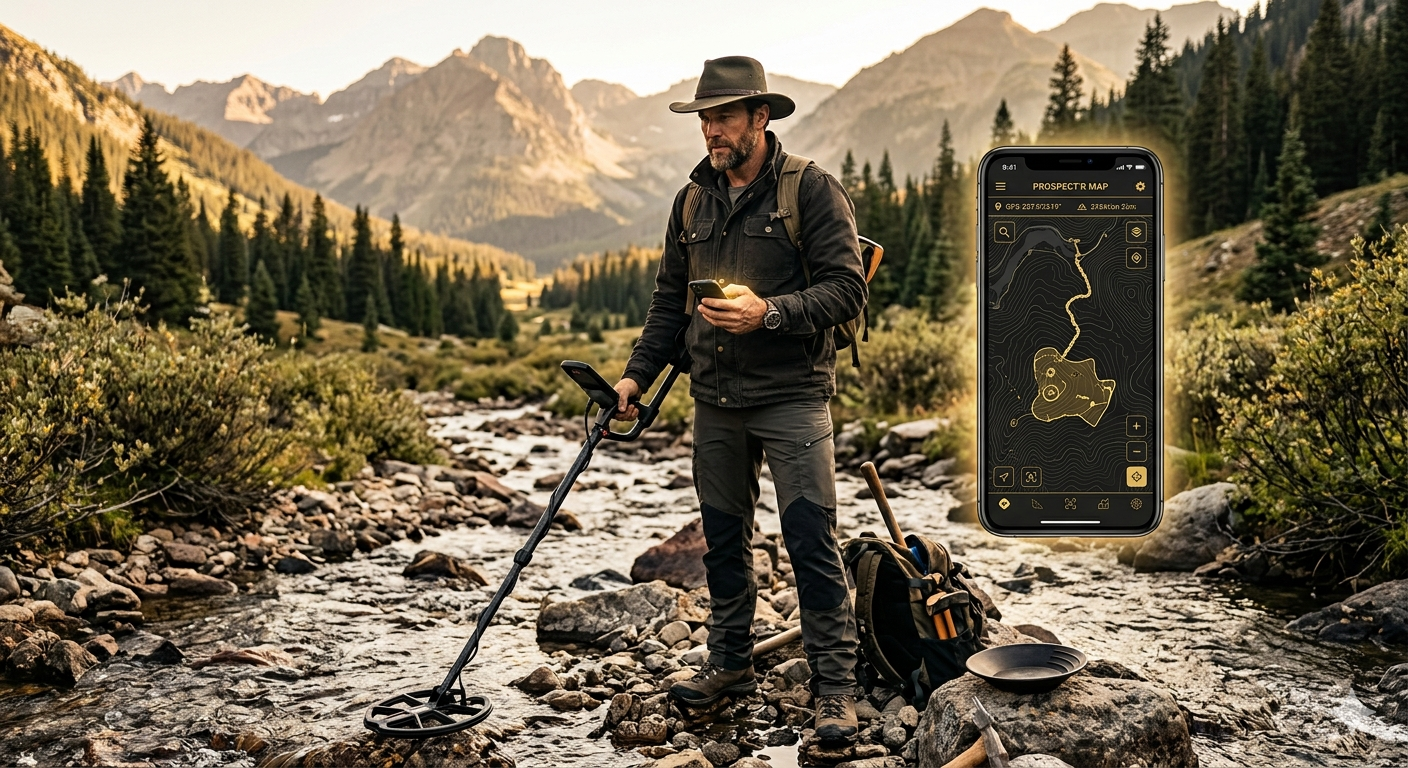
The thrill of discovery has remained unchanged for centuries.
Whether it's a gleaming gold nugget hidden beneath layers of gravel or a century-old relic buried beneath an abandoned homestead, the moment of uncovering something lost to history still sends a rush of excitement through prospectors and treasure hunters around the world.
What has changed dramatically, however, is how those discoveries are being made.
For generations, prospectors relied on intuition, paper maps, geological knowledge, and countless hours of trial and error. Success often depended on experience, persistence, and a little luck. Today, a new generation of prospectors is entering the field armed with powerful metal detectors, drones, artificial intelligence, satellite imagery, historical map overlays, and sophisticated prospecting applications that place an unprecedented amount of information directly into their pockets.
The modern gold rush isn't being driven by pickaxes and burros.
It's being powered by technology.
The New Age of Metal Detecting
Modern metal detectors have become engineering marvels.
The earliest detectors provided little more than a simple beep when metal was present beneath the ground. Prospectors dug nearly every target they encountered, often recovering more junk than treasure.
Today's machines are far more advanced.
Multi-frequency detectors can transmit multiple frequencies simultaneously, allowing users to detect targets at greater depths while improving target identification. Advanced ground balancing systems help compensate for highly mineralized soil conditions that often plague gold-bearing regions. Waterproof designs, wireless audio systems, integrated GPS, and customizable settings have become standard features among many premium detectors.
These technological improvements allow prospectors to spend less time digging trash and more time recovering valuable targets.
For relic hunters, the benefits are equally impressive. Modern detectors can identify subtle differences between iron objects, brass artifacts, coins, and other historically significant finds. Areas that were once considered "hunted out" are now producing remarkable discoveries thanks to improvements in detector technology.
Prospecting Apps: The New Treasure Maps
Perhaps the biggest transformation in recent years has been the emergence of prospecting-focused mobile applications.
What was once a hobby dependent upon stacks of maps and research books can now be managed through a smartphone.
Modern prospecting applications provide users with access to satellite imagery, topographic maps, GPS navigation, public land information, mining claim boundaries, waterway data, historical imagery, and location-marking tools.
Instead of guessing where to search, prospectors can make informed decisions before ever leaving home.
Apps such as Gold Prospector represent the next evolution of this technology. By bringing together mapping tools, historical research, terrain analysis, community-driven discoveries, and artificial intelligence, these platforms are transforming smartphones into comprehensive field companions.
Imagine arriving in an unfamiliar area and instantly being able to identify nearby waterways, historical mining districts, geological formations, public lands, and previous prospecting activity—all from a single application.
For modern treasure hunters, the smartphone has become as essential as the detector itself.
Artificial Intelligence Enters the Gold Fields
Artificial intelligence is beginning to reshape nearly every industry, and gold prospecting is no exception.
AI systems are capable of analyzing enormous amounts of information in seconds. Geological surveys, satellite imagery, terrain models, historical mining records, hydrological systems, and previous discoveries can all be processed simultaneously.
The result is something prospectors have dreamed about for decades: data-driven prospecting.
Rather than randomly searching vast landscapes, AI can identify patterns associated with productive gold-bearing environments and highlight areas that warrant further investigation.
Experienced prospectors understand that gold is rarely distributed randomly. It follows predictable geological rules. Ancient river channels, exposed bedrock, inside bends of streams, fault systems, and historical placer deposits often contain clues to hidden gold.
Artificial intelligence can analyze these variables across thousands of square miles far faster than any individual researcher.
The goal is not to replace prospectors.
The goal is to help them make smarter decisions.
Historical Maps Meet Modern Technology
One of the most exciting developments in both gold prospecting and relic hunting is the ability to overlay historical maps onto modern satellite imagery.
For decades, researchers spent countless hours comparing old paper maps to current landscapes in an effort to identify forgotten locations.
Today, software can accomplish the same task instantly.
Old mining camps, stagecoach routes, railroad depots, schools, churches, settlements, and hydraulic mining operations can be overlaid directly onto modern maps with remarkable accuracy.
For relic hunters, this technology is invaluable.
Many historically significant locations have disappeared from modern maps entirely. Buildings collapse, roads vanish, and landscapes change over time. Historical overlays allow hunters to virtually travel through time and identify locations where people once lived, worked, and traveled.
The same technology benefits gold prospectors by revealing forgotten mining operations, abandoned placer workings, drift mines, and prospect pits that may still contain undiscovered gold.
Sometimes the best clues were left behind more than a century ago.
Drones Provide a New Perspective
Modern drones have introduced a completely new way to explore potential hunting locations.
From the air, prospectors can identify terrain features that may be impossible to recognize from ground level. Dry wash systems, exposed bedrock, ancient stream channels, tailing piles, and abandoned mining features often become far more obvious when viewed from above.
Relic hunters benefit as well.
Old foundations, forgotten roads, stone walls, and subtle landscape changes can reveal historical activity areas hidden beneath vegetation or overlooked by previous searchers.
A ten-minute drone flight can often save hours—or even days—of field exploration.
LiDAR and Terrain Analysis
Another emerging technology changing the prospecting world is LiDAR.
LiDAR uses laser-based mapping systems to create highly detailed three-dimensional terrain models. Unlike conventional satellite imagery, LiDAR can often reveal landscape features hidden beneath vegetation.
Old mining ditches, hydraulic cuts, building foundations, wagon roads, and historical earthworks become visible with extraordinary detail.
As public access to LiDAR data continues to expand, prospectors and relic hunters are gaining access to information that was previously available only to government agencies and professional surveyors.
Combined with artificial intelligence and mapping applications, LiDAR may become one of the most valuable prospecting tools available.
Community-Powered Discovery
Technology is not only improving how prospectors search—it's improving how they share information.
Modern prospecting platforms increasingly incorporate community-driven features that allow users to post discoveries, exchange tips, document productive areas, and learn from one another.
A prospector who discovers a productive geological feature in Arizona may unknowingly help a hunter in California recognize a similar pattern. Relic hunters can share historical research, compare finds, and collaborate on projects that would have been nearly impossible a decade ago.
The result is a growing network of knowledge that benefits everyone involved in the hobby.
The Future of Prospecting
The future of gold prospecting is likely to look very different from its past.
Artificial intelligence will become more sophisticated. Terrain analysis will become more accurate. Historical map overlays will improve. Drones will become smarter. Prospecting applications will continue integrating new data sources and analytical tools.
Yet despite these advancements, one thing will remain unchanged.
No application can replace the excitement of hearing a detector signal. No artificial intelligence can duplicate the feeling of seeing gold emerge from a pan. No drone can experience the thrill of uncovering a relic that has remained hidden for generations.
Technology may change how we search.
But the spirit of discovery remains timeless.
For today's prospectors, the future is not about replacing traditional skills. It is about combining centuries of field experience with the most advanced tools ever available.
The next great discovery may not belong to the person with the biggest detector.
It may belong to the person who knows how to use technology the smartest.