
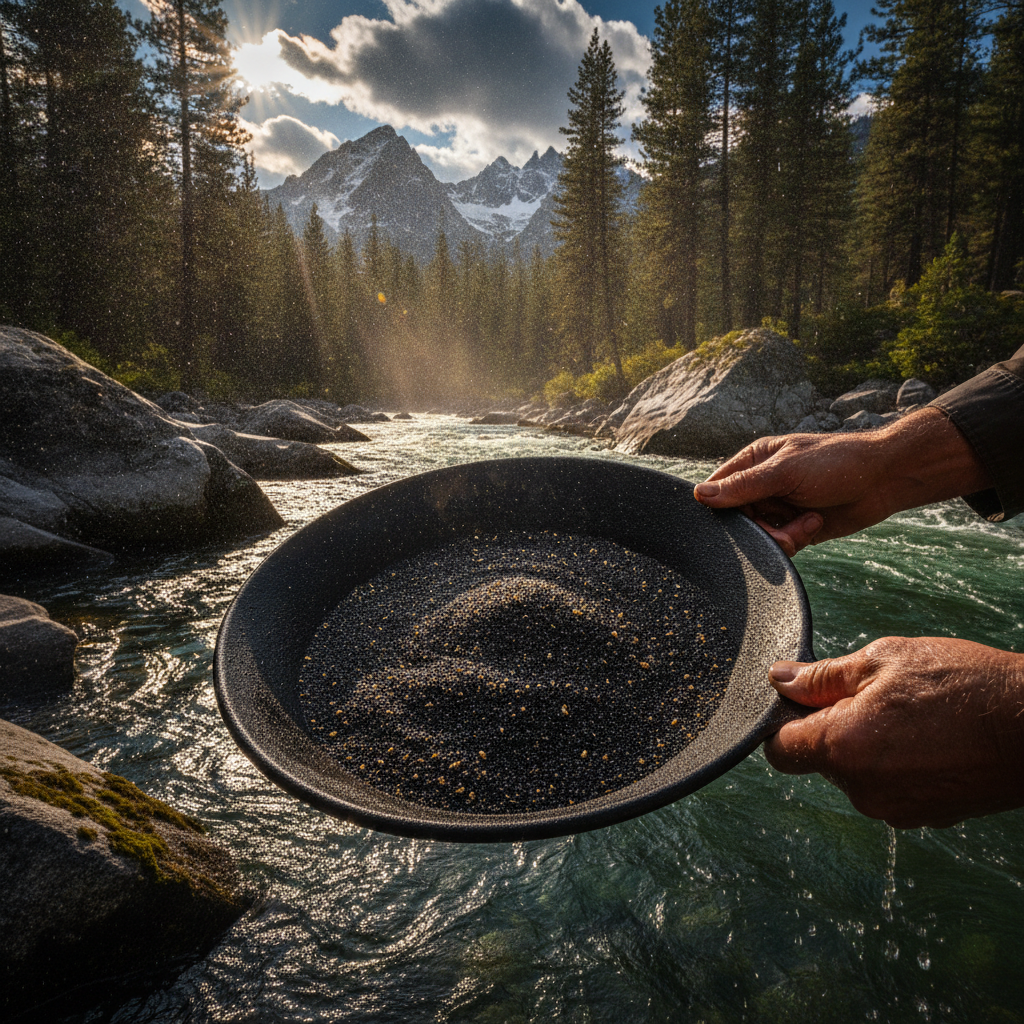
Here is a thing that happens roughly ten thousand times a day, somewhere in the creeks and rivers of the American West: a person lowers a gold pan into the water, swirls it around with what they imagine to be artful precision, and watches as the lighter material washes away in a cloudy plume. What remains, sitting at the bottom of the pan like a dark prophecy, is a crescent of black sand. The person stares at it. They may poke at it with a finger. They may tilt the pan one direction, then the other, hoping to spot a wink of yellow hiding beneath the darkness. And then — in a moment that separates the casual from the committed — they have to decide what to do with it.
Most dump it back in the creek.
This is understandable. Black sand is heavy, stubborn, and profoundly unhelpful to the person who simply wants to see gold in their pan. It clings to everything. It resists separation. It is, in the parlance of the frustrated prospector, a pain in the neck. And yet black sand may be the single most important substance a gold prospector encounters that isn't gold itself. It is both the signpost and the obstacle, the compass and the maze. To understand black sand — what it is, where it comes from, why it accumulates where it does, and what it is actually telling you about the geology beneath your feet — is to understand something fundamental about how gold deposits work. To ignore it is to prospect blind.
The Heaviest Stuff in the River
To understand black sand, you first need to understand a concept so simple it almost sounds stupid: heavy things sink. When water flows over rock, it picks up particles of varying sizes and densities. As the water slows — behind a boulder, at the inside of a bend, in the hydraulic shadow of a bedrock shelf — it loses the energy needed to carry its heaviest passengers. Those passengers drop out of suspension and settle to the bottom, while the lighter material keeps traveling downstream. This process, known as gravity separation, is the reason gold concentrates where it does. It is also the reason black sand concentrates in exactly the same places.
The U.S. Geological Survey defines sediment transport as a function of particle size, shape, and density interacting with water velocity and turbulence. In this framework, gold — with a specific gravity of roughly 19.3 — is the undisputed heavyweight champion of the stream. But black sand minerals are no featherweights. Magnetite has a specific gravity of about 5.2. Hematite comes in around 5.3. Ilmenite sits at roughly 4.7. These numbers don't sound particularly impressive next to gold's 19.3, but compare them to quartz sand at 2.65, and the picture changes dramatically. Black sand minerals are roughly twice as dense as the ordinary sand surrounding them. They are heavy enough to drop out of the current and concentrate in the same traps, the same crevices, the same bedrock irregularities where gold accumulates.
This is not a coincidence. It is physics. And it is the first and most important lesson black sand has to teach: where black sand concentrates, the hydraulic conditions for gold concentration have been met.
What's Actually in That Dark Crescent
The term "black sand" is a catchall, a prospector's shorthand for what is actually a complex assemblage of heavy minerals with distinct chemical compositions, crystal structures, and — this matters more than you might think — magnetic properties. To call it all "black sand" is a bit like calling everything in an orchestra "instruments." Technically correct, but it misses the nuance that makes the music interesting.
The two dominant minerals in most black sand concentrates are magnetite and hematite. Magnetite (Fe₃O₄) is the one that sticks to magnets. It is an iron oxide with an inverse spinel crystal structure, and it is strongly ferromagnetic — meaning a simple refrigerator magnet will pull it right out of your pan. According to the USGS Mineral Resources Data System, magnetite is one of the most common heavy minerals in placer deposits throughout the western United States. It weathers out of mafic and intermediate igneous rocks — basalts, gabbros, diorites — and from metamorphic rocks that once were something else entirely. If you pan a creek draining volcanic terrain, you will find magnetite. That is practically a guarantee.
Hematite (Fe₂O₃) is magnetite's more oxidized cousin. It is typically weakly magnetic or non-magnetic, and it tends to be harder to separate from gold concentrates precisely because a magnet won't grab it. Hematite can appear as a steely gray to reddish-brown mineral, and in fine-grained form it is responsible for the red and rusty colors you see staining rocks and soils across the arid West. The USGS reports on iron ore frequently note hematite's ubiquity in weathered terrains. Where you find it in quantity, you are often looking at a source rock rich in iron — which, depending on the geology, may or may not be associated with gold-bearing formations.
But magnetite and hematite are only the beginning. A thorough inventory of black sand minerals from a typical Western placer might include:
Ilmenite (FeTiO₃) — an iron-titanium oxide that is weakly magnetic and often indistinguishable from magnetite by eye. Ilmenite is the world's primary source of titanium, a fact that occasionally causes excitement among prospectors who learn they've been throwing away a valuable industrial mineral. The excitement is usually premature. The concentrations in most recreational gold pans are nowhere near economic.
Chromite (FeCr₂O₄) — a chromium-bearing iron oxide that shows up in drainages fed by ultramafic rocks, particularly serpentinites. In California's Sierra Nevada foothills, where serpentinite is the state rock and outcrops are common along the Mother Lode belt, chromite in your pan is neither unusual nor unwelcome. Its presence indicates you are working near an ophiolite sequence — a slice of ancient oceanic crust thrust up onto the continent — and these geological settings frequently host gold mineralization. The USGS Professional Paper 820, a comprehensive survey of mineral resources, details chromite's association with ultramafic-hosted deposits throughout the western Cordillera.
Garnet — specifically almandine and pyrope varieties — shows up as dark red to nearly black grains that are denser than quartz but lighter than magnetite (specific gravity around 3.5–4.3). Garnets are indicator minerals for metamorphic terrain, and their presence in a concentrate tells you the drainage is cutting through schists, gneisses, or amphibolites. In parts of Idaho, Montana, and the Carolinas, garnet-rich black sands are strongly associated with lode gold deposits hosted in metamorphic rocks.
Monazite and zircon — these are the minerals that occasionally make black sand genuinely hazardous, because both contain radioactive thorium and uranium. Monazite, a rare-earth phosphate, can contain up to 20% thorium oxide by weight. Zircon, a zirconium silicate, can incorporate uranium into its crystal lattice. The USGS Fact Sheet on rare-earth elements notes that monazite-bearing placer deposits have historically been mined for their rare-earth content in several countries. For the recreational prospector, the concentrations encountered in a gold pan pose no meaningful health risk. But if you are processing large volumes of black sand concentrates — running them through sluices, accumulating buckets of the stuff in your garage — awareness of the radioactive component is prudent.
Cinnabar (HgS) — mercury sulfide, which appears as small, brilliant red grains amid the black. In historic gold mining districts, particularly in California's Coast Ranges where mercury was mined extensively to supply the gold industry, cinnabar in your pan is a reminder that the geological story of gold and mercury are deeply intertwined. The USGS Mercury Program has extensively documented the environmental legacy of mercury in California's gold country watersheds.
The Indicator Mineral Game
Here is where black sand stops being an annoyance and starts being a tool. Geologists have long understood that the mineral composition of stream sediments serves as a kind of fingerprint for the rocks upstream. This is the basis of indicator mineral analysis, a prospecting technique that the Geological Survey of Canada, the USGS, and mining companies worldwide have used for decades to locate everything from diamond pipes to copper porphyries to gold deposits.
The principle is straightforward: certain minerals form in association with certain ore deposit types. If you find those minerals in a stream, you can trace them upstream to their source. For gold prospectors, the relevant indicator minerals include not just the usual black sand suspects but also more exotic companions — scheelite (calcium tungstate, which fluoresces blue under UV light), arsenopyrite (iron arsenic sulfide, a common associate of mesothermal gold deposits), and various sulfide minerals that oxidize and crumble in the surface environment but occasionally survive long enough to make it into your pan.
The USGS Open-File Report 03-238 on geochemical landscapes and mineral-resource assessments provides a framework for understanding how heavy mineral concentrates in stream sediments reflect upstream geology. The report details sampling methodologies used by government geologists to systematically characterize drainage basins — essentially a sophisticated version of what every recreational prospector does when they pan a creek and look at what's left.
What does this mean in practice? It means that the composition of your black sand concentrates is telling you something specific about the rocks in the watershed above you. A concentrate dominated by magnetite with minor chromite suggests mafic to ultramafic source rocks — the kind of terrain where orogenic gold deposits form along major fault zones. A concentrate rich in garnet and ilmenite points to metamorphic host rocks — the kind of terrain where gold can occur in quartz veins cutting through schist and gneiss. A concentrate with visible pyrite (gold-colored, metallic, cubic crystals that fool beginners every single day) indicates sulfide mineralization upstream, which is often — though not always — associated with hydrothermal gold systems.
The experienced prospector doesn't just look for gold in the pan. They read the black sand like a geological text. They note its volume (more heavy minerals means more concentrated flow, or more productive source rocks). They note its composition (magnetic vs. non-magnetic, metallic vs. glassy, dark vs. red). And they use that information to decide whether to keep working a particular stretch of creek or move on to something more promising.
A Brief History of People Paying Attention
The idea that black sand could serve as a guide to gold was not lost on the original 49ers, though they understood it more intuitively than scientifically. James Marshall, whose discovery of gold at Sutter's Mill in January 1848 launched the California Gold Rush, reportedly noticed heavy dark sand in the tailrace alongside the gold flakes that changed the course of American history. Within months, thousands of men were sloshing pans in the American River and its tributaries, and the practical observation spread quickly: where you see the black stuff, look harder.
By the 1860s, the hydraulic mining operations that would reshape — and in some cases literally erase — entire mountain landscapes in the northern Sierra were processing staggering volumes of gravel. The National Park Service's documentation of hydraulic mining at the Whiskeytown National Recreation Area describes operations that blasted hillsides with high-pressure water cannons, sending the slurry through long sluice boxes where gold and heavy minerals settled behind riffles. The black sand that accumulated in those riffles was a constant problem. It trapped fine gold within its mass, coating tiny gold particles with iron oxide films and making separation difficult. Miners who didn't address the black sand problem left significant gold behind — a fact that modern-day prospectors, reworking old tailings piles, occasionally rediscover with delight.
The solution the hydraulic miners eventually adopted was mercury amalgamation. They coated the riffle surfaces with liquid mercury, which bonded with gold to form a dense amalgam that could be collected and then heated to drive off the mercury, leaving behind relatively pure gold. It was effective. It was also an environmental catastrophe. The USGS Fact Sheet 2005-3014 estimates that hydraulic mining operations in the Sierra Nevada released an estimated 10 million pounds of mercury into the watershed system between 1850 and 1884. Much of that mercury is still there, trapped in sediments, slowly methylating into toxic compounds that work their way up the food chain. The black sand that vexed those original miners now serves as a reservoir for their chemical legacy.
In Alaska, where gold mining on an industrial scale began in the early 1900s, black sand took on a different character. The beach placers at Nome, where gold was discovered in the surf zone in 1899, contained extraordinary concentrations of magnetite alongside fine gold. The USGS Bulletin 328, documenting the gold placers of the Nome district, describes beach sands with heavy mineral concentrations running 20-40% by weight — far higher than typical riverine placers. The magnetite there had been concentrated by wave action over thousands of years, the ocean doing the same gravity separation work that rivers do, only more efficiently. Miners at Nome developed specialized techniques for dealing with the magnetic fraction, including simple magnetic separators built from horseshoe magnets and wooden troughs.
The Physics of Separation (Or: Why Fine Gold Hides in Black Sand)
There is a particular frustration unique to gold prospecting, and it goes like this: you can see the gold. It is right there, in your pan, tiny yellow specks glinting among the black grains. But you cannot get it out. Every time you tilt the pan to wash away more black sand, some of the gold goes with it. Every time you try to pick out a speck with wet fingers, it slides away or disappears into the dark mass. The gold is there. The gold is taunting you.
This frustration has a scientific explanation, and it has to do with particle size, surface tension, and hydrodynamic equivalence.
Hydrodynamic equivalence is the concept that particles of different densities will behave the same way in flowing water if their settling velocities are equal. A small, dense particle (like a fine gold flake) can have the same settling velocity as a larger, less dense particle (like a magnetite grain). The USGS Bulletin 1876 on placer-gold recovery methods describes this relationship mathematically: settling velocity is a function of particle diameter squared, multiplied by the density difference between the particle and the fluid, divided by the viscosity of the fluid. What this means in practice is that a gold particle roughly one-fifth the diameter of a magnetite grain will settle at the same rate. They will concentrate together. They will resist separation together. They are, hydraulically speaking, twins.
Surface tension compounds the problem. At the scale of fine gold — particles smaller than about 100 microns, or roughly the diameter of a human hair — surface tension forces become significant relative to gravity. Fine gold particles can be trapped in the surface tension film between water and air, causing them to float even though gold is nearly twenty times denser than water. They can also be trapped in the interstices between black sand grains, held in place by capillary forces. This is why aggressively washing black sand concentrates in a pan almost always results in gold loss. The fine stuff doesn't behave the way you expect heavy material to behave. It clings. It floats. It vanishes.
A third factor — and this one is almost never discussed outside of metallurgical circles — is the phenomenon of iron oxide coating. Fine gold particles that have spent any significant time in an oxidizing environment (which is to say, any gold particle in any surface placer deposit) tend to develop thin coatings of iron oxide on their surfaces. These coatings make the gold particle less "gold-like" in its surface chemistry. A coated particle is less likely to be captured by mercury amalgamation (relevant historically), less likely to be captured by gravity separation (relevant always), and more likely to behave like the iron oxide particles surrounding it. In effect, the black sand is camouflaging the gold. The iron oxide minerals are not just concentrating alongside the gold; they are actively disguising it.
Strategies for the Black Sand Problem
So what does one actually do about it? The answer depends on your scale of operation and your tolerance for tedium.
Magnetic separation is the first and most obvious approach. If roughly half your black sand is magnetite, and magnetite is strongly magnetic, then a magnet will remove half the problem immediately. The technique is simple: dry your concentrates, spread them on a flat surface, and pass a strong rare-earth magnet (wrapped in a plastic bag for easy release) over the material. The magnetite leaps to the magnet. The gold, being non-magnetic, stays put. Remove the magnet from the area, strip off the bag to release the magnetite, and repeat. Each pass removes more magnetic material and increases the relative concentration of gold in what remains.
The plastic bag trick is essential. Without it, you will spend the rest of your natural life trying to scrape magnetite off a neodymium magnet. With it, you simply turn the bag inside out and the magnetite falls free. This is one of those small practical insights that separates people who have actually done this from people who have only read about it.
But magnetic separation only gets you so far. The non-magnetic fraction — hematite, ilmenite, garnet, and the various other heavies — remains, and it still contains gold that needs to be liberated. For this, prospectors have developed several approaches:
Blue bowl concentrators use a spiraling flow of water to separate gold from heavy mineral concentrates by exploiting the density difference between gold (19.3) and the remaining black sand minerals (4.7–5.3). The water flow is adjusted so that the black sand slowly migrates to the rim and overflows, while the denser gold stays trapped at the bottom. It is slow. It requires patience and careful adjustment. It works.
Miller tables and shaker tables use the same principle on a larger scale, combining water flow with vibration to stratify material by density on a sloped surface. The gold, being densest, migrates to one side while lighter heavies migrate to the other. These are the workhorses of small-scale gold processing operations, and a well-tuned table can achieve gold recoveries above 95% even from fine-grained concentrates.
Chemical methods — specifically, using weak acids to dissolve the iron oxide minerals and liberate trapped gold — are occasionally employed by serious amateur prospectors, though they raise environmental and safety concerns that are not trivial. Hydrochloric acid will dissolve magnetite and hematite. It will not dissolve gold. This selectivity makes it theoretically attractive. The practical realities of handling strong acids in a camp setting make it less so.
Panning — patient, careful, skilled panning — remains the most accessible method. The key insight is to keep the material wet (to prevent fine gold from floating on surface tension films), to use a slow, controlled side-to-side motion rather than a washing motion (to stratify the material by density without ejecting the fine gold), and to accept that final separation will take time. A lot of time. An experienced panner can separate fine gold from black sand concentrates with remarkable efficiency. An impatient one cannot.
Reading the Geological Map in Your Pan
Let us return to the larger picture. You are standing in a creek somewhere in the public lands of the American West — perhaps on Bureau of Land Management acreage, where recreational gold panning is generally permitted without a plan of operations, as described in BLM regulations on mining claims and mineral activities. You have panned a few scoops of material. You have your crescent of black sand. Now what?
First, assess the volume. A heavy, thick crescent of black sand indicates you are working in an area where the hydraulic conditions concentrate heavy minerals effectively. This is good. It means the same conditions have been concentrating gold — assuming gold is present in the source rocks. A thin, sparse showing of black sand suggests either that the source rocks are relatively light (granitic terrain produces less black sand than volcanic or metamorphic terrain) or that the creek's energy is too high to allow deposition, carrying everything downstream. In the latter case, you may want to move to a slower-flowing section.
Second, check the magnetics. Scoop the concentrate into a small vial and hold a magnet to the outside. If most of the material jumps to the magnet, you are looking at a magnetite-dominant concentrate, which suggests mafic volcanic or intrusive rocks upstream. If very little responds to the magnet, the non-magnetic fraction dominates — hematite, ilmenite, garnet — pointing to a different geological source. Both scenarios can host gold, but the type of gold deposit and the prospecting strategy may differ.
Third, look at color and texture. Pure magnetite concentrates are jet black with a metallic luster. Hematite-rich concentrates have a slightly reddish tinge, especially when scratched or powdered. Garnet-rich concentrates show deep red to purple individual grains when examined closely. Ilmenite tends toward a dark brownish-black. Each of these tells a story about what's upstream, and mapping the changing composition of your black sand as you move from creek to creek across a region is a legitimate prospecting technique — one that the USGS National Geochemical Survey employs at a continental scale to characterize the mineral potential of drainage basins across the country.
Fourth — and this is where technology can genuinely help — record your findings. The Gold Prospector app allows you to mark locations and note the characteristics of your finds, building over time a personal geological map of the areas you work. Recording not just where you found gold but where you found heavy black sand concentrations, what those concentrates looked like, and how they changed from location to location creates a dataset that can guide future prospecting trips. You are doing, in miniature, what government geologists do with millions of dollars of funding and teams of PhDs. You are mapping the mineral potential of your drainage basins, one pan at a time.
The Other Black Sand: Beach Placers and Coastal Deposits
Not all black sand is found in mountain creeks. Some of the most dramatic concentrations of heavy minerals on Earth occur on beaches, where wave energy has been doing the work of gravity separation for millennia.
The black sand beaches of the Pacific Northwest — particularly in southern Oregon and northern California — have attracted gold prospectors since the 1850s. The beaches near Gold Beach, Oregon (the town is literally named for the phenomenon) contain fine gold concentrated by wave action from gold-bearing sediments carried to the ocean by the Rogue River. The Oregon Department of Geology and Mineral Industries has documented these deposits extensively, noting that the gold tends to concentrate in thin pay streaks within layers of black sand, usually at the contact between beach sand and underlying bedrock or clay.
These beach placers present their own challenges. The gold is extremely fine — "flour gold," in prospector parlance — because it has traveled long distances from its source, being abraded and flattened along the way. The black sand concentrations are massive, sometimes forming layers inches thick. And the deposits are constantly reworked by tides and storms, meaning that a productive spot one day may be stripped bare the next. Timing matters. Winter storms move sediment differently than summer swells. The best concentrations often appear in late winter, after heavy storm activity has reworked the beach profile and created new pay layers.
Beach prospecting also carries distinct legal considerations. Many Oregon and California beaches are within state park boundaries or other protected areas. California State Parks generally prohibits mineral collection without specific authorization. The legal landscape is a patchwork, and prospectors need to verify the status of any beach before breaking out the sluice box.
Black Sand as Economic Resource
There is a recurring fantasy in gold prospecting circles that goes something like this: "If I can't find enough gold in this black sand, maybe the black sand itself is worth something." This fantasy is not entirely unfounded, though it is usually more romantic than practical.
Magnetite and ilmenite are indeed economically important minerals. Magnetite is used in coal washing (as a dense medium for gravity separation — the same physics, applied industrially), in water treatment, and as a feedstock for steel production. Ilmenite is the primary source of titanium dioxide, the white pigment used in everything from paint to toothpaste. The USGS Mineral Commodity Summary for titanium reports that the United States imported approximately 76% of its titanium mineral concentrates in 2023, suggesting a domestic supply gap that theoretically creates opportunity.
But "theoretically" is doing a lot of work in that sentence. The economics of mineral extraction are brutally scale-dependent. A prospector accumulating a few buckets of magnetite concentrate from weekend panning trips is not going to find a buyer willing to pay meaningful money for the material. Industrial consumers of magnetite and ilmenite purchase thousands of tons at prices that make small-scale collection uneconomic. The logistics of cleaning, drying, packaging, and shipping a few hundred pounds of black sand will almost certainly cost more than the material is worth.
There are exceptions. Rare-earth-bearing black sands — those containing significant monazite or xenotime — have occasionally attracted commercial interest, particularly during periods of rare-earth supply anxiety when China restricted exports and prices spiked. The USGS Mineral Commodity Summary for rare earths documents these market dynamics. But again, the concentrations found in recreational gold panning are orders of magnitude below what constitutes an economic deposit.
The real economic value of black sand, for the recreational prospector, remains its role as a guide to gold. Its monetary worth is not in what it is but in what it points toward.
The Magnetite-Gold Paradox
There is an apparent contradiction in the relationship between black sand and gold that is worth exploring, because it reveals something important about how placer deposits form.
The contradiction is this: black sand and gold concentrate together because of their shared high density. But gold is nearly four times denser than magnetite. In a perfectly sorted system, gold should sink below the black sand layer, not mix with it. And in mature, well-sorted placer deposits — especially those that have been reworked by water over long periods — this is exactly what happens. The gold settles to bedrock. The black sand forms a layer above it. The two are associated but stratified.
This has practical implications. If you are shoveling material from the surface of a gravel bar and finding lots of black sand but no gold, the gold may be there — just lower down. The black sand you are seeing is the top of the heavy mineral column. The gold, being denser, has migrated to the bottom. You need to dig deeper, ideally to bedrock, where the densest material has been trapped in cracks and irregularities over decades or centuries of deposition.
The USGS Bulletin 1876 describes this stratification pattern in detail, noting that "in well-developed placers, gold tends to concentrate at or near the bedrock surface, while lighter heavy minerals form overlying layers that decrease in density upward." The bulletin recommends that prospectors always sample bedrock material when evaluating a placer deposit, rather than relying solely on surface or near-surface samples. The black sand on top is telling you that heavy minerals are concentrating. The question of whether gold is among them can only be answered by going deeper.
Conversely, in deposits that have not been extensively reworked — recent flood deposits, for example, or material that has been rapidly dumped by a high-energy event — gold and black sand may be intimately mixed throughout the column. In these settings, you might find gold at any depth, and the black sand is a direct indicator rather than a distant signal.
The Metal Detector's Perspective
For metal detectorists, black sand presents a different kind of challenge: electromagnetic interference. Magnetite and other iron-bearing minerals are conductive and magnetically responsive. When a metal detector's search coil passes over a concentration of black sand, the minerals produce a signal — often a broad, rolling response that can mask the sharper signal from a gold nugget or other target buried nearby.
This phenomenon, known as ground mineralization, is particularly problematic in goldfields where black sand concentrations are heavy. The soils of Arizona's Bradshaw Mountains, the gravels of California's Klamath River, the beaches of Nome — all present extreme ground mineralization challenges that can render a poorly configured metal detector essentially useless.
Modern gold-hunting metal detectors address this through a feature called ground balancing, which adjusts the detector's response to compensate for the background mineral signature of the soil. Manual ground balancing requires the operator to calibrate the detector over a clean patch of mineralized ground before beginning a search. Automatic ground balancing performs this calibration continuously, tracking changes in mineralization as the detectorist moves across the terrain. The most sophisticated units offer multiple ground balance channels, allowing the detector to simultaneously compensate for both the conductive and magnetic components of the ground signal.
Even with good ground balancing, heavy black sand concentrations can reduce detection depth significantly. A detector that finds a half-gram nugget at eight inches in mild ground might only detect the same nugget at four inches in highly mineralized soil. This is not a flaw in the technology; it is a fundamental limitation imposed by physics. The stronger the background signal from the ground, the harder it is to distinguish the target signal from a piece of gold. Experienced nugget hunters learn to read these conditions — often by noting the density and composition of black sand in their sample pans — and adjust their expectations and search patterns accordingly.
The Deep Time Perspective
Black sand is ancient. The magnetite grain in your pan may have crystallized from magma 100 million years ago, been incorporated into a mountain range, been weathered free by rain and ice, been tumbled down a thousand miles of river, and been concentrated in the particular bend of the particular creek where you happened to stick your pan. Its journey is a record of geological processes operating over timescales that dwarf human comprehension.
And the gold that concentrates alongside it has an even older story. The USGS notes that most of the gold in Earth's crust arrived during the Late Heavy Bombardment, approximately 3.9 billion years ago, when a rain of meteorites delivered heavy elements to the planet's surface. That gold was subsequently recycled through the mantle, concentrated by hydrothermal fluids into veins and lodes, exposed by erosion, and distributed by rivers into the placer deposits that prospectors work today.
The black sand in your pan is the geological record of all of this. The magnetite speaks of ancient volcanic eruptions. The chromite speaks of oceanic crust subducted and thrust up onto the continent. The garnet speaks of rocks buried miles deep and then exposed by millions of years of erosion. The ilmenite speaks of titanium-rich magmas. And the gold — those tiny yellow specks hiding among the dark grains — speaks of processes so violent and so ancient that they predate the existence of multicellular life on Earth.
Every pan is a library. The black sand is most of the text. The gold is the illustration that gets all the attention. But the text is what tells the story.
Practical Field Protocol
Let us end with something useful. Here is a field protocol for systematically using black sand as a prospecting tool, drawn from techniques described in USGS Bulletin 1876 and adapted for the recreational prospector:
1. Systematic sampling. Don't just pan wherever looks good. Establish a sampling pattern — every 100 yards along a creek, for example, or at every major tributary junction. Pan a standardized volume of material (a full pan from the same depth at each site) and save the concentrates in labeled bags or vials.
2. Magnetic testing. At each site, test the concentrate with a magnet. Estimate the percentage of magnetic vs. non-magnetic material. Record this. Changes in the magnetic fraction from site to site indicate changes in source geology, which may correlate with changes in gold potential.
3. Visual assessment. Examine the non-magnetic fraction under magnification if possible. Note the colors, textures, and relative proportions of different mineral grains. Look for unusual minerals — red garnets, green epidote, silvery arsenopyrite, metallic pyrite — that might indicate proximity to a mineralized zone.
4. Volume tracking. Note the total volume of heavy mineral concentrate relative to the volume of raw material panned. A site producing thick heavy mineral concentrates from a relatively small amount of gravel is demonstrating strong natural concentration — the kind of hydraulic trap that also concentrates gold.
5. Mapping. Plot your results on a map. Mark the location, black sand volume, magnetic percentage, notable minerals, and gold content (if any) at each site. Over time, patterns will emerge. You may notice that gold consistently appears at sites where the magnetic fraction drops below a certain percentage, or where garnet becomes abundant, or downstream of a particular geological contact. These patterns are your edge. Tools like the Gold Prospector app make this kind of systematic location tracking practical in the field, allowing you to build a database of observations tied to GPS coordinates that you can reference on future trips.
6. Follow the heavies upstream. If you find an area with abundant black sand and gold, sample upstream to determine how far the gold-bearing material extends. When the gold disappears but the black sand continues, you have likely passed the source area. Back up and look at the terrain with fresh eyes — the gold may be coming from a bench deposit, a terrace, or a vein exposed in the creek bank.
The Moral of the Dark Crescent
Black sand is not the enemy. It is not the obstacle standing between you and gold. It is, in fact, the most honest informant you have. It cannot lie. It cannot exaggerate. It concentrates according to the laws of physics in direct proportion to the hydraulic forces acting on it, and it tells you, with absolute fidelity, what the rocks upstream are made of and how the creek is sorting its sediment load.
The prospector who learns to read black sand — to distinguish magnetite from hematite, to recognize chromite and garnet, to interpret changes in concentrate volume and composition from site to site — gains access to information that no amount of enthusiasm or expensive equipment can substitute for. They are no longer guessing where gold might be. They are reading the geological evidence and following it to its logical conclusion.
The gold is in the details. It always has been. And the details, more often than not, are black.
Sources & Citations
- USGS Water Science School — Sediment and Suspended Sediment
- USGS Mineral Resources Data System — Online Spatial Data
- USGS Mineral Commodity Summaries 2024 — Iron Ore
- USGS Professional Paper 820 — United States Mineral Resources
- USGS Fact Sheet 2011-3042 — Rare-Earth Elements
- USGS Mercury Program
- National Park Service — Hydraulic Mining at Whiskeytown
- USGS Fact Sheet 2005-3014 — Mercury Contamination from Historic Mining
- USGS Bulletin 328 — Gold Placers of the Nome District, Alaska
- USGS Open-File Report 03-238 — Geochemical Landscapes and Mineral Resource Assessment
- USGS National Geochemical Survey
- Oregon Department of Geology and Mineral Industries
- California State Parks — Rules and Regulations
- USGS Mineral Commodity Summaries 2024 — Titanium
- USGS Mineral Commodity Summaries 2024 — Rare Earths
- USGS Bulletin 1876 — Placer-Gold Recovery Methods
- USGS — How Is Gold Formed?
- BLM — Mining Claims and Mineral Activities