
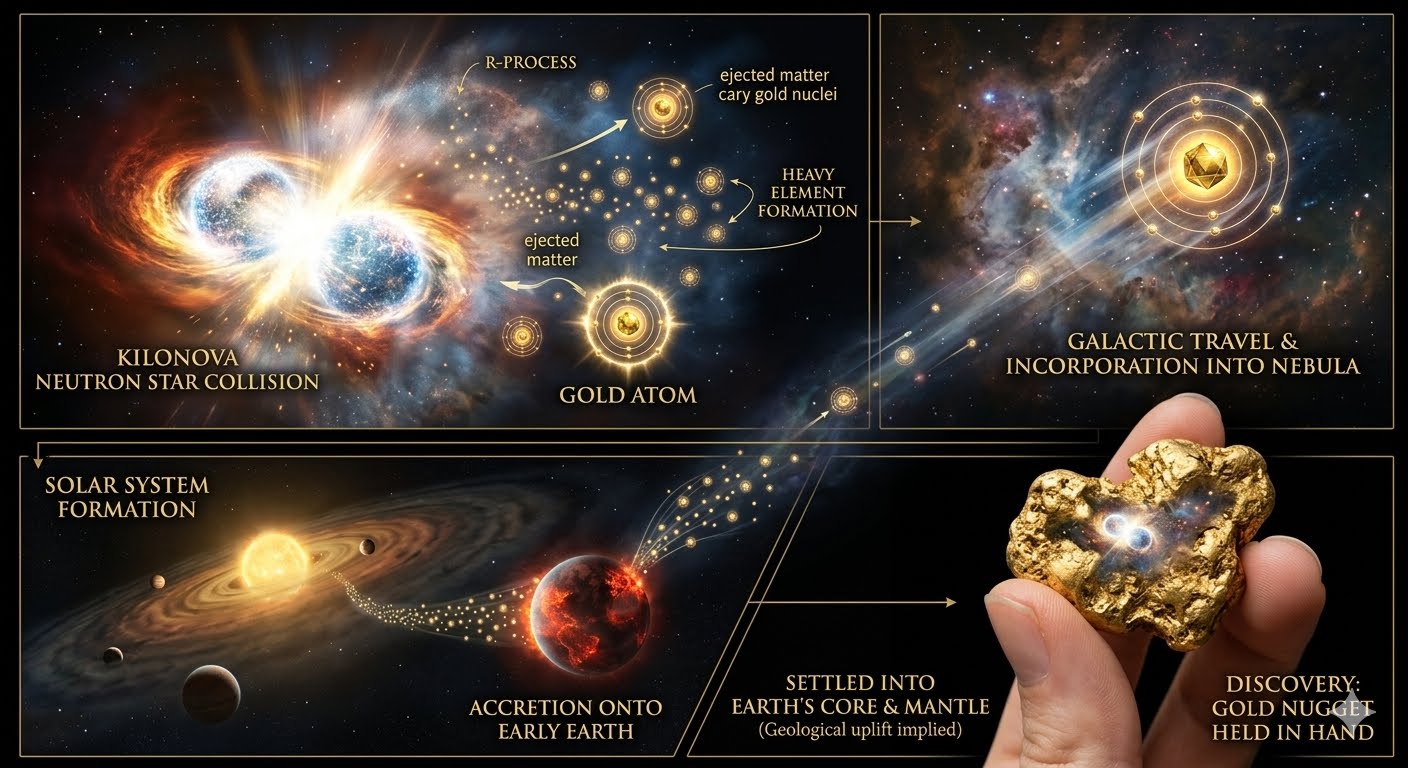
Every prospector has experienced the moment. A signal sounds through the headphones. A few scoops of dirt are removed. The detector passes over the hole again. The target remains. Moments later, a small gold nugget emerges from the soil, glimmering in the sunlight after perhaps millions of years hidden beneath the earth. Most prospectors immediately think about the nugget's weight, value, or beauty. Few stop to consider the remarkable reality that the gold in their hand has traveled farther and endured longer than almost anything else they will ever touch. The truth is astonishing. That nugget is older than the mountains surrounding it, older than the rivers that carried it, older than Earth itself. In a very real sense, every gold nugget is a fragment of cosmic history.
For centuries, people believed gold was simply another metal found within the earth. Today, scientists understand that its origins are far more extraordinary. Unlike common elements such as oxygen, carbon, or silicon, gold cannot be produced through the normal life cycle of stars. While stars spend billions of years converting hydrogen into helium and creating many of the lighter elements that make up our world, gold requires conditions so extreme that they rarely occur anywhere in the universe. The immense pressures and energies needed to create gold are beyond what most stars can achieve, even during their final stages of life.
For many years, scientists believed supernova explosions were responsible for producing most of the universe's gold. A supernova occurs when a massive star reaches the end of its life and explodes with incredible force, briefly shining brighter than entire galaxies. These explosions create temperatures and pressures so extreme that atoms are violently fused together, producing many of the heavier elements found throughout the cosmos. While supernovas certainly contribute to the creation of gold, researchers eventually realized they could not fully explain the quantities of gold observed throughout the universe. Something even more powerful had to be involved.
The answer came from one of the most violent events ever discovered. When massive stars die, they sometimes leave behind neutron stars, incredibly dense objects containing the mass of an entire star compressed into a sphere only a few miles across. A teaspoon of neutron star material would weigh billions of tons on Earth. Occasionally, two neutron stars become locked together in orbit, slowly spiraling inward over millions or even billions of years. When they finally collide, the resulting explosion releases unimaginable amounts of energy. During those brief moments, conditions become perfect for creating some of the heaviest elements in existence, including gold, platinum, and silver.
In 2017, scientists observed one of these collisions for the first time using gravitational wave detectors and telescopes around the world. The event confirmed decades of scientific theories and revealed that a single neutron star collision could create more gold than exists in countless worlds combined. Long before our solar system formed, ancient collisions like these scattered gold throughout the galaxy. Tiny particles of that newly created gold drifted through space, eventually becoming part of a vast cloud of gas and dust that would one day give birth to our Sun and the planets orbiting it.
Approximately 4.6 billion years ago, gravity began pulling that cloud together. Most of the material collapsed into what became our Sun, while the remaining dust and debris formed a rotating disk around it. Within that disk, particles collided and stuck together. Small grains became rocks, rocks became planetesimals, and planetesimals eventually became planets. Hidden among those materials were atoms of gold forged billions of years earlier during ancient stellar catastrophes. As Earth formed, that gold became part of the young planet.
But Earth's gold nearly disappeared forever.
During its earliest years, Earth was a molten world covered by oceans of liquid rock. Heavy elements such as iron, nickel, and gold gradually sank toward the planet's center. Scientists believe the vast majority of Earth's original gold now resides deep within the core, locked away more than 1,800 miles beneath our feet. In fact, there may be enough gold hidden within Earth's core to cover the entire surface of the planet in a layer several feet thick. Yet almost none of it is accessible to humanity.
If most of Earth's gold sank into the core billions of years ago, why do prospectors still find gold near the surface today? Many scientists believe the answer lies in a violent chapter of Earth's early history known as the Late Heavy Bombardment. During this period, enormous asteroids repeatedly struck the young planet. These impacts delivered fresh supplies of precious metals to Earth's outer crust after the core had already formed. In other words, much of the gold humans mine today may have arrived from space long after Earth itself was created.
The journey was still far from over. Deep beneath Earth's surface, geological forces continued concentrating gold into deposits. Magma pushed upward through fractures in the crust. Hot, mineral-rich fluids circulated through underground fault systems. Over millions of years, these fluids transported microscopic quantities of gold through rock formations before depositing them inside cracks and fissures. Quartz veins formed. Lode deposits developed. Entire gold districts emerged. The famous gold-bearing regions of California, Alaska, Australia, and South Africa all owe their existence to these slow but powerful geological processes.
Eventually, erosion took over. Rain, rivers, landslides, and weathering began breaking apart the gold-bearing rock. Gold was released from its host formations and carried downhill into creeks and rivers. Because gold is so dense, it settled into cracks, crevices, gravel bars, and ancient stream channels while lighter materials continued downstream. Over thousands and sometimes millions of years, nature concentrated the gold into placer deposits that prospectors continue searching for today.
When a modern prospector recovers a gold nugget from a creek bed, they are witnessing the final chapter of an almost unimaginable journey. That nugget may have originated in the collision of two neutron stars billions of years before Earth existed. It may have traveled across the galaxy, survived the formation of the solar system, endured asteroid impacts, been buried deep within mountains, and then spent millions of years moving through rivers before finally coming to rest beneath a detector coil.
Perhaps that is why gold has fascinated humanity for so long. Beyond its beauty and value lies something even more profound. Every nugget is a survivor. Every flake is a piece of cosmic history. Long before humans walked the Earth, before dinosaurs roamed the continents, before the oceans formed, the atoms within that gold were already beginning their incredible journey.
The next time you hold a piece of gold in your hand, take a moment to appreciate what you're truly looking at. You're not simply holding a precious metal. You're holding a relic from the birth of the universe.