
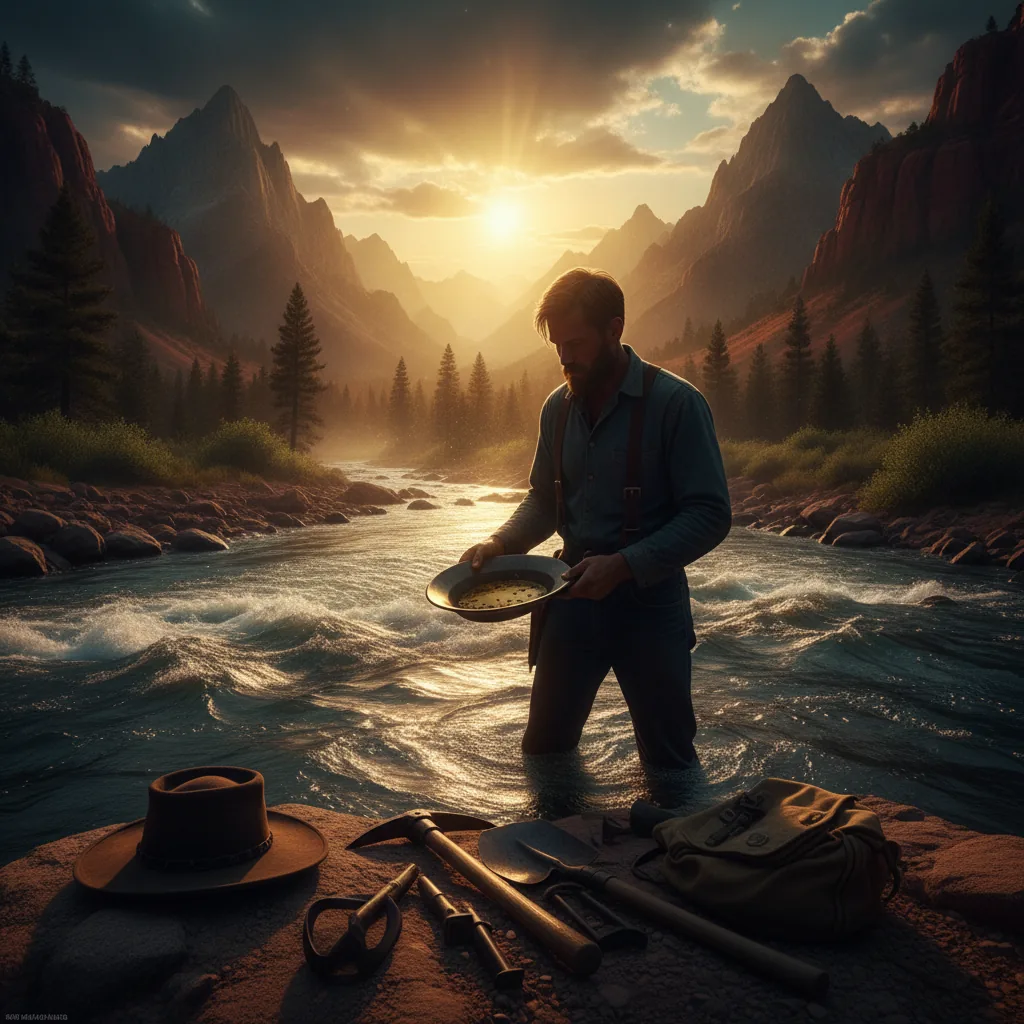
We were somewhere around the North Fork of the American River, on the edge of the Sierra foothills, when the fever began to take hold. I remember saying something like, "I feel a little lightheaded, maybe you should pan the next bar—" and suddenly there was a terrible roar all around us and the sky was full of what looked like the ghosts of two hundred thousand dead men, all of them clutching pickaxes and screaming about color. Then it was quiet again. Just the river. Just the gravel. Just the oldest and most dangerous drug ever refined on this continent: the belief that there is treasure in the ground and that you, specifically, are the fool destined to find it.
This is a story about treasure hunting. Real treasure hunting — not the cartoon kind with a parchment map and a big red X, though we will get to the maps, because the maps are real and they are terrifyingly good these days. This is about the disease that got into the American bloodstream in 1848 and never left. It's about gold, and the men and women who chase it with detectors and shovels and pans and a level of optimism that would embarrass a Las Vegas roulette addict. And it's about the cold hard truth underneath the myth, which is that the gold is genuinely still out there — the numbers say so — and the only thing standing between you and it is roughly one hundred and seventy-five years of accumulated bad luck, bad geology, and worse decisions.
Buy the ticket, take the ride. Let's go find some.
The Original Bad Trip: January 1848
It started, as these things do, with a man who wasn't even looking. James W. Marshall was building a sawmill for John Sutter on the South Fork of the American River when he spotted something glittering in the tailrace. According to the National Park Service, that single flash of metal on January 24, 1848, detonated the largest voluntary human migration in the history of the American West. Within eighteen months, some 300,000 people had abandoned their farms, their families, and whatever passed for their good judgment to descend on California like locusts with mining pans.
Think about the sheer derangement of it. Men sold everything they owned to board leaking ships that sailed all the way around Cape Horn — a voyage of five to eight months through some of the worst seas on the planet — on the strength of a rumor. Others walked across the continent on the overland trails, dying of cholera and dysentery and sheer stupidity in numbers that would make a modern actuary weep. The Library of Congress notes that San Francisco exploded from a sleepy settlement of roughly 200 souls in 1846 into a roaring, lawless boomtown of some 36,000 by 1852. That's not growth. That's a chemical reaction.
And the gold was real. According to the U.S. Geological Survey and the broader historical record, California produced staggering quantities of the stuff in those first frenzied years — enough to reshape the global economy, mint a state, and bankroll the American conquest of a continent. The early Forty-Niners, working the richest and most accessible placer deposits with nothing but pans and rockers, were pulling out fortunes in a single day. It was, briefly, exactly as good as the rumors promised. Which is precisely what makes it a drug. The first hit is always the best one.
Where the Treasure Actually Went (and Where It Still Hides)
Here is the part they don't put on the postcards: the easy gold got cleaned out fast. By the mid-1850s, the surface placers were largely picked over, and mining shifted to increasingly industrial and horrifying methods. Hydraulic mining — blasting entire hillsides apart with high-pressure water cannons — moved unfathomable volumes of earth and choked the rivers with debris until California actually banned it in the landmark 1884 Sawyer Decision, one of the first environmental rulings in American history. The Malakoff Diggins State Historic Park, now preserved by California State Parks, is a monument to that madness — a canyon carved not by a river but by greed and water pressure.
But — and this is the whole point, the reason grown adults still wade into freezing rivers with a plastic pan — they never got all of it. Not even close. The USGS estimates that vast quantities of gold remain in the American landscape, locked in hardrock veins, buried in deep gravels, scattered through stream systems in flakes and nuggets too small or too awkward for the old-timers to bother with. Modern detecting technology can find pieces the Forty-Niners walked right over. The USGS Geology, Minerals, Energy, and Geophysics Science Center continues to map and study these deposits, and the fundamental geology hasn't changed. Gold is where it always was. The rivers keep re-sorting it every flood season, delivering fresh material down from the eroding highlands into the same bars and bends that made men rich in 1849.
The gold, in other words, is patient. It has been in the ground for hundreds of millions of years — forged, according to current astrophysical thinking cited by the USGS and the wider scientific community, in the cataclysmic collision of neutron stars long before the Earth even existed. It waited out the dinosaurs. It waited out the Forty-Niners. It can certainly wait out you and your beeping machine. The question is not whether the treasure exists. The question is whether you have the stomach to go get it.
The Machine and the Madness: Metal Detecting as a Way of Life
Somewhere in the second half of the twentieth century, the treasure dream got a new drug delivery system: the metal detector. Suddenly you didn't need a river and a pan and the patience of a Buddhist monk. You needed a coil on a stick, a set of headphones, and the peculiar willingness to walk in slow overlapping arcs across a hillside for six hours in the sun while a machine screams electronic gibberish into your skull.
I have seen men in this state. I have been a man in this state. There is a specific glassy look that comes over a person about four hours into a fruitless detecting session, a thousand-yard stare that combines religious devotion with the early stages of heatstroke. Every signal is the signal. Every rusty nail is, for the two seconds before you dig it, a Spanish doubloon or a nugget the size of a walnut. The detector doesn't lie, exactly — it just tells you there's metal down there. Whether that metal is your fortune or somebody's discarded shotgun shell is a matter of faith and, increasingly, technology.
The physics is honest even when the operator is delusional. Modern detectors use electromagnetic induction — a transmit coil generates a field, buried conductive objects generate their own eddy currents in response, and a receive coil picks up the echo. Higher frequencies favor small gold; lower frequencies punch deeper. Pulse induction machines shine in the highly mineralized, iron-heavy "hot ground" of gold country, where lesser machines just moan and false-signal themselves into uselessness. None of this is magic. It's applied science strapped to a shaft, held by a hopeful lunatic.
And here's where the modern era genuinely bends the odds. The old-timers had rumor and instinct. You have satellite geology, historical production data, and a supercomputer in your pocket. This is where the Gold Prospector app earns its place in the pack — it pulls together the geological and historical data that tells you where gold has actually been found, so you're not just wandering into the wilderness and swinging a coil at random like some kind of caffeinated dowser. It won't dig the hole for you. But it will keep you from digging in the wrong county, which is more than the Forty-Niners ever had.
The Law of the Land, or: How Not to Get Arrested Chasing a Dream
Now we arrive at the ugly, sobering, absolutely essential part of the trip — the part where a responsible guide grabs you by the collar before you drive off a cliff. Because the single fastest way to turn a treasure hunt into a nightmare is to dig where you have no legal right to dig, and America is a patchwork quilt of jurisdictions, each with its own rules, tempers, and enforcement personalities.
Start with the good news. The Bureau of Land Management administers vast tracts of public land in the West, much of it open to recreational prospecting and mining claims under the venerable General Mining Law of 1872. On unappropriated BLM land, recreational panning, sluicing, and metal detecting for gold are generally permitted, and you can even stake a claim — though the rules on claims, notices, and fees are a bureaucratic swamp all their own. The BLM's own guidance stresses that recreational mining should be low-impact and that you must respect existing claims; another prospector's staked claim is legally theirs, and jumping it is a fine way to meet the local sheriff.
The U.S. Forest Service manages another enormous chunk of gold country, and similar rules apply on National Forest land — recreational, hand-tool prospecting is broadly allowed, but anything that disturbs the surface significantly may require a Notice of Intent or a Plan of Operations. Motorized equipment, dredging, and larger operations are heavily regulated and vary by district. Call the ranger station. Actually call them. The Forest Service would rather explain the rules than cite you for breaking them.
Now the part that will save your freedom: the National Park Service is a hard, unambiguous no. Under NPS regulations, metal detecting and collecting are prohibited in national parks, full stop. It is a federal offense. Rangers do not find your treasure story charming. Historic sites, battlefields, and archaeological areas are protected under the Archaeological Resources Protection Act of 1979, which carries genuinely serious penalties — fines and prison time — for disturbing cultural resources on federal land. That old coin or musket ball you dug up might be evidence in a felony. Leave it.
State parks vary wildly. Some California State Parks permit recreational gold panning in designated areas — Marshall Gold Discovery State Historic Park, of all places, the very spot where the whole delirium began, allows limited panning in the American River — but always under specific rules and only where posted. Private land requires the owner's permission, in writing if you have any sense. The universal, non-negotiable maxim of treasure hunting is this: know whose dirt you're standing on before you put a shovel in it. The dream does not exempt you from the law. If anything, the law is the only thing standing between the honest prospector and the total anarchy that would strip the land bare in a single season.
The Physics of Where Gold Hides
Let's sober up further and talk geology, because the treasure hunter who understands geology is a hunter, and the one who doesn't is just a tourist with a metal detector and a sunburn.
Gold is dense — nearly nineteen times heavier than water, more than seven times heavier than the average river gravel around it. This single physical fact governs everything. When gold erodes out of a hardrock vein — the primary "lode" deposit — and washes into a stream, its weight makes it behave in stubborn, predictable ways. It sinks. It drops out of moving water the instant the current slows. It works its way down through gravel to bedrock and lodges in cracks, crevices, and potholes. The USGS's studies of placer deposits and the classic literature on placer gold describe exactly this behavior: gold accumulates on the inside of river bends, behind boulders, at the base of waterfalls, and anywhere the water's velocity abruptly drops.
This is why the old-timers followed the rivers, and why you should too. The gravels the Forty-Niners worked are still being replenished. Every winter storm, every spring melt, tears a little more gold out of the highlands and marches it down the drainage, sorting it by weight along the way, leaving it in the same natural traps that have concentrated it since the Sierra was young. Learn to read a streambed — the point bars, the drop-offs, the bedrock exposures — and you are reading a treasure map written in fluid dynamics. The USGS Mineral Resources Program maintains data and maps that let you tie your local creek to the larger geologic story: the gold belts, the ancient river channels, the fault zones that plumbed hot mineral-rich fluids up toward the surface eons ago.
The best treasure hunters I've ever known were, at heart, amateur geologists who happened to be armed. They didn't chase legends. They chased bedrock. They understood that the gold isn't hidden by pirates — it's hidden by a hundred million years of water doing exactly what water does. Beat the water at its own game and the treasure follows.
The Great American Buried-Treasure Delusion
Of course, gold in the ground is only half the treasure-hunting fever. The other half — the more romantic, more dangerous, more thoroughly delusional half — is buried treasure. Cached loot. Lost mines. The stagecoach strongbox some outlaw supposedly stashed in a hillside before getting shot. The American West is thick with these stories, and they are almost entirely garbage, which does absolutely nothing to diminish their power over the human brain.
Consider the Lost Dutchman Mine, the granddaddy of American treasure legends, said to lie somewhere in the Superstition Mountains east of Phoenix. For over a century, people have died — genuinely, repeatedly died — searching for it in that brutal terrain. The Arizona State Parks system's Lost Dutchman State Park is literally named for the myth. No verified gold has ever been produced from it. The mine may never have existed at all. And still they go, drawn by that same neurochemical hook that pulled 300,000 people around Cape Horn in 1849.
Or take the more recent case of the Forrest Fenn treasure — a chest of gold and jewels that the eccentric art dealer claimed to have hidden somewhere in the Rocky Mountains, sparking a nationwide hunt. According to reporting from outlets including the New York Times, the chase drew hundreds of thousands of searchers, and at least five people died trying to find it before it was finally recovered in 2020. Five dead. Over a real treasure this time — but a treasure whose sole purpose was to prove that the fever is as potent in the twenty-first century as it was in the nineteenth.
The lesson here is not that legends are worthless — some are true, most are not, and telling the difference is its own dark art. The lesson is that the treasure fever, uncut and unmanaged, will kill you. It short-circuits judgment. It sends people into the desert without water, into flooded rivers without sense, up crumbling mineshafts that have been quietly waiting a hundred years to collapse on exactly this kind of optimist. The most important piece of treasure-hunting gear is not the detector or the pan. It's the part of your brain that can still say no when the fever says go.
How to Actually Do This Without Dying or Getting Arrested
So you've read this far and the fever has you anyway. Fine. I'm not your mother. But if you're going to chase the American treasure dream, chase it like a professional lunatic rather than an amateur one. Here is the field protocol, hard-won and offered without warranty.
First, research before you rove. Pull the historical production records. The gold is where the gold has always been — the districts that produced in the 1850s are the districts producing today. USGS data and historical mining reports will point you at real ground. This is precisely the kind of work the Gold Prospector app is built to compress: overlaying geological and historical data so you spend your weekends digging in places with a documented pedigree instead of throwing darts at a map. The old-timers would have committed murder for this information.
Second, sort out the legal ground before you leave the driveway. Is it BLM? Forest Service? Private? A national park where a detector will get you handcuffed? Is there an active claim on it? The BLM's claim records and the local ranger district are your friends here. Ten minutes of homework beats a court date.
Third, respect the water. More prospectors are hurt by rivers than by anything else. Cold water saps strength faster than you think. Spring runoff turns a friendly summer creek into a killer. Never wade what you can't read, never turn your back on rising water, and never, ever prospect a flash-flood-prone desert wash when there's weather in the highlands upstream.
Fourth, tread lightly. Fill your holes. Pack out your trash — and everyone else's, because a clean prospector is a welcome one and a slob gives the whole community a reason to get us all banned. Low-impact isn't just the legal standard on public land; it's the difference between keeping these places open and watching them get locked up forever.
Fifth, temper the fever with arithmetic. The vast majority of your signals will be trash. The vast majority of your pans will be barren. The gold, when it comes, comes in flakes and flour more often than nuggets. Treasure hunting is a game of statistics and stubbornness, and the people who get rich are almost always the ones selling the equipment. Do it because the doing is good — because there is genuinely nothing else on Earth quite like the moment a real flash of color settles in the bottom of your pan and you realize you're holding something that was forged in a dying star and buried in that creek before the pyramids. Do it for that. If you get rich too, treat it as a bonus and don't tell anybody where you found it.
The Last Word from the Edge of the River
The sun is going down now over the foothills, and the river is doing what it has done for ten thousand years — carrying its cargo of ground-up mountains toward the sea, and somewhere in that gravel, the yellow metal that drove a nation mad. The Forty-Niners are gone. Their boomtowns are ghost towns or state parks. Their picks are rusted and their fortunes long spent. But the gold is still here. The USGS confirms it. The geology guarantees it. The rivers keep delivering it, indifferent and inexhaustible.
That's the strange, enduring truth of American treasure hunting: the myth is a lie and the treasure is real, both at the same time. There is no map with a red X. There is no pirate chest waiting under a palm tree. But there is gold in the ground, right now, in numbers that would have staggered James Marshall, and it is legally and physically within reach of anyone with enough knowledge, enough respect for the land and the law, and enough of that beautiful American derangement to go looking.
The fever never really goes away. Once it's in you, it's in you for good. So do it right. Study the geology. Obey the law. Fill your holes. Watch the water. And when that color finally settles in your pan — and if you do the work, it will — you'll understand why 300,000 people once sailed around the bottom of the world on the strength of a rumor. Some rumors are true. This one always was.
Buy the ticket. Take the ride. Just don't drink the river water.
Sources & Citations
- National Park Service — The California Gold Rush: https://www.nps.gov/articles/000/the-california-gold-rush.htm
- Library of Congress — The California Gold Rush: https://www.loc.gov/classroom-materials/united-states-history-primary-source-timeline/rise-of-industrial-america-1876-1900/california-gold-rush/
- USGS — How much gold has been found in the world?: https://www.usgs.gov/faqs/how-much-gold-has-been-found-world
- USGS — Where does all Earth's gold come from?: https://www.usgs.gov/faqs/where-does-all-earths-gold-come
- USGS — Geology, Minerals, Energy, and Geophysics Science Center: https://www.usgs.gov/centers/gmeg
- USGS Mineral Resources Program: https://www.usgs.gov/programs/mineral-resources-program
- USGS Professional Paper — Principles of the Gold-Bearing Placer Deposits: https://pubs.usgs.gov/publication/pp630
- California State Parks — Malakoff Diggins State Historic Park: https://www.parks.ca.gov/?page_id=494
- California State Parks — Marshall Gold Discovery State Historic Park: https://www.parks.ca.gov/?page_id=25671
- Bureau of Land Management — Mining Claims: https://www.blm.gov/programs/energy-and-minerals/mining-and-minerals/locatable-minerals/mining-claims
- U.S. Forest Service — Minerals and Mining: https://www.fs.usda.gov/managing-land/minerals
- National Park Service — Metal Detecting: https://www.nps.gov/subjects/metaldetecting/index.htm
- National Park Service — Archaeological Resources Protection Act of 1979: https://www.nps.gov/subjects/archeology/archeological-resources-protection-act.htm
- Arizona State Parks — Lost Dutchman State Park: https://azstateparks.com/lost-dutchman
- The New York Times — Forrest Fenn Treasure Found: https://www.nytimes.com/2020/06/07/us/forrest-fenn-treasure-found.html