
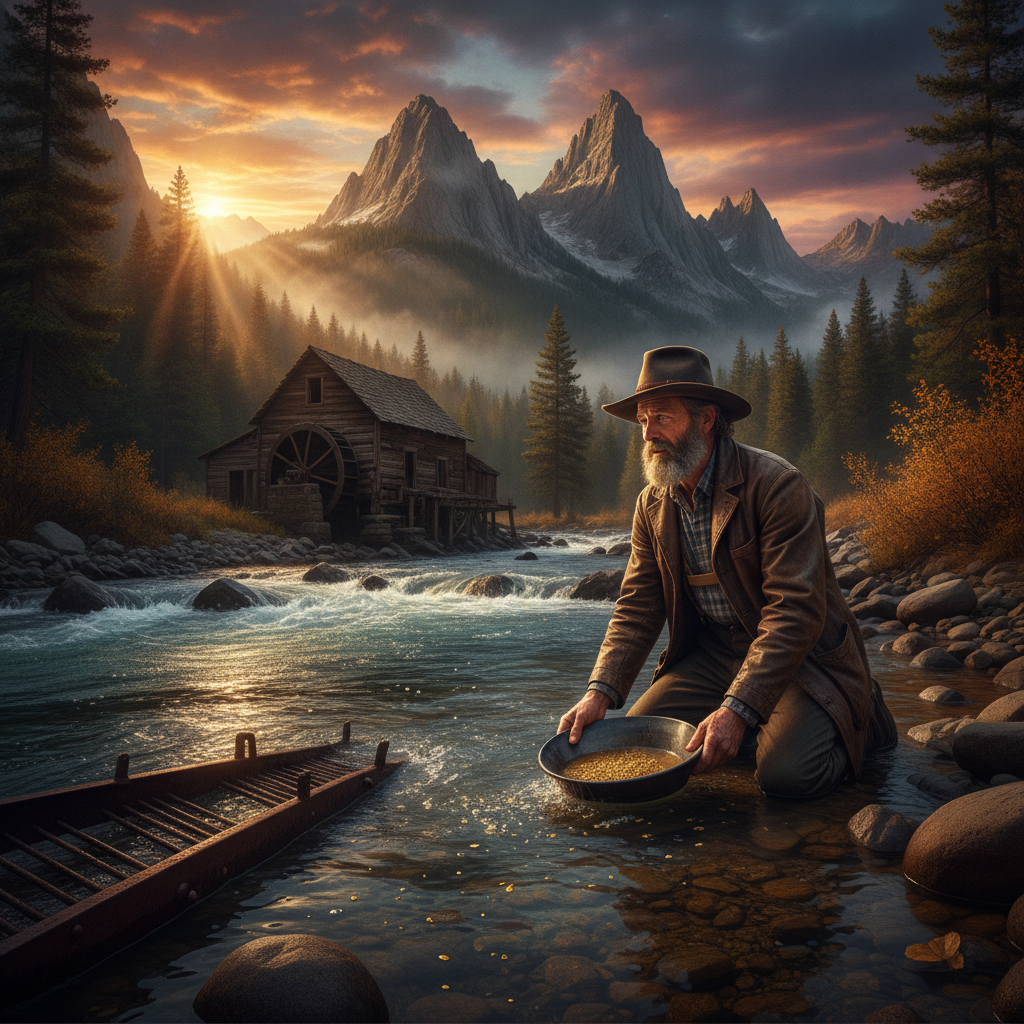
Here is a thing worth sitting with for a moment: the single most consequential moment in the economic history of the American West happened because a man was annoyed about a ditch.
The man was James W. Marshall, a New Jersey–born carpenter and wheelwright with a talent for building things and a genius for bad luck. In the winter of 1848 he was supervising the construction of a sawmill for John Sutter on the South Fork of the American River, at a spot the local Nisenan people called Cullumah. The mill had a problem. The tailrace — the channel that carried water away from the wheel — wasn't deep enough. So each night Marshall would let the river run hard through it to scour out the gravel, and each morning he'd walk down to inspect what the water had cut. On the morning of January 24, 1848, he was doing exactly that when something in the ditch caught the light.
According to the National Park Service, Marshall picked up "some flakes of gold about half the size and shape of a pea." He was, in his own later telling, not immediately certain. He bit one. He hammered another between two rocks to see if it would shatter like fool's gold or flatten like the real thing. It flattened. Marshall put a few flakes in his hat, rode to Sutter's fort, and the two men consulted an encyclopedia and ran a crude acid test. It was gold.
Now here is the part that tells you everything about how history actually works: they tried to keep it a secret.
The Worst-Kept Secret in the History of the World
Sutter did not want a gold rush. Sutter wanted a sawmill and a flour mill and an agricultural empire, and he understood immediately — correctly, tragically — that gold would ruin all of it. It would draw away his workers. It would flood his land with squatters. It would, in the end, destroy him. So Sutter and Marshall asked their workers to keep quiet for six weeks.
Secrets like this do not keep. A merchant named Samuel Brannan, who ran a store near the fort, understood the assignment better than anyone. Brannan did not go looking for gold. Brannan went looking for the people who would look for gold. He bought up every pick, shovel, and pan he could find, then reportedly walked through the streets of San Francisco holding a vial of gold dust over his head and shouting that there was gold in the American River. The California State Parks account of the era notes that Brannan became California's first millionaire — not by mining, but by selling to miners. It is the oldest truth in prospecting: in a gold rush, sell shovels.
By the summer of 1848 San Francisco had nearly emptied. Sailors deserted their ships in the harbor — hundreds of vessels sat abandoned, some later hauled ashore and used as buildings. Soldiers walked away from their posts. The Library of Congress records that the price of everyday goods went vertical: eggs, boots, whiskey, a night's lodging. Everything cost a fortune because everyone who might otherwise have made those things had gone up into the hills with a pan.
December 5, 1848: The Day It Went National
For most of 1848, the rush was a California affair, a rumor the rest of the country half-believed. Newspapers back East printed the stories the way they printed sea serpents. Then, on December 5, 1848, President James K. Polk did something that turned a rumor into a stampede. In his annual message to Congress, Polk officially confirmed the gold discoveries, describing an "abundance of gold" so extraordinary that it "would scarcely command belief."
Polk had a political reason. The United States had just taken California from Mexico in the Treaty of Guadalupe Hidalgo, signed in February 1848 — a few days, as it happens, after Marshall's discovery, though neither government knew it. Polk wanted to justify the war and encourage settlement of the new territory. So he leaned in. And to remove all doubt, a military courier delivered an actual tea caddy full of California gold to the War Department, where it was put on public display.
That did it. A president's word plus 230 ounces of physical proof turned the country inside out. The people who came the following year would be known forever by the year they arrived: the Forty-Niners.
The Math of Madness
To understand why sane people abandoned farms, families, and functioning lives, you have to do the math the way a Forty-Niner did it.
In 1848 and 1849, the surface gold in California was — for a brief, historically freakish window — genuinely lying around. Rivers had spent millions of years doing the sorting work for free. A man with a pan and a strong back could, in the very best early diggings, recover an ounce or more of gold in a day. An ounce of gold was worth roughly $16 at the time. The average American laborer in 1849 made about a dollar a day. So the gold fields offered, at the extreme high end, something like ten to twenty times the wages a working man could earn anywhere else on Earth.
People do not respond to averages. They respond to the ceiling. And the ceiling was absurd. Stories circulated — some true — of nuggets pulled whole from crevices, of one lucky claim producing thousands of dollars in a week. The U.S. Geological Survey has documented that some of the richest early placer deposits were extraordinary by any historical standard. The problem, as with all such things, is that the ceiling was for the few and the average was for the many. But you cannot sell a gold rush on averages, and nobody tried.
Roughly 300,000 people came to California between 1848 and 1855. They came overland on the brutal California Trail, dying of cholera and accident. They came by sea around Cape Horn, a voyage of five to eight months. They came across the fever-ridden Isthmus of Panama. According to U.S. Census data, California's non-Native population exploded from around 14,000 in 1848 to nearly 100,000 by the end of 1849. It was, per capita, one of the largest voluntary migrations in human history, and it happened in about eighteen months.
What the Geology Was Actually Doing
Here is where the story gets genuinely useful for anyone who wants to find gold today, because the same forces that made the Forty-Niners rich are still operating, and they operate on rules you can learn.
The gold of the Sierra Nevada came from a place and a process called the Mother Lode — a belt of gold-bearing quartz veins running roughly 120 miles along the western flank of the Sierra. That gold was originally locked in hard rock, deposited by superheated, mineral-rich fluids that circulated through faults and fractures as ancient oceanic crust was smashed against and shoved beneath North America over the course of the Jurassic and Cretaceous periods. This is lode gold — gold still in its birthplace, embedded in stone.
But the Forty-Niners of 1848 and 1849 were not, for the most part, mining lode gold. They were mining placer gold, and the difference is the whole story. Over millions of years, erosion tore the veins apart. Rain, frost, and rivers ground the host rock to sand and carried it downhill. Gold, being astonishingly heavy — nearly twenty times denser than water and about seven times denser than the sand it travels with — does not go far or fast. As the USGS explains in its overview of how gold moves and concentrates, gold sinks. It settles into the low-energy pockets of a river: behind boulders, on the inside of bends, in cracks in the bedrock, wherever the water slows down enough to drop its heaviest cargo.
In other words, the river spent millions of years doing exactly what a gold pan does in ninety seconds — separating the heavy from the light. The Forty-Niners simply arrived to collect the accumulated sorting work of geologic time. That's why the early years were so rich and why they didn't last: the rivers had been concentrating gold for eons, and a few hundred thousand people cleaned out the easy stuff in about a decade.
This matters to you because the physics has not changed. Gold still concentrates where water slows. If you understand where a river drops its heavy load, you understand where to look. Modern prospecting tools — including reading historical claim density and known deposit zones inside the Gold Prospector app — are really just ways of asking the same question the Forty-Niners answered with their boots: where did the gold settle out?
The Technology Arms Race
What happened next is the pattern that repeats in every gold rush and, honestly, in every gold field you might work today: as the easy gold vanished, the technology got more aggressive.
First came the pan — the simplest possible device, and still the one every prospector learns first. Then came the rocker, or cradle, which let a crew process more gravel than a single panner could. Then the long tom, and then the sluice, a long inclined trough with riffles across the bottom that trap heavy gold as water and gravel wash through. A sluice is nothing more than an artificial riverbed engineered to do the settling job faster. The National Park Service traces this evolution as a direct response to diminishing returns: when the gold got harder to reach, the machines got bigger.
And then the machines got monstrous. By the 1850s, companies were using hydraulic mining — aiming high-pressure water cannons called monitors at entire hillsides, blasting the ancient gravel loose and washing it through enormous sluices. It was spectacularly effective and environmentally catastrophic. Hydraulic mining flushed an estimated 1.5 billion cubic yards of debris into California's river systems, clogging rivers, burying farmland, and worsening floods downstream. The National Park Service documents the scale of it, and the fallout led, in 1884, to the Sawyer Decision — one of the first major environmental rulings in American history — which effectively banned the practice of dumping hydraulic debris into navigable rivers. The gold rush had become large enough to require the invention of environmental law to restrain it.
The People Who Paid
It would be a betrayal of the actual history to tell this story purely as adventure, because the Gold Rush was also one of the most destructive events ever visited on California's Native peoples.
Before 1848, California's Indigenous population numbered perhaps 150,000. Within roughly two decades it had collapsed to around 30,000. The National Park Service and numerous state records document that this catastrophe was driven by disease, starvation as miners destroyed traditional food sources, forced displacement, and outright killing — some of it organized and state-funded. California's first governor, in 1851, openly predicted "a war of extermination." The gold that made some men rich was, for the people who had lived on that land for thousands of years, an apocalypse.
Chinese immigrants, who came by the tens of thousands, were subjected to the Foreign Miners' Tax and pushed off the richest claims, permitted mostly to rework ground others had abandoned. Mexican and Chilean miners — many of them the most skilled prospectors in the fields, since Latin American mining traditions were centuries old — faced violence and legal harassment. The romance of the rugged individualist prospector is real, but it is only part of a story that also includes exclusion, violence, and dispossession. Any honest account has to hold both.
The Numbers, When the Dust Settled
So how much gold actually came out?
Estimates from the USGS and economic historians put total California Gold Rush production, from 1848 through the mid-1850s peak years, at somewhere around 750,000 pounds of gold — well over $2 billion in the dollars of the era, and the equivalent of tens of billions today. It reshaped the global money supply. It helped fund the industrialization of the American economy. It accelerated California to statehood in 1850, skipping the usual territorial waiting period entirely.
But here is the number that should interest a modern prospector most: geologists have long estimated that as much as 80 percent of California's gold is still in the ground.
Read that again. The Forty-Niners, for all their frenzy, got the accessible stuff — the surface placers and the shallow, obvious veins. The gold that was harder to reach, finer, more deeply buried, or simply overlooked, largely remains. And every winter, high water in the Sierra rivers continues to erode the Mother Lode and re-sort fresh gold into the same kinds of pockets the Forty-Niners worked. The rush "ended," but the geologic machine that created it never turned off.
Standing Where Marshall Stood — Legally
Today the spot where Marshall bit that first flake is Marshall Gold Discovery State Historic Park in Coloma, California — the modern spelling of Cullumah. There is a reconstructed sawmill and a monument. And in a fact that delights every prospector who learns it, recreational gold panning is permitted in a designated stretch of the American River right there in the park, using hand tools only. You can pan the same river where the whole thing started.
That said — and this is the part where the romance meets the paperwork — you cannot just wander onto any river and start digging. Where you can and cannot prospect is governed by a genuinely complicated overlay of land ownership and regulation, and getting it wrong ranges from embarrassing to illegal.
Much of the historic gold country sits on public land managed by the Bureau of Land Management or the U.S. Forest Service, and on many of these lands, recreational panning and sluicing with hand tools is allowed. But rules vary by district, some areas are closed by active mining claims, and any activity beyond simple hand methods — using a motorized dredge, for instance — is heavily regulated. In California specifically, suction dredging in rivers has been the subject of ongoing legal restriction. National Parks are almost universally off-limits to collecting of any kind: as the National Park Service makes clear, recreational mineral collection, including gold panning, is prohibited in most national park units unless a specific park explicitly allows it. The rule of thumb worth tattooing on the inside of your eyelids: know exactly whose land you're on and exactly what that landowner permits before you put a shovel in the dirt.
This is, frankly, where a modern app earns its keep. Sorting out land status, historical claim density, and where gold has actually been found is precisely the kind of homework that separates a productive weekend from a wasted one — and the same reasoning that made Sam Brannan rich applies in reverse. The Forty-Niners had rumors and biased newspapers. You have geologic maps, land-status data, and USGS deposit records. The Gold Prospector app exists to fold that information into one place, so you can ask the two questions that actually matter — where did gold concentrate? and am I allowed to look there? — before you ever leave the house.
What the Gold Rush Actually Teaches
Strip away the mythology and the Gold Rush leaves behind a small set of durable truths, and every one of them is useful to a person holding a pan in the twenty-first century.
The first is that gold is where the water slowed down. That was true for the river that concentrated it over ten million years, and it's true for the sluice box on your tailgate. Learn to read a river — the inside of bends, the downstream side of boulders, the bedrock cracks, the spots where fast water suddenly goes slack — and you are reading the same map the Forty-Niners read with their feet.
The second is that the ceiling lies and the average tells the truth. For every man who struck it rich in 1849, many more went home broke, or didn't go home at all. The people who reliably prospered were the ones who worked methodically, understood their ground, and — like Brannan — kept their expectations attached to reality. Modern prospecting is a hobby that rewards patience and punishes the fantasy of the single life-changing nugget.
The third, and maybe the most encouraging, is that the gold is still there. The rush was not the extraction of all the gold; it was the extraction of the easy gold, by hundreds of thousands of people working before there were metal detectors, GPS, satellite geology, or 175 years of accumulated knowledge about where deposits form. Every winter, the Sierra rivers keep doing what they've always done. The Mother Lode is still eroding. And 80 percent of it, by the geologists' reckoning, has never seen a pan.
James Marshall, for what it's worth, got almost none of it. He died poor in 1885, having never profited meaningfully from the discovery that reordered the American continent. His last years were spent giving lectures and selling autographs to tourists, a living monument to the oldest lesson of the gold fields: finding the gold and keeping the gold are two entirely different skills.
But he did give the rest of us something. He walked down to inspect a ditch on a cold January morning, saw a glint, and could not let it go. That instinct — the refusal to walk past the glint — is the whole thing. It's why people still wade into cold Sierra rivers with a pan and a dream. The gold is real, the geology is knowable, and the machine that makes it never stopped running. All that's left is to go and look, in the right place, on the right side of the law, the way Marshall did — except now, unlike him, you can know the odds before you start.
Sources & Citations
- National Park Service — The California Gold Rush: https://www.nps.gov/articles/000/the-california-gold-rush.htm
- California State Parks — Gold Rush History: https://www.parks.ca.gov/?page_id=1093
- California State Parks — Marshall Gold Discovery State Historic Park: https://www.parks.ca.gov/?page_id=484
- Library of Congress — The Gold Rush: https://www.loc.gov/collections/california-first-person-narratives/articles-and-essays/early-california-history/gold-rush/
- U.S. Dept. of State, Office of the Historian — Milestones 1830–1860: https://history.state.gov/milestones/1830-1860/texas-annexation
- History.com — Gold Rush of 1849: https://www.history.com/topics/19th-century/gold-rush-of-1849
- U.S. Geological Survey — Prospecting for Gold in the United States: https://pubs.usgs.gov/gip/prospect2/prospectgip.html
- U.S. Geological Survey — Geology and Mineral Resources of the Mother Lode Belt: https://www.usgs.gov/publications/geology-and-mineral-resources-mother-lode-belt
- U.S. Census Bureau — 1850 Fast Facts: https://www.census.gov/history/www/through_the_decades/fast_facts/1850_fast_facts.html
- National Park Service — Gold Mining Techniques: https://www.nps.gov/subjects/goldrush/mining-techniques.htm
- National Park Service — Hydraulic Mining (Whiskeytown): https://www.nps.gov/whis/learn/historyculture/hydraulic-mining.htm
- U.S. Geological Survey — Gold Statistics and Information: https://www.usgs.gov/centers/national-minerals-information-center/gold-statistics-and-information
- Bureau of Land Management — Recreational Mining: https://www.blm.gov/programs/energy-and-minerals/mining-and-minerals/recreational-mining
- U.S. Forest Service — Minerals & Geology Management: https://www.fs.usda.gov/managing-land/minerals-geology
- National Park Service — Prospecting and Mining Regulations: https://www.nps.gov/orgs/1207/prospecting-and-mining.htm