
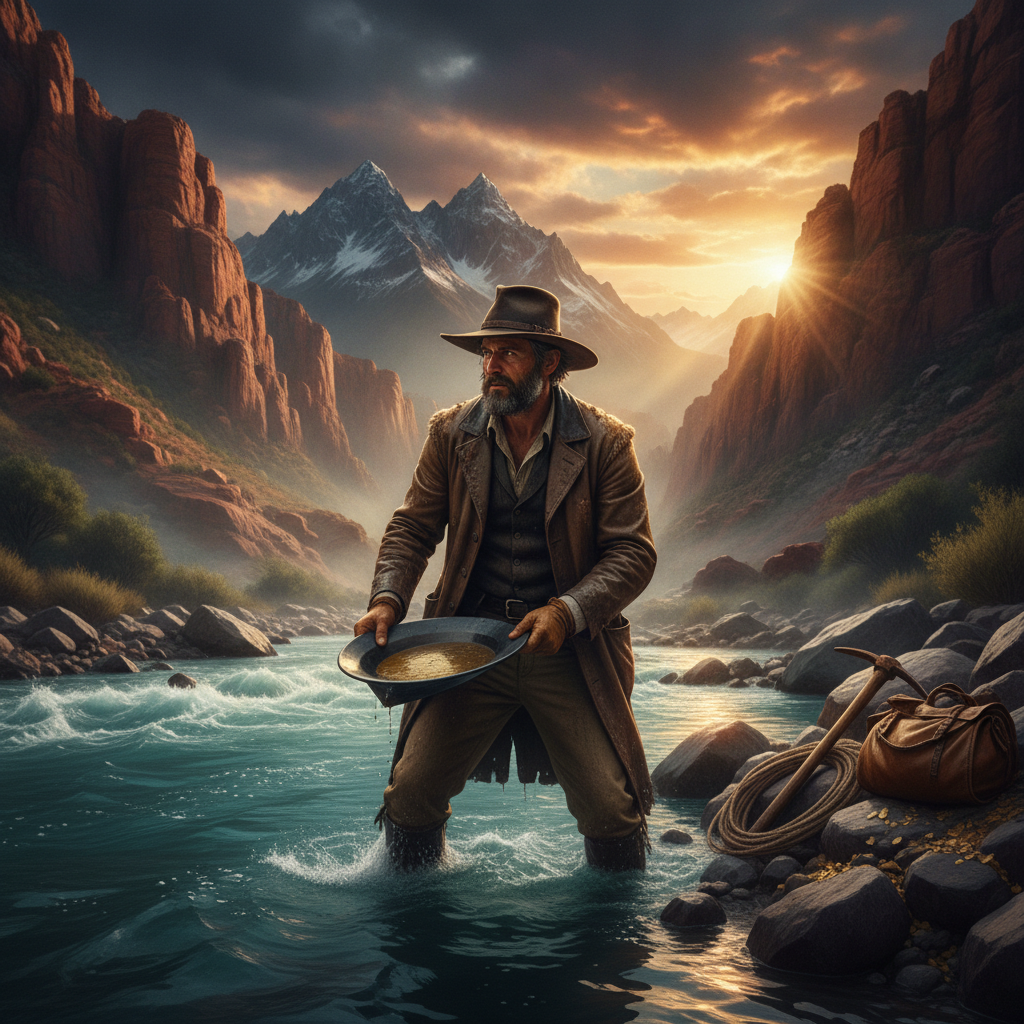
We were somewhere around the third bend of a nameless creek in the Sierra foothills when the delusion began to take hold. The sun was a hammer. The water was cold enough to stop a man's heart, and my partner — a lunatic in waders who claimed he could "smell" placer gold — was on his knees in the gravel screaming about a color in his pan that turned out to be a fleck of mica. Fool's gold. The eternal punchline. And that, right there, is the whole problem with amateur prospecting: everybody wants the payoff and nobody wants the plan.
Let me tell you something that took me years and too many blistered hands to understand. Gold does not care about your enthusiasm. It does not respond to hope, prayer, or the frantic energy of a man who bought a $40 pan at a hardware store and drove three hundred miles on a rumor. Gold responds to one thing only: strategy. Cold, ruthless, geologically-informed strategy. The kind that starts weeks before you ever touch water, and continues long after everyone else has quit and gone home to nurse their disappointments with cheap beer.
This is the article about that strategy. Buckle in. It's going to get technical, and occasionally it's going to get weird, but every word of it is built on the hard bedrock of real science and real law. Because the difference between a prospector and a tourist is roughly the same as the difference between a surgeon and a man with a knife.
The First Rule: Gold Is Predictable, You Are Not
Here is the great cosmic joke that most weekend warriors never get. Gold is one of the most predictable substances on Earth. It obeys physics with a devotion that borders on the religious. It is nearly nineteen times denser than water and more than six times denser than the sand and gravel it travels with, which means it behaves in ways you can actually anticipate if you bother to learn the rules of the game.
The U.S. Geological Survey has spent well over a century documenting where gold forms and how it moves. According to the USGS Geology, Minerals, Energy, and Geophysics Science Center, most of the gold recovered in the American West originated in hydrothermal veins — deep fractures where superheated, mineral-rich fluids deposited gold as they cooled and encountered changes in pressure and chemistry. That's the lode source. But most recreational prospectors aren't chasing hardrock veins with dynamite and heartbreak. They're chasing placer gold — the stuff that has weathered out of those veins over millions of years and been dragged downhill by water, gravity, and time.
And placer gold, my friends, is where strategy lives. Because water and gravity are not random. They are the two most reliable enforcers in the natural world, and once you understand how they conspire to concentrate gold, you stop wandering the wilderness like a drunk looking for his car and start hunting like a predator who knows exactly where the prey goes to drink.
Research Before Rubber Boots: The War You Win at the Desk
Every great prospecting trip is won or lost before you leave the house. I cannot overstate this. The man who shows up to a creek with no research is the man who will spend eight hours panning barren tailings that some Chinese laborer already worked to death in 1867.
Start with history, because history is a map drawn in blood and greed. The California Gold Rush and the subsequent stampedes across the West left behind an extraordinary paper trail of exactly where people found gold. The USGS Mineral Resources Program maintains the Mineral Resources Data System (MRDS), a database of hundreds of thousands of mineral occurrences, prospects, and past-producing mines across the United States. This is not folklore. This is documented, surveyed, government-verified geology telling you where the metal has already proven itself. If you're not consulting it, you're prospecting blind.
The old rule holds: gold is where gold was. Nature doesn't relocate ore bodies to be polite. If a district produced in the 1850s, the geology that made it produce is still sitting there, and the modern prospector's job is to find what the old-timers missed — the fine gold their crude equipment couldn't catch, the bench deposits they overlooked, the flood gold redistributed by a century and a half of storms.
This is precisely the kind of legwork a gold prospecting app can compress, and it is what Gold Prospector was built to do. Instead of cross-referencing paper maps, historical mining reports, and geologic surveys by hand at three in the morning, you can pull documented gold occurrences, terrain data, and public-land boundaries into one place and actually plan a route that makes sense. The desk war doesn't have to take weeks anymore. But make no mistake — you still have to fight it.
Reading Water Like a Fugitive Reads a Highway
Now we get to the physics, and this is where the amateurs bleed out. Gold moves through a creek system in a way that is beautifully, exploitably logical. It is heavy. When flowing water loses energy — when it slows down — it drops its heaviest cargo first. Gold is always the first thing to fall out and the last thing to move again.
So where does water slow down? The USGS literature on placer deposits and generations of field experience point to the same recurring traps:
Inside bends of the creek. Water on the outside of a curve moves fast and cuts the bank. Water on the inside moves slow and drops its load. Gold accumulates on the inside of bends with a stubborn reliability you can bank on.
Behind and in front of large boulders. Any obstruction creates a low-pressure pocket, a dead zone where the current can't hold heavy material. These are called eddies, and they are gold traps of the first order. The upstream side of a big immovable rock is a classic catch.
Bedrock crevices. This is the sacred ground. Gold sinks until it hits something it cannot pass through, and bedrock is that something. Cracks, crevices, and irregularities in exposed bedrock act like natural sluice riffles, catching gold and holding it for centuries. Cleaning out bedrock crevices with a crevice tool and a snuffer bottle is one of the most reliable techniques in the entire discipline.
Where the gradient flattens. When a steep, fast section of creek suddenly levels out, the water dumps energy and drops gold. Look for these transition zones on your topographic maps before you ever arrive.
The strategy here is not to pan randomly and pray. It's to read the water like a story with a predictable ending, identify the deposition zones, and test them systematically. Dig a sample, pan it, count your colors. If you get gold, you dig deeper and wider. If you get nothing, you move to the next logical trap. This is the difference between hunting and gambling.
The Concept of "Paystreaks" and Why Straight Lines Matter
Here's a piece of strategy that separates the serious from the hopeful. Placer gold doesn't scatter evenly across a creek bottom like salt on a fry. It concentrates into paystreaks — linear zones of enriched material that follow the path the gold took as it moved downstream. These paystreaks run roughly parallel to the current flow, and once you find one, you can follow it.
This means that when you hit good gold in a spot, your next move is not to celebrate — it's to sample upstream and downstream in a line to map the paystreak's direction and extent. The paystreak is your quarry. A single good pan is an accident. A mapped paystreak is a strategy paying dividends. The old-timers who made real money understood this intimately, and it's why hydraulic mining and dredging historically followed the ancient river channels rather than random surface digging.
Speaking of ancient channels — this is the deep game. The California Geological Survey and USGS have extensively documented the Tertiary gravels of the Sierra Nevada, remnants of prehistoric river systems that carried astonishing quantities of gold long before the modern rivers existed. Where those ancient channels have been cut by today's canyons, or where they surface as gravel benches high above the current creek, you find gold that hasn't moved in tens of millions of years. Finding one of these ancient channel remnants is the strategic holy grail. It requires studying geologic maps, not just splashing around in the wet stuff.
Benches, Terraces, and the Gold That Isn't in the Water
Every rookie fixates on the active stream. This is a mistake that costs real gold. Creeks change course over centuries. A river that runs in one channel today may have run twenty feet higher and forty feet to the left a thousand years ago, leaving behind a bench or terrace of old gold-bearing gravel now sitting dry above the current waterline.
These bench deposits are frequently overlooked because they require you to think in four dimensions — to imagine the creek as it was, not just as it is. Look for flat gravel shelves along the canyon walls above the modern stream. Look for rounded river cobbles sitting in places where no water currently flows. That rounding is the signature of ancient river action, and where there were rounded rocks and moving water, there may be gold that no one has touched since the river abandoned it.
The strategic prospector always asks: where was the water? Not just where is it now. This single mental discipline will put you onto ground the crowd walks right past.
Metal Detecting: A Different War with the Same General
Now, if your weapon of choice is a metal detector rather than a pan, the strategy shifts but the underlying geology stays identical. Detecting for gold nuggets is a specialized art. Most gold in placer environments is fine — too fine to trigger a detector. The nugget hunter is playing a lower-probability, higher-payoff game, and it demands even more strategic discipline.
The successful nugget shooter targets the same lode-source regions the pan prospector does, but focuses on areas where coarse gold is documented — because you can't detect what isn't there in nugget form. Desert regions like the goldfields of Arizona, Nevada, and the California deserts are prime because the arid environment leaves gold on or near the surface without the deep alluvial burial you find in wet placer country. The Bureau of Land Management, which administers vast tracts of these Western goldfields, publishes land-status and mining-district information that's essential for knowing both where to hunt and whether you're legally allowed to.
The strategic detectorist works old hardrock tailings piles, patches of exposed bedrock, and areas below known lode outcrops where nuggets have weathered downhill. Ground balancing your detector correctly for highly mineralized soil is not optional — it's the difference between hearing the whisper of a nugget and drowning in false signals. And gridding an area methodically, overlapping your sweeps, is the tactical equivalent of the pan prospector's systematic sampling. Random swinging is for tourists.
The Law: Where Strategy Meets the Long Arm
Here is where a lot of would-be prospectors ruin themselves, and I want to be dead serious for a moment because this part is not a joke and the consequences are real. Where you prospect matters enormously, and getting it wrong can mean fines, confiscated equipment, or worse.
Most recreational prospecting in the American West happens on public land administered by two agencies: the Bureau of Land Management and the U.S. Forest Service. Under the General Mining Law of 1872, which the BLM still administers, U.S. citizens have the right to prospect for and develop mineral deposits on much of the public domain. Casual, recreational use — panning, using a pan and shovel, non-motorized sluicing — is generally permitted on BLM land that is open to mineral entry, though rules vary and some areas are withdrawn.
On National Forest land, the U.S. Forest Service allows recreational panning and prospecting in many areas, but activities that cause significant surface disturbance may require a Notice of Intent or a Plan of Operations. Motorized equipment, in particular, triggers additional scrutiny.
National Parks are a hard no. Prospecting and mineral collecting are prohibited in units administered by the National Park Service, full stop. Do not pan in a national park. Rangers do not find it charming.
And then there's California, which deserves its own paragraph of warning. Suction dredging in California rivers and streams has been subject to intense regulation and restriction for years due to concerns about aquatic habitat and mercury remobilization — the toxic legacy of historic mining. The California State Parks system and state environmental agencies maintain their own rules that layer on top of federal law. Before you fire up any motorized equipment in California, you had better understand exactly what's legal, because the state does not mess around.
The strategic prospector treats legal research as part of the same intelligence operation as geologic research. Know the land status. Know the agency. Know whether a claim already covers the ground you're eyeing — because prospecting on someone else's valid mining claim is both illegal and a fast way to a confrontation you don't want. The Gold Prospector app's overlay of public-land boundaries is genuinely useful here, keeping you oriented on which agency's dirt you're standing on before you dig the first shovelful.
Sampling: The Discipline That Feels Like Failure
Let me describe the psychological warfare of real prospecting strategy, because nobody warns you about this. The core technique — systematic sampling — feels like failure most of the time. You dig a hole. You pan it. You get nothing. You move. You dig another hole. You pan it. Nothing. This goes on, sometimes for hours, sometimes for days.
The weak of spirit interpret each empty pan as a verdict. The strategist interprets it as information. Every barren sample eliminates a possibility and narrows the field. You're not failing — you're conducting a search, and search requires you to check places that turn out to be empty. This is exactly how the professionals do it: they test methodically, they keep notes, they map their results, and they let the data tell them where the gold concentrates rather than deciding in advance where they hope it is.
Keep a log. Where you sampled, how deep, what material, how many colors. Photograph the spots. Mark the coordinates. Over time, this log becomes the single most valuable strategic asset you own — a personalized map of where the metal actually lives in your chosen ground, built from your own verified data. This is where a digital field tool earns its keep, letting you drop pins, log samples, and build a real picture of a drainage over multiple trips instead of relying on the treacherous fog of memory.
Timing the Water: When to Strike
Strategy includes the calendar. The single best time to prospect a placer stream is after high water recedes. Winter storms and spring snowmelt do the prospector's work for free — flooding rearranges gravel, scours out crevices, tears at banks, and redistributes gold into new deposition zones. When the water drops in late spring and summer, freshly concentrated paystreaks are exposed and waiting.
This is why timing matters as much as location. The prospector who hits a creek right after the first big flood recedes is working ground that nature just reshuffled and re-enriched. The one who shows up in the dry dead of a low-water year, working the same picked-over gravel everyone else already hit, is fighting uphill. Watch the streamflow data — the USGS operates a nationwide network of stream gauges whose real-time and historical data you can consult to understand a creek's flow behavior and time your assault accordingly.
The desert nugget hunter has a different calendar entirely — hunting is often best in the cooler months for the simple survival reason that the summer desert will kill you. Strategy means knowing not just where, but when the ground gives up its treasure and when it merely gives up your life.
Equipment as Strategy, Not Shopping
There's a disease among newcomers where they believe that buying more gear equals finding more gold. This is backwards. The best-equipped fool is still a fool. Your equipment should be dictated by your strategy, not the other way around.
If you're prospecting a new drainage to find where the gold is, your primary tools are cheap and simple: a good pan, a classifier to screen out oversized material, a shovel, a crevice tool, and a snuffer bottle. This is the sampling kit. It's light, it's fast, and it lets you test a lot of ground quickly. Only once you've located a productive paystreak does it make sense to escalate to a sluice box or, where legal, more serious equipment. Bringing a heavy production setup to unproven ground is like showing up to a knife fight with a cannon you don't know how to aim.
For the detectorist, the strategic investment is in a machine tuned for gold — a high-frequency VLF or a pulse-induction unit for heavily mineralized ground — plus good coils and, above all, the discipline to learn the machine intimately. A cheap detector run by an expert beats an expensive one run by a novice every single time.
The Final Truth: Patience Is a Weapon
I've watched a lot of people quit prospecting. They quit because they came for the wrong reasons — because they wanted gold to be easy, a quick score, a shortcut out of whatever life had trapped them in. Gold does not work that way and never has. The forty-niners who got rich were, for the most part, not the miners but the men who sold the miners shovels and whiskey. The actual dirt-work of extracting gold has always been brutal, methodical, and slow.
But here's the thing that keeps the true believers coming back to the water year after year: the strategy actually works. When you research the geology, read the history, understand the physics of water and gravity, respect the law, sample systematically, time your trips to the floods, and keep meticulous records — you will find gold. Not always a lot. Sometimes just a few colors in the bottom of your pan glinting in the afternoon sun like a private message from the deep past. But it's real, and you earned it with your mind before you earned it with your hands.
That's the whole game. Not luck. Not hope. Not the frantic energy of a man screaming about mica in a cold creek. Just cold, patient, savage strategy — the kind that turns the wilderness from a casino into a hunting ground, and turns you from a tourist into a prospector.
Now go do your research. The desk war comes first. The water can wait — it's been waiting for sixty million years, and it'll wait a little longer for a man with a plan.
Sources & Citations
- USGS Geology, Minerals, Energy, and Geophysics Science Center — https://www.usgs.gov/centers/gmeg
- USGS Mineral Resources Program (MRDS) — https://www.usgs.gov/programs/mineral-resources-program
- USGS Circular on Placer Deposits and Stream Geomorphology — https://pubs.usgs.gov/circ/2005/1279/
- California Geological Survey — https://www.conservation.ca.gov/cgs
- U.S. Bureau of Land Management — https://www.blm.gov/
- BLM — General Mining Law of 1872 & Locatable Minerals — https://www.blm.gov/programs/energy-and-minerals/mining-and-minerals/locatable-minerals/mining-law
- U.S. Forest Service — Minerals and Geology Management — https://www.fs.usda.gov/managing-land/minerals-geology
- National Park Service — Mining in the National Parks — https://www.nps.gov/orgs/1785/mining-in-the-national-parks.htm
- California State Parks — https://www.parks.ca.gov/