
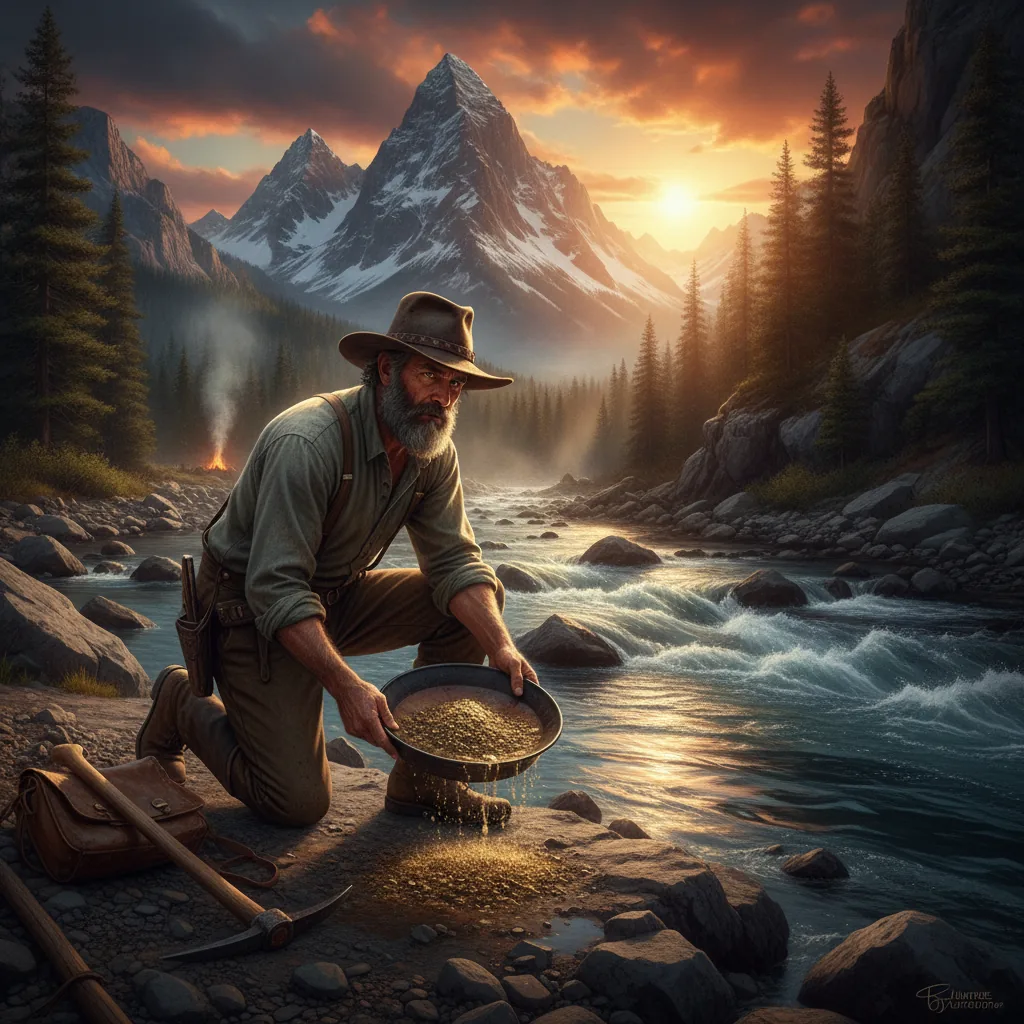
We were somewhere around the dry wash north of the dead Joshua tree when the heat began to take hold. I remember thinking the canteen felt suspiciously light, the kind of light that whispers you idiot in a voice you've heard before, and the sun was doing that thing it does at 113 degrees where the whole valley shimmers like a bad television signal and your own boots seem to be lying to you about how far you've walked. There was gold out there. Or there was the idea of gold, which in the desert is a far more dangerous thing, because the idea weighs nothing and the water weighs everything, and the man who forgets that ratio is the man they find three days later, mummified and grinning, clutching a pan with two flakes of color in it.
This is an article about not being that man. Or that woman. Gold fever is a real affliction—it has been documented, in one form or another, since the forty-niners poured into the Sierra Nevada in 1849 and started dying in heroic, preventable numbers—and the modern prospector with a $1,400 metal detector and a YouTube education is no less susceptible than the half-mad Cornishman who walked off a boat with a shovel and a Bible. The gold doesn't care about your gear. The country doesn't care about your dreams. And the country, statistically, is the thing that will kill you long before you ever find an ounce.
The First Truth: It's the Environment That Hunts You
Let's establish the body count before we get romantic. The places gold lives—the desert washes of the Mojave and the Sonoran, the steep timbered drainages of the Sierra and the Klamath, the bone-dry ranges of Nevada and Arizona—are precisely the places the National Weather Service spends its days warning people away from. Heat is the quiet killer. The NWS notes that heat is consistently among the deadliest weather hazards in the United States, outpacing hurricanes and tornadoes in an average year, and the victims are overwhelmingly people who underestimated it: hikers, workers, prospectors—anyone who believed they were tougher than thermodynamics.
They are not. Nobody is. The human body is a magnificent machine engineered to operate within a core temperature window roughly the width of a credit card, and when the ambient air climbs past your skin temperature, your only cooling mechanism left is sweat—evaporation—which means you are now bleeding water into the sky at a rate that will astonish you. The Centers for Disease Control and Prevention documents the grim escalator: heat cramps, then heat exhaustion—the pale, clammy, nauseated, dizzy stage where you can still be saved—and then heat stroke, where the body's thermostat shatters, the skin goes hot and dry, the mind goes sideways, and the organs begin to cook. Heat stroke is a medical emergency with a mortality rate that climbs sharply with every minute of delay. People in this state have been known to take off their clothes, dig holes, and argue with rocks. They feel, by all accounts, perfectly fine right up until the lights go out.
I have seen the early stage of it in a man near the Colorado River, a recreational dredger who'd skipped breakfast and water in equal measure and started narrating his afternoon to a creosote bush. We poured water on him, got him into shade, and he was lucid in twenty minutes. He got lucky. The desert keeps a ledger, and most entries don't end with a happy ride home.
Water Is the Only Gold That Matters
Here is the math nobody wants to hear, the math that ruins the fantasy of "packing light." In serious desert heat, performing physical labor—and swinging a detector or working a sluice all day is labor, make no mistake—a person can lose well over a liter of fluid per hour through sweat. The National Park Service at Death Valley tells visitors plainly to drink two to four liters of water a day and to eat salty snacks to replace electrolytes, and that's for tourists strolling near the parking lots. The prospector working the gravels at 2 p.m. needs more, and needs it on a schedule, not on a whim, because by the time you feel thirsty you are already behind, and in extreme heat you may not feel thirsty until you are dangerously dehydrated.
The cruel twist—and the desert is full of cruel twists—is that you can also kill yourself by drinking water alone. Pound back gallon after gallon of plain water while sweating out salt, and you can dilute your blood sodium into a condition called hyponatremia, which the National Park Service at the Grand Canyon warns about specifically. The symptoms mimic heat exhaustion—nausea, confusion, headache—which means the well-meaning fool drinks more water and digs himself deeper. The fix is electrolytes: salty food, electrolyte tablets, real balance. Water and salt are partners. Bring both, or bring a coroner's note.
Plan your water like a man planning a prison break. Calculate what you'll need, then add fifty percent for the disaster you haven't imagined yet—the twisted ankle, the longer-than-expected hike out, the buddy who didn't pack enough. Never rely on finding water in the field. The seductive blue line on a topo map is, in the West, a liar more often than not; the U.S. Geological Survey distinguishes between perennial, intermittent, and ephemeral streams precisely because most desert "streams" are ghosts that flow three weeks a year. And the water you do find—a stagnant pool, a cattle tank, a sluggish creek downstream of a mine—is a chemistry experiment. The CDC and USGS both warn that surface water in mining country can carry mercury, arsenic, and other heavy metals, the toxic ghosts of the very Gold Rush you're trying to channel. Filter for bugs, but a filter won't touch dissolved arsenic. Carry your water in. Don't gamble your kidneys on a creek.
The Cold That Waits on the Other Side of the Sun
The amateur fears the heat and forgets the cold, which is how the heat's quieter cousin gets so many of us. Deserts and mountains share a vicious habit: the temperature falls off a cliff after sundown. The same Mojave wash that hit 110 at noon can drop 40 or 50 degrees overnight, and a prospector who packed only for the inferno—shorts, a t-shirt, a fantasy of warmth—is now a candidate for hypothermia under a spectacular field of stars.
Hypothermia doesn't require snow. The CDC notes that it can set in at temperatures well above freezing, especially if you're wet, tired, and the wind is up—and the high-country gold streams of the Sierra and the Rockies are cold, wet, and windy by their very nature. You stand in 50-degree snowmelt working a sluice for three hours, soaked to the thigh, and your core begins to leak heat faster than your body can make it. The early signs are the dangerous ones: shivering, clumsiness, slurred speech, and the peculiar mental fog that keeps the victim from recognizing his own decline. The USFS and NPS both preach the same gospel—stay dry, layer with materials that insulate when wet (wool and synthetics, never cotton, which the backcountry crowd rightly calls "death cloth"), and carry more warm gear than your optimistic afternoon brain thinks you'll need.
The Things That Bite, Sting, and Wait Beneath the Rock
Now we come to the fauna, and I will be honest with you because the magazines won't: the wildlife is the least of your problems, statistically, but it is the part your reptile brain will obsess over, so let's deal with it and move on.
Rattlesnakes. Gold country and rattlesnake country are, geologically and climatically, nearly the same map. You will be turning over rocks, reaching into crevices, and walking through brush—all activities a rattlesnake interprets as a declaration of war. The good news, per the CDC's NIOSH guidance for outdoor workers, is that the vast majority of bites are not fatal when treated, and many are "dry" bites with no venom injected. The bad news is that a venomous bite is an excruciating medical emergency that requires getting to a hospital with antivenom—which is a problem when you're four miles up a jeep track with no signal. Prevention is the whole game: watch where you put your hands and feet, never reach blindly under ledges, wear sturdy boots, give every snake a wide and respectful berth, and don't try to handle, kill, or photograph them up close, which is how a startling percentage of bite victims earn their trip to the ICU. If bitten, the modern protocol is brutally simple—stay calm, keep the limb still and below the heart, remove rings and watches before swelling starts, and get to a hospital fast. Forget the cowboy stuff. The CDC is explicit: do not cut the wound, do not suck out venom, do not apply a tourniquet, do not ice it. Those are myths that kill.
Scorpions, spiders, Africanized bees, and the rest round out the cast, but the same logic applies: shake out your boots and bedroll, look before you reach, and respect that you are a guest in a house full of armed residents. The mountain lion and the bear are romantic fears, real but rare; the NPS bear-safety guidance is worth knowing if you work the northern ranges—store your food, make noise, don't surprise them—but you are vastly more likely to be done in by a 40-foot fall while scrambling a steep drainage than by anything with teeth.
Terrain: The Slow, Stupid Ways to Die
And that fall is the thing. The unglamorous truth, supported by accident data from the National Park Service search-and-rescue operations, is that the most common backcountry catastrophes are not exotic. They are falls, sprains, getting lost, and exposure—the boring stuff that compounds. A prospector picks his way down a loose talus slope toward a promising pocket of bedrock, the rock slides, the ankle goes, and now a routine afternoon becomes a survival situation four miles from the truck with night coming on.
Old mine country adds a uniquely horrifying wrinkle. The West is riddled with abandoned mines, and the Bureau of Land Management runs an entire Abandoned Mine Lands program devoted to the fact that these places kill curious people every year. Their campaign has a name worth tattooing on your forearm: "Stay Out — Stay Alive." Vertical shafts hidden under brush. Rotted timbers that look solid. Pockets of bad air—oxygen-deficient or full of toxic gas—that drop a person without warning. Unstable ceilings, flooded workings, leftover explosives gone unstable with age. The old-timers found the gold, yes, and many of them also died finding it, and their workings are now booby traps. Admire them from the surface and keep walking. No nugget is worth a 200-foot fall down a forgotten winze.
Don't Get Lost: Navigation in the Age of the Dying Battery
Getting lost is the gateway disaster. It turns a half-day trip into an overnight survival ordeal, and the modern prospector is uniquely vulnerable because he has outsourced his entire sense of direction to a glowing rectangle that runs on a battery and depends on a signal that does not exist where the gold is.
Here is the discipline. Tell someone your plan. Not vaguely—specifically. Where you're going, what road, what wash, when you'll be back, and when to call for help if you're not. The NPS and BLM hammer this because search-and-rescue teams can only find you if they know roughly where to start, and a left-behind trip plan has saved more lives than any gadget. Carry a paper map and a compass and—critically—know how to use them, because the day your phone dies is the day you'll wish you'd practiced. The USGS topographic map program still produces the foundational maps of this country, and a laminated quad of your area weighs nothing and never needs charging.
This is the place—and the only place—where I'll tell you that your phone, used wisely, is a legitimate survival multiplier. A tool like the Gold Prospector app earns its keep here precisely because it lets you cache maps and mark your dig sites, your vehicle, your water cache, and your route before you lose signal, so the device works as an offline navigation reference rather than a useless glass brick the moment you cross out of cell coverage. Mark the truck. Mark the spring. Mark the spot where you parked at the trailhead. A phone that knows where the truck is, even with no bars, is worth its weight in the very metal you're chasing. But—and this is the iron law—it is a backup to the map and compass, never the reverse. Batteries die. Screens crack. The map in your pack and the skill in your head are the systems that don't fail when the temperature hits 115 and your power bank gives up the ghost.
And consider, for serious backcountry work, a satellite communicator or personal locator beacon. When you are beyond cell range—which is most of the good ground—a device that can summon search-and-rescue from anywhere is the difference between an embarrassing story and a fatality. The NPS has acknowledged the role these devices play in modern rescues. They are not cheap. Neither is a funeral.
The Ten-Pound Kit That Keeps You Breathing
The mountaineering world long ago codified a survival checklist called the "Ten Essentials," and the National Park Service endorses the modern systems-based version of it. The prospector should treat it as gospel, because the activities overlap completely: you are a person far from help in unforgiving terrain. The systems are: navigation (map, compass, and your phone's offline tools); headlamp with spare batteries; sun protection—and in gold country this is not optional, it's a wide-brimmed hat, long sleeves, real sunscreen, and sunglasses, because the sun here is a slow-cooking weapon; first aid; knife and repair kit; fire (lighter, matches, tinder); emergency shelter—even a cheap mylar bivy can stop hypothermia from finishing what the cold night started; extra food; extra water and the means to treat more; and extra clothes for the temperature swing you didn't plan for.
I'd add a few items the list doesn't, born of the specific lunacy of prospecting. A signal mirror and a loud whistle—three blasts is the universal distress call, and a whistle carries far past a shouting voice that's already gone hoarse. A genuinely large supply of water beyond what you think you need. Electrolyte replacement, because of the hyponatremia problem we covered. And a hard, honest assessment of your vehicle, because in remote gold country your truck is your most important piece of survival equipment, and a breakdown twenty miles down a washboard track in 105-degree heat is itself a life-threatening event. Full tank. Good tires. A second spare if you're going deep. Recovery boards. Extra coolant, extra oil, extra everything. The BLM's guidance for backcountry vehicle travel exists because people drive themselves into situations they can't drive out of, then walk away from the one shaded, signal-flashing, water-carrying object that could have saved them. Stay with the vehicle. It's bigger, easier to spot from the air, and full of supplies.
Fire and the Tinderbox: Don't Become the Disaster
Two notes on fire, because gold country and fire country are the same country, and the prospector has a moral and legal duty here that goes beyond his own survival. Much of the best ground sits on land managed by the U.S. Forest Service, which issues fire restrictions and outright bans during dry months for the obvious reason that a single careless spark can incinerate a hundred thousand acres and a few firefighters along with it. Know the restrictions before you go. Check them the morning you leave. A campfire, a cigarette, even a hot exhaust pipe parked over dry grass can start a catastrophe that makes your survival problem into a national news story. The fire that saves your life from hypothermia and the fire that ends a forest are the same chemistry; treat the power with the terror it deserves.
The Permission to Be There: Survival Includes the Legal Kind
A different kind of survival, but real: knowing where you are legally allowed to dig keeps you out of the kind of trouble that ends with confiscated gear, fines, or worse. The land in the West is a patchwork—BLM, Forest Service, state, private, tribal, wilderness, withdrawn—and the rules about prospecting, panning, detecting, and disturbing the ground vary by every inch of it. The BLM's mining-claim system governs much of the federal mineral estate, and the National Park Service flatly prohibits metal detecting and collecting in most park units—a fact that has separated many a confused hobbyist from his detector. This isn't survival in the snakebite sense, but a citation or a trespass charge can ruin you just as thoroughly as dehydration, only slower and with more paperwork. Know the land status before you set foot on it.
Gold Fever Is the Real Predator
Now we arrive at the thing the survival manuals never mention, the thing I came here to tell you, the bat-country truth at the dead center of this whole enterprise: the most dangerous animal in the gold fields is the one operating your own brain.
Gold fever is not a metaphor. It is a genuine alteration of judgment, a tunnel vision that historians have documented since the Klondike stampede sent thousands of unprepared men marching into the subarctic to freeze and starve in pursuit of metal most of them never found. The Canadian authorities eventually required every stampeder to haul a literal ton of supplies over the Chilkoot Pass before they'd let them into the Yukon—not out of cruelty, but because they were tired of recovering the bodies of optimists. That ton of goods was a survival mandate written in the language of bureaucracy, born of watching gold fever kill men by the hundreds.
The fever works like this. You find color. A few flakes in the pan, a faint signal in the headphones, and something ancient and chemical lights up in the back of your skull. Suddenly the canteen doesn't matter. The position of the sun doesn't matter. The four-mile hike back doesn't matter. There might be more, just a little deeper, just over that ridge, just past the point where the light starts to go and the temperature starts to swing and the rational man would have turned around an hour ago. The gold becomes the only fact in the universe, and every survival instinct you packed in the truck gets quietly overruled by a glittering idiot voice promising riches.
This is how it gets you. Not with a sudden disaster, but with a thousand small surrenders of judgment, each one reasonable in isolation, all of them adding up to a man alone at dusk, low on water, miles from his truck, with a bad ankle and a phone at four percent and a few grams of gold that won't buy back a single one of the choices that put him there. I have felt the pull. Everyone who's ever swirled a pan and seen that yellow flash settle in the riffle has felt it. The trick—the entire trick of staying alive out there—is to make your survival decisions before the fever hits, to set hard rules in the cold light of the parking lot and obey them when the hot glittering madness arrives. Turn-around time, non-negotiable. Water reserve, untouchable. The fever will argue with you. The fever is a liar. The desert keeps a ledger, and the desert does not grade on enthusiasm.
The Way Home Is the Whole Point
So here is the gospel, distilled. The gold has been in the ground for tens of millions of years and it will wait for you. The river will be there next weekend. The pocket of bedrock isn't going anywhere. You are the perishable item in this equation—the soft, water-hungry, heat-fragile, easily-lost organism—and your entire job, the real prospecting skill that nobody photographs for the magazines, is to come home alive every single time so you can go out again.
Plan the water like your life depends on it, because it does. Tell someone where you're going. Carry the map and the compass and the skill to use them. Mark your truck and your water in your phone before the signal dies. Pack for the cold that comes after the heat. Stay out of the old mines. Give the snakes their space. Watch your footing on the loose rock. Know the fire rules and the land rules. And above all, set your turn-around time before the fever can talk you out of it.
Do all that, and the West opens up into the most magnificent treasure-hunting ground on the face of the earth—a country of canyons and quartz veins and ancient river gravels still hiding the gold the old-timers missed. Skip it, get greedy, believe you're the exception, and you become a cautionary footnote, another grinning mummy in a dry wash with two flakes of color in his pan and a story nobody will ever fully tell. The choice, as always, is yours, and it gets made not at the moment of crisis but in the cool sane hour before you ever leave the truck. Choose to come home. Then go find your gold.
Sources & Citations
- National Park Service — The California Gold Rush: https://www.nps.gov/articles/the-california-gold-rush.htm
- National Weather Service — Heat Safety: https://www.weather.gov/safety/heat
- CDC — About Extreme Heat: https://www.cdc.gov/heat-health/about/index.html
- National Park Service — Death Valley Safety: https://www.nps.gov/deva/planyourvisit/safety.htm
- National Park Service — Grand Canyon Hydration and Hyponatremia: https://www.nps.gov/grca/planyourvisit/hydration.htm
- USGS — Perennial, Intermittent, and Ephemeral Streams: https://www.usgs.gov/special-topics/water-science-school/science/perennial-intermittent-and-ephemeral-streams
- USGS — Mercury Contamination in Aquatic Environments: https://www.usgs.gov/mission-areas/water-resources/science/mercury-contamination-aquatic-environments
- CDC — Hypothermia: https://www.cdc.gov/winter-weather/about/hypothermia.html
- CDC NIOSH — Venomous Snakes: https://www.cdc.gov/niosh/outdoor-workers/about/venomous-snakes.html
- National Park Service — Bear Safety: https://www.nps.gov/subjects/bears/safety.htm
- National Park Service — Search and Rescue: https://www.nps.gov/articles/search-and-rescue.htm
- Bureau of Land Management — Abandoned Mine Lands: https://www.blm.gov/programs/public-safety-and-fire/abandoned-mine-lands
- USGS — Topographic Maps: https://www.usgs.gov/programs/national-geospatial-program/topographic-maps
- National Park Service — Electronic Devices in the Backcountry: https://www.nps.gov/articles/000/electronic-devices-in-the-backcountry.htm
- National Park Service — The Ten Essentials: https://www.nps.gov/articles/10essentials.htm
- Bureau of Land Management — Off-Highway Vehicle Recreation: https://www.blm.gov/programs/recreation/recreation-activities/off-highway-vehicle
- U.S. Forest Service — Fire Management: https://www.fs.usda.gov/managing-land/fire
- Bureau of Land Management — Mining Claims: https://www.blm.gov/programs/energy-and-minerals/mining-and-minerals/locatable-minerals/mining-claims
- National Park Service — Metal Detecting: https://www.nps.gov/articles/metal-detecting.htm
- Library of Congress — Gold Rush to the Yukon: https://www.loc.gov/classroom-materials/united-states-history-primary-source-timeline/rise-of-industrial-america-1876-1900/gold-rush-to-the-yukon/