
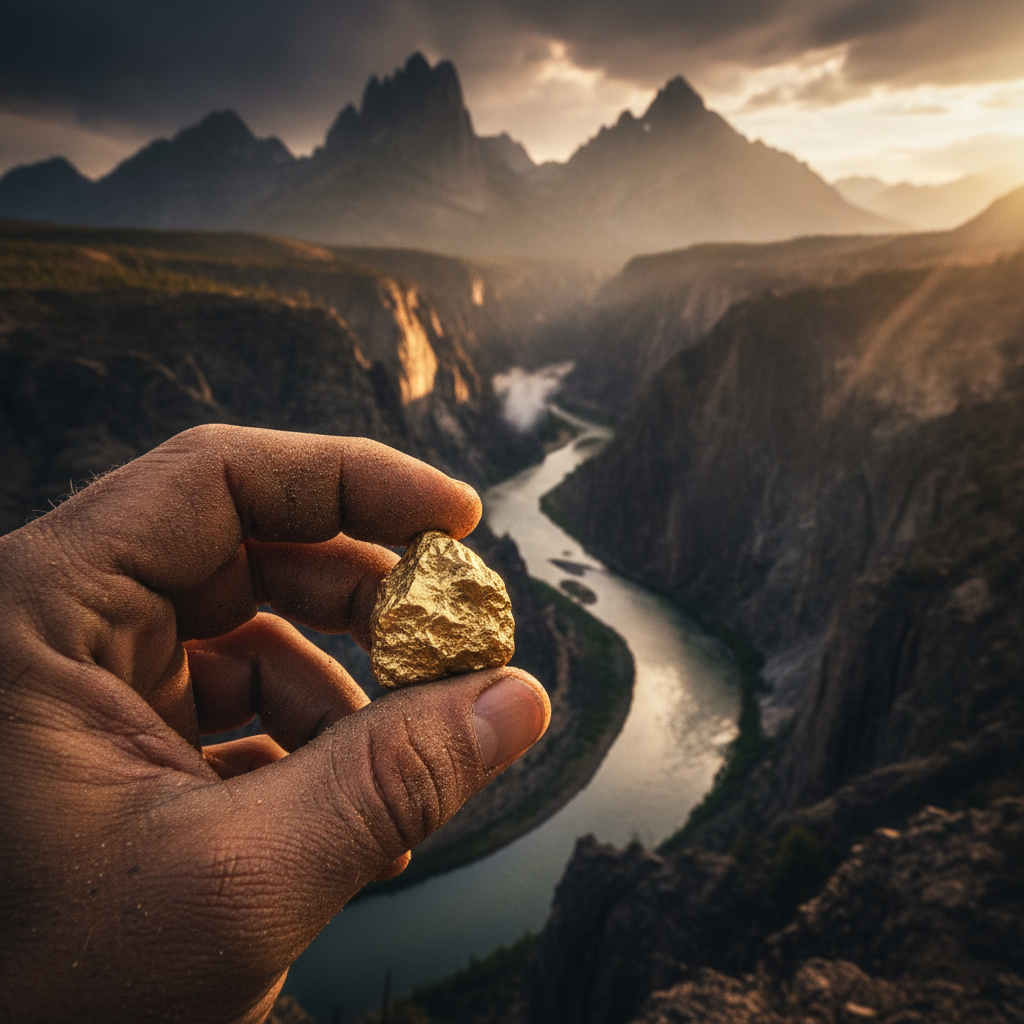
A nugget, when you finally hold one, is heavier than you expect it to be. This is the first thing anyone tells you and the first thing nobody quite believes until it happens. Gold weighs nineteen times what water weighs, almost twice what lead weighs, and the body has no prior arrangement with that fact. The hand reaches for what it assumes is a pebble and receives instead a small dense surprise, a thing that seems to want to fall faster than gravity should allow. People go quiet at this moment. I have watched them. The quiet is not joy exactly, though there is joy in it. It is closer to a kind of confirmation, the sudden physical proof that the long improbable story they have been telling themselves about the ground was, against all odds, true.
Nugget hunting is the part of gold prospecting that traffics in this proof. Not the fine flour gold that disappears between your fingers, not the colors you pan from a creek and store in a vial like punctuation. A nugget is a sentence completed. It is gold that has decided, over a span of time the mind cannot hold, to become a single solid object you can carry in your palm. And the people who hunt them are, in my experience, a particular kind of people: patient in a way that looks from the outside like obsession, attentive to the ground in a way that resembles devotion, and possessed of a faith that the next square foot of dirt, unlike the ten thousand square feet before it, will be the one.
What a Nugget Actually Is
We should be precise, because the word carries more romance than it deserves and the romance obscures the geology. A gold nugget is a naturally occurring piece of native gold large enough to be seen and picked up, typically described by the U.S. Geological Survey as native gold that has been weathered out of its original host rock and concentrated by natural processes. Most nuggets are not pure. They are alloyed with silver, sometimes with copper, sometimes with traces of other metals, and their fineness — the proportion that is actually gold — tends to run somewhere between 830 and 950 parts per thousand depending on where they came from. The surface of a weathered nugget is often purer than its interior, because the silver leaches out first, leaving a skin of higher-karat gold behind. This is why nuggets can look more golden than the gold inside them.
The deeper question, the one that took geologists most of a century to answer and that they are arguably still answering, is how gold gathers itself into a nugget at all. The conventional account, the one taught in field schools and described in USGS prospecting literature, is mechanical. Gold begins life locked in quartz veins, the so-called lode deposits, forced into fractures in the rock by hot mineral-rich fluids deep in the crust. Erosion does the rest. Mountains come apart. Rock breaks down into gravel and sand and the gold within it, being heavier than nearly everything around it, refuses to travel as far or as fast. It sinks. It lags behind. It accumulates in the low places, the bends, the bedrock cracks, the ancient riverbeds. These are placer deposits, and most nuggets are placer nuggets, gold that has been freed from stone and rounded and battered by water and time.
But mechanics alone has a problem, and the problem is that some nuggets are too big and too pure to be explained by sorting alone. Research published in academic geology has increasingly suggested that gold may also grow in place through chemical and even biological processes — that dissolved gold can precipitate out of groundwater, that certain bacteria can concentrate gold, that nuggets can in some sense accrete rather than merely accumulate. A study in the journal Nature Geoscience documented bacterial activity associated with the cycling of gold, the dissolution and re-precipitation that may build grains over time. The truth is probably that both stories are true, in different proportions in different places. Gold is a stubborn, beautiful, slightly mysterious metal, and the nugget is its most concentrated expression of that stubbornness.
The Difference Between Looking and Finding
I have come to believe that nugget hunting is less a technique than a relationship with probability. The placer gold of the world is not distributed evenly or fairly. It is distributed according to the indifferent logic of water and weight, and the entire craft of the nugget hunter is learning to read that logic backward — to look at a landscape and ask, where would the gold have stopped?
The answer is almost always the same and almost always more complicated than it sounds. Gold stops where energy drops. A river moving fast carries gold along with everything else; where the river slows — at the inside of a bend, behind a boulder, in the lee of a bedrock outcrop, where a steep canyon opens suddenly into a flat — the water can no longer hold the heaviest particles and they fall. Over thousands of years they fall into the same places again and again, working their way down through the lighter gravel until they reach bedrock and can fall no further. This is the famous principle behind the prospector's instinct to "get to bedrock," and it is why the cracks and crevices in exposed bedrock, what old-timers called the false bedrock and true bedrock layers, are where so many nuggets are eventually found.
But rivers move. They have always moved. The river you are standing beside is not the river that laid down the gold you are hunting. Some of the richest nugget ground in the American West sits high and dry on hillsides and benches, the beds of ancient Tertiary rivers that flowed millions of years ago and have since been left stranded by uplift and erosion. The Sierra Nevada is laced with these fossil channels, and the hydraulic miners of the nineteenth century blasted entire hillsides apart with water cannons to get at them, a practice so destructive that it was effectively ended by the 1884 Sawyer Decision after the debris choked the rivers and flooded the valleys downstream. The history of nugget hunting is in this sense inseparable from the history of how badly people have wanted gold and what they were willing to do to the land to have it.
The Detector and the Patience It Requires
For most of human history, finding a nugget meant seeing it. The Forty-Niners of the California Gold Rush, whose arrival the National Park Service chronicles in unsparing detail, pulled the surface nuggets — the obvious ones, the ones lying in plain sight or just under it — within a remarkably short span. The easy gold was gone in a few feverish years. What remained was harder, deeper, more hidden, and for more than a century there was no good way to find it short of moving enormous quantities of dirt.
Then came the metal detector, and it changed nugget hunting more profoundly than almost any single technology in the history of the pursuit. The modern electronic nugget detector — particularly the pulse induction machines and the high-frequency VLF units developed over the last several decades — can sense a sub-gram piece of gold buried under a foot of mineralized soil. This is not a small thing. It means that ground worked over and abandoned by the old-timers, ground they walked across a thousand times, is full of gold they could not see and could not reach. The great Australian goldfields of Western Australia and Victoria, where some of the largest nuggets ever recorded were found, have given up extraordinary detector finds in the modern era precisely because the early miners left so much behind.
But the detector does not make the patience unnecessary. It relocates it. A nugget hunter with a detector spends most of their day digging targets that turn out to be nails, bullet fragments, boot eyelets, bottle caps, the rusting metallic debris of every human who ever passed through. The ground in old mining districts is, in a sense, a junk drawer, and the detector cannot always tell the junk from the gold until you have dug it. Highly mineralized soil — the iron-rich, "hot" ground where gold tends to occur — makes the discrimination harder still, throwing false signals that fool both the machine and the operator. Learning to ground-balance a detector, to read its tones, to know when a faint repeatable signal is worth digging and when it is the earth itself talking, is a skill that takes years and that no manual fully conveys.
Reading the Ground Before You Walk It
The best nugget hunters I have encountered do an enormous amount of their work before they ever leave the house. They study geologic maps. They read the old mining records, the production reports, the bulletins published by state geological surveys and by the USGS, which maintains an extensive archive of historical mineral resource data through its Mineral Resources online spatial data system. They learn which districts produced coarse gold, because a district that produced fine gold is unlikely to suddenly yield nuggets. They look at where the lode deposits sit and trace, in their minds and on the maps, where the eroded gold would have traveled.
This research is where a tool like the Gold Prospector app earns its place in the kit, not as a substitute for knowledge but as a way to carry the knowledge into the field. Being able to see documented historical workings, geologic context, and public-land boundaries on the same screen as your own location is, frankly, the kind of thing the old-timers would have considered witchcraft. The reading of the ground is still the prospector's job. But having the maps in your pocket rather than spread across a kitchen table forty miles away changes how the day unfolds. You can stand on a bench, look at the land, and check what the data says about the land at the same time, and the two readings — the one through your eyes and the one through the records — sometimes line up in a way that tells you exactly where to put the coil down.
Where the Nuggets Are, and Where You Are Allowed to Look
The geography of American nugget hunting is a map of old mining districts. California, Nevada, Arizona, Oregon, Idaho, Montana, Alaska — the gold-bearing regions follow the geology, and the geology follows the mountain ranges and the ancient subduction zones that built them. Arizona in particular has become a destination for detector-based nugget hunting because of its dry placers, its concentrated coarse gold, and the relative ease of working ground that was never thoroughly hydraulicked. The Bureau of Land Management administers vast tracts of land across all of these states where recreational prospecting is, with significant qualifications, permitted.
The qualifications matter, and they matter legally as well as ethically. On most BLM-managed public land, casual or recreational prospecting using hand tools and a metal detector is generally allowed without a permit, but the moment you start to disturb the ground in any organized or mechanized way, or work a site that is under an active mining claim, you have crossed into territory governed by the General Mining Law of 1872 and a thicket of subsequent regulation. A great deal of the most promising ground is claimed, and a claim grants the holder the right to the minerals there; detecting on someone's valid claim without permission is, depending on the jurisdiction and the circumstances, both a trespass and a theft. The BLM maintains records of mining claims, and checking claim status before you dig is not optional. It is the difference between a hobby and a problem.
The rules grow stricter still on land managed by the U.S. Forest Service, where a notice of intent or a plan of operations may be required for activities that disturb surface resources, and they become absolute on land managed by the National Park Service, where prospecting and the removal of any mineral material, including a single nugget picked up off the ground, is flatly prohibited in nearly all units. The instinct to pocket a gold nugget you happen to spot in a national park is understandable and it is also a federal offense. The land you are allowed to hunt is a smaller subset of the gold-bearing land than the beginner imagines, and the responsibility for knowing which is which falls entirely on the prospector.
The Largest Nuggets, and What They Tell Us
It is worth pausing over the great nuggets, because they are the cathedrals of this pursuit, the rare objects that justify the faith. The largest gold nugget ever authentically recorded was the Welcome Stranger, found in Victoria, Australia, in 1869 by two miners working just inches below the surface; it weighed, by the figures generally cited in the geological and historical record, over 2,300 troy ounces in its gold content — a slab of metal so large it had to be broken up on an anvil before it could be weighed on the available scales. California produced its own monsters during the rush years; pieces weighing scores of pounds came out of the Sierra Nevada, documented in the production histories compiled by the USGS bulletins on gold deposits.
What these giants tell us, beyond the obvious, is that nuggets are not evenly distributed even within rich ground. Gold is patchy. A district can produce thousands of small nuggets and one impossible giant, and the giant gives no warning. This is the cruelty and the lottery logic of nugget hunting, the thing that keeps people walking the same ground for thirty years. The next signal could be a boot tack. The next signal could be the find of a lifetime. The detector does not know and neither do you, and the only way to learn which it is, is to dig.
The Discipline of It
I keep returning, in thinking about all of this, to the word patience, because it is the word the prospectors themselves use and because it does not quite capture what they mean. What they mean is closer to a willingness to be wrong ten thousand times in pursuit of being right once. The good nugget hunter digs every signal not because every signal is gold but because the discipline of digging every signal is the only thing that guarantees they will not walk away from the one that was. The temptation to discriminate, to skip the faint or the iffy or the probably-trash, is the temptation that leaves gold in the ground. The ones who find nuggets are, more than they are skilled or lucky, the ones who did not skip.
There is a methodology to this that can be taught. Work the ground slowly and in overlapping passes, keeping the coil low and level. Grid the productive areas rather than wandering. When you find one nugget, slow down and work outward in widening sweeps, because nuggets cluster and where there was one there is often another. Dig clean, recover the target carefully, and check the hole again with the detector to be sure you have not left a second piece behind in the loosened dirt. Refill what you dig, both because it is the law on most public land and because it is the difference between a prospector and a vandal. The land remembers how it was treated and so, increasingly, do the agencies that manage it.
The Faith Underneath
What strikes me finally about nugget hunting is how much of it happens below the visible. The gold is below the surface, the geology is below the present, the history is below the topsoil in the form of every prospector who came before, and the motivation is below conscious reckoning, in some place where the desire for gold meets the older human desire to be the one who finds what is hidden. The nugget is the proof, but the proof is almost beside the point. The point is the looking, the long attentive looking, the willingness to spend a day or a year or a life walking slowly across the ground with a machine that hums when it senses metal, waiting for the hum to mean what you have wanted it to mean.
And then, sometimes, after the ten thousandth boot tack, it does. The signal repeats, clean and bright. You dig, and you halve the hole, and the detector still sings, and you halve it again, and there in the loosened dirt is a small dense yellow thing that does not belong to the brown and gray around it. You pick it up. It is heavier than you expected. It is always heavier than you expected. And in that weight is the whole improbable story, confirmed at last, of how the gold gathered itself and waited, through a span of time the mind cannot hold, for you to come along and lift it into the light.
Sources & Citations
- U.S. Geological Survey — Gold Science and Resources: https://www.usgs.gov/centers/gmeg/science/gold
- USGS — Prospecting for Gold in the United States: https://pubs.usgs.gov/gip/prospect1/prospectgip.html
- Nature Geoscience — Microbial cycling of gold: https://www.nature.com/articles/ngeo1361
- USGS — Geology of the Sierra Nevada: https://www.usgs.gov/publications/geology-sierra-nevada
- National Park Service — The California Gold Rush: https://www.nps.gov/articles/the-california-gold-rush.htm
- USGS — Mineral Resources Online Spatial Data: https://mrdata.usgs.gov/
- Bureau of Land Management — Mining and Minerals: https://www.blm.gov/programs/energy-and-minerals/mining-and-minerals
- BLM — Mining Claims and the General Mining Law of 1872: https://www.blm.gov/programs/energy-and-minerals/mining-and-minerals/mining-claims
- U.S. Forest Service — Minerals and Geology Management: https://www.fs.usda.gov/managing-land/minerals
- National Park Service — Prospecting and Mining Regulations: https://www.nps.gov/orgs/1832/prospecting-and-mining.htm
- USGS Bulletin 610 — Gold Deposits: https://pubs.usgs.gov/bul/0610/report.pdf