
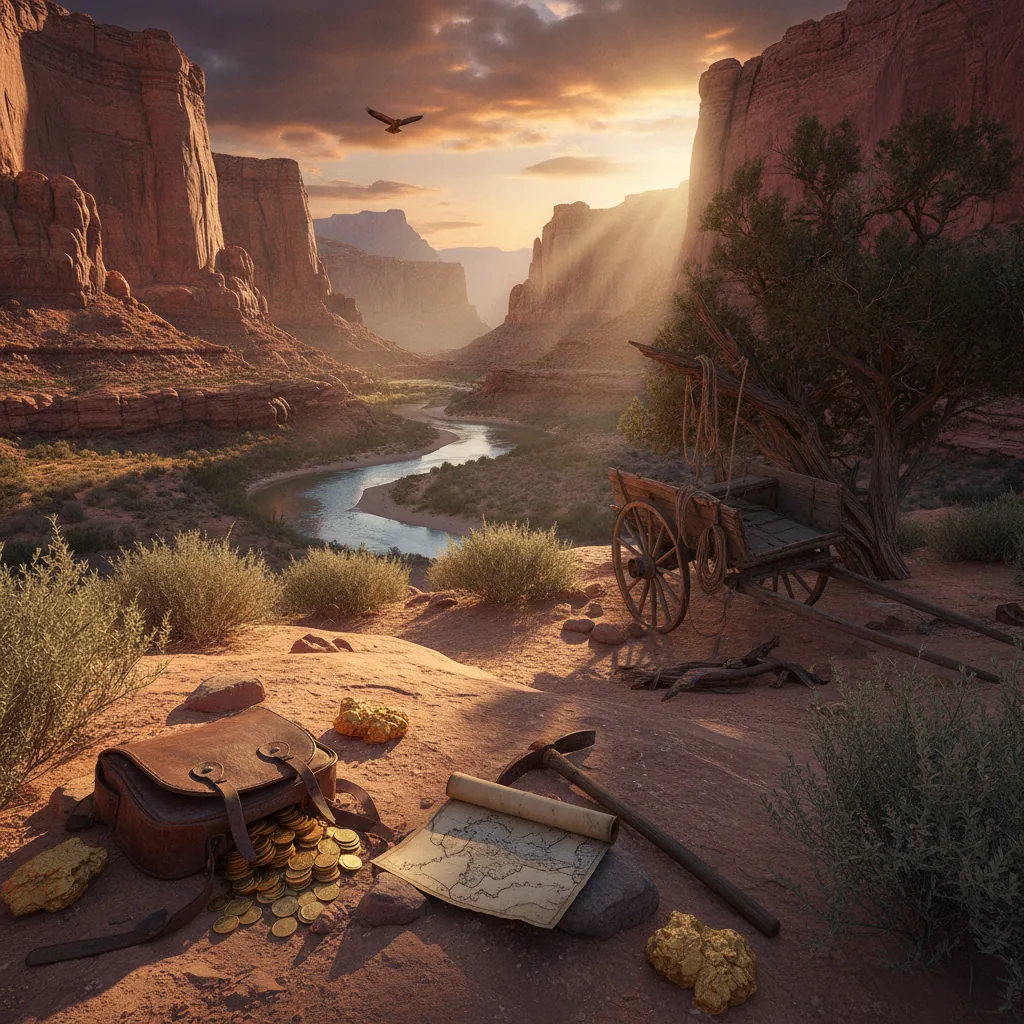
Gold is heavy. This is the first thing you need to understand about lost treasure in the American West — not its color, not its luster, not the way it catches morning light in a streambed, but its weight. A single cubic foot of gold weighs 1,206 pounds. A man can carry perhaps forty pounds of it over rough terrain before his knees begin to argue with his ambition. A mule can manage perhaps three hundred pounds, along with water and provisions, before it starts to fail on a switchback. The history of lost treasure is, in many essential ways, a history of weight — of the mismatch between what people could carry and what they refused to leave behind, between the gravitational pull of gold and the gravitational pull of survival.
The United States Geological Survey estimates that approximately 244,000 metric tons of gold have been discovered throughout human history. A meaningful fraction of this total was pulled, panned, sluiced, and blasted from the mountains and rivers of the American West between the years 1848 and 1900. Some of it made its way to San Francisco mints and Eastern bank vaults. Some of it was fashioned into jewelry, dental work, and decorative flourish. And some of it — nobody knows quite how much — was lost. Dropped, buried, cached, hidden, abandoned in haste, forgotten in death, or simply consumed by the landscape that produced it in the first place.
It is this last category — the lost gold — that concerns us here. Not because it represents the largest share of the total (it doesn't), but because it represents something more interesting than quantity. It represents stories. And stories, unlike gold, have the peculiar property of growing heavier the longer they sit in the ground.
I. Before the Rush
The notion that treasure lies hidden in the American West did not begin with James Marshall's discovery at Sutter's Mill on January 24, 1848. It began centuries earlier, when Spanish colonizers pushed northward out of Mexico with a specific and documented hunger for precious metals. The National Park Service's interpretation of the Coronado Expedition notes that Francisco Vázquez de Coronado marched into present-day New Mexico and Kansas between 1540 and 1542, searching for the legendary Seven Cities of Cíbola — cities rumored to have walls of gold and streets inlaid with turquoise. He found adobe pueblos. He found dry arroyos and bewildered indigenous peoples. He did not find gold.
But the Spanish, in the centuries that followed, did find silver and gold in considerable quantities across what is now the American Southwest. Spanish mining operations in New Mexico, Arizona, and parts of southern California extracted precious metals from the earth with forced indigenous labor, processing it through crude smelting operations and transporting it southward along established routes. The documentary record of these operations is incomplete — deliberately so, in many cases, since miners had reason to underreport their yields to the crown, which claimed a royal fifth of all production. The Bureau of Land Management's documentation of El Camino Real de Tierra Adentro traces one of the principal routes along which this wealth moved, a 1,600-mile trail running from Mexico City to the settlements of northern New Mexico.
Along this route, and along the web of lesser trails that fed into it, things were lost. Mule trains were ambushed by Apache raiders. Wagons overturned in flash floods. Miners cached their ore in caves and under rock overhangs, intending to return with more pack animals, and then died of thirst or violence or simple misadventure before they could. The landscape absorbed these losses the way a sponge absorbs water — silently, completely, without obvious trace. The Sonoran and Chihuahuan deserts are vast enough to swallow entire expeditions, let alone a few hundred pounds of smelted metal.
These early losses gave rise to the first layer of treasure legend in the American West. The Lost Padre Mine. The Lost Tayopa Mine. The Treasure of Victorio Peak. Each story carries a kernel of documentary plausibility wrapped in successive layers of embellishment, speculation, and outright fabrication. The factual core — that Spanish mining operations existed, that they produced gold and silver, that some of this production was lost or hidden — is well-established. The specific locations, quantities, and circumstances become progressively less reliable as you move outward from the documentary record into oral tradition, newspaper accounts, and the particularly American genre of treasure-hunting literature.
II. The Geometry of the Gold Rush
The California Gold Rush, which the National Park Service identifies as one of the defining events in American westward expansion, created the conditions for treasure loss on an industrial scale. Between 1848 and 1855, an estimated 300,000 people migrated to California. They came by ship around Cape Horn, by overland trail across the Great Basin, and by the fever-inducing shortcut through Panama. They brought with them tools, provisions, hopes, and — importantly — very little infrastructure for keeping their finds safe once they had them.
The geometry of the Gold Rush was simple and brutal. Gold was found in the Sierra Nevada foothills, primarily in a region stretching roughly from Mariposa in the south to the Feather River country in the north — a zone the California Geological Survey has mapped in exhaustive detail. Once found, the gold had to be transported to San Francisco, Sacramento, or one of the smaller trading centers where it could be sold, deposited, or spent. The distance from the diggings to civilization was anywhere from fifty to two hundred miles, much of it over rough mountain terrain, through territory where law enforcement was effectively nonexistent.
Consider the arithmetic of vulnerability. A successful miner in 1849 might accumulate, over a season of backbreaking labor, twenty to fifty ounces of placer gold — worth, at the prevailing rate of roughly $16 per ounce, between $320 and $800. (In 2026 dollars, accounting for both inflation and the gold price, this would represent tens of thousands of dollars.) This gold would be carried in a leather poke or belt, on the miner's person, along trails frequented by other miners, merchants, and — inevitably — men whose preferred method of extraction involved a pistol rather than a gold pan. The California State Parks system preserves several of the historic mining towns where this commerce took place, and the interpretive materials at these sites do not sugarcoat the violence and chaos that characterized the era.
The individual miner's losses, while tragic, were generally small in absolute terms. The larger losses came from the operations designed to solve the problem of individual vulnerability: the express companies, stagecoach lines, and banking operations that sprang up to transport accumulated wealth from the mines to the cities. Wells Fargo, Adams & Company, and other firms operated armored stagecoaches and, later, rail shipments that carried substantial quantities of gold. These shipments were targets of proportional ambition.
III. The Stagecoach Problem
Between 1856 and 1884, stagecoach robbery was a routine hazard of gold-country life. The most famous practitioner was Charles Earl Bowles, known as Black Bart, who robbed twenty-eight Wells Fargo stagecoaches between 1875 and 1883, operating alone and on foot in the rugged terrain of Northern California. Bowles's method was simple: he stood in the road at a curve or grade where the horses were moving slowly, pointed a shotgun at the driver, and demanded the strongbox. He never fired a shot. He left poems at the scenes of his crimes. He was, by the standards of stagecoach robbers, a gentleman.
What Bowles did with the gold he stole — reportedly totaling somewhere between $15,000 and $18,000 over his career — remains partially unaccounted for. He spent some of it living quietly in San Francisco under the alias Charles Bolton, posing as a mining engineer. But his lifestyle did not obviously account for his total haul, and speculation about cached Bowles gold has persisted for more than a century. The speculation is probably unfounded — Bowles was not the caching type, and he had expenses — but it illustrates a broader and more legitimate phenomenon: the gap between what was stolen and what was recovered.
Wells Fargo's own records, portions of which are held at the Wells Fargo Corporate Archives, document hundreds of robberies during the stagecoach era. In many cases, the gold was recovered when the robbers were caught. In other cases, it was not. The strongboxes themselves were heavy iron affairs weighing forty to sixty pounds empty. Loaded with gold coin and dust, they might weigh two hundred pounds or more. A robber who managed to get a strongbox off a coach then faced the problem of transporting it over terrain that was, by design, remote from roads and settlements. Some robbers cached their take near the robbery site, intending to return for it later. Some of them never did — because they were killed, captured, or simply couldn't find their cache again in a landscape of nearly identical ridgelines and oak-studded ravines.
The terrain itself was an accomplice to loss. The Sierra Nevada foothills are a landscape of seasonal transformation. A distinctive boulder that marks a cache site in dry August may be submerged in a swollen creek by January. A lightning-struck pine that served as a landmark may be consumed by wildfire the following summer. The Tahoe National Forest and the Eldorado National Forest encompass thousands of square miles of this kind of country — terrain that is simultaneously beautiful and disorienting, where a man can walk for days without seeing another human being and where the landscape rearranges itself with the seasons like a puzzle someone keeps reshuffling.
IV. The Confederacy of the Desperate
The Civil War added a peculiar chapter to Western treasure history. While the major battles raged east of the Mississippi, the war's financial pressures reached into every corner of the continent. Gold shipments from California were critical to the Union's ability to finance its war effort — the National Park Service notes that California contributed an estimated $173 million in gold to the Union between 1861 and 1865. Confederate sympathizers in the West made periodic attempts to intercept these shipments, and several documented incidents resulted in gold being lost, hidden, or diverted.
The most persistent of these stories involves the so-called Confederate treasury gold — various shipments allegedly hidden by retreating Confederate forces in the final days of the war. While most historians place these events in the Southeast — Virginia, Georgia, the Carolinas — a secondary tradition locates Confederate gold caches in the borderlands of the Southwest, where Confederate sympathies were stronger and the terrain more accommodating to concealment. The National Archives' Civil War research collections contain fragmentary references to gold shipments along the southern border, but nothing that rises to the level of a confirmed, unrecovered cache.
This is a pattern that recurs throughout treasure history: the documentary evidence is strong enough to suggest that something was lost, but not specific enough to tell you where. It is the treasure-hunter's essential predicament — enough evidence to sustain hope, not enough to sustain a search.
V. The Lost Dutchman and the Architecture of Legend
No discussion of lost treasure in the American West can avoid the Superstition Mountains of central Arizona, and the legend of the Lost Dutchman's Gold Mine. The story is a masterwork of accumulated narrative — a geological formation wrapped in an Apache curse wrapped in a German immigrant's deathbed confession wrapped in a century of obsessive, sometimes fatal, searching.
The basic outline, as documented by the Arizona State Parks system, runs as follows: Jacob Waltz (or Walz), a German-born prospector, reportedly worked a fabulously rich gold deposit somewhere in the Superstition Mountains east of Phoenix during the 1870s and 1880s. He produced gold — this much seems established, as neighbors and acquaintances reported seeing quantities of high-grade ore in his possession. He died in 1891 without clearly revealing the location of his mine. On his deathbed, he is said to have given directions to a woman named Julia Thomas, who searched for the mine and failed to find it.
The Superstition Mountains are, geologically speaking, a plausible location for gold deposits. The range consists largely of Tertiary volcanic rocks — welded tuffs, basalt flows, and associated intrusive formations — that overlie older Precambrian basement rocks. The USGS Arizona Water Science Center has mapped this geology in detail. Gold-bearing quartz veins can and do occur in volcanic terranes, particularly where hydrothermal fluids have circulated through fracture systems. Several small gold mines operated in the Superstition Mountains and surrounding areas during the late nineteenth century. The question is not whether gold exists in the Superstitions — it does — but whether it exists in the fabulous concentrations suggested by the Dutchman legend.
The answer is almost certainly no. The geological conditions in the Superstitions are not consistent with the kind of bonanza-grade deposit described in the legend. But this has not deterred searchers. Since Waltz's death, the Superstition Mountains have been the site of continuous treasure-hunting activity. Multiple people have died in the search — from falls, dehydration, heat exposure, and, in several documented cases, violence. The mountains are rugged beyond casual description: a labyrinth of deep canyons, knife-edge ridges, and near-vertical cliff faces where summer temperatures routinely exceed 110 degrees Fahrenheit. The area is now part of the Tonto National Forest's Superstition Wilderness, and the U.S. Forest Service manages it with an awareness that a significant number of visitors are there not for recreation but for gold.
The Lost Dutchman legend is worth examining not because the mine is likely to be found — it probably does not exist in the form described — but because it illustrates the architecture of a treasure legend with perfect clarity. The structure is always the same: a documented source of gold, a plausible reason for its loss or concealment, a tantalizing fragment of directional information, and terrain difficult enough to explain why no one has found it yet. These four elements, combined in varying proportions, generate every treasure legend in the American West. They are the load-bearing walls of the genre.
VI. What the Ground Actually Contains
Set aside legend for a moment and consider what the ground of the American West actually contains in terms of recoverable lost material. The answer is: more than you might think, and less than you might hope.
The Bureau of Land Management administers approximately 245 million acres of public land in the Western states. Much of this land was, at one point between 1848 and 1920, the site of active mining, ranching, military, or transportation activity. The people who conducted these activities dropped things. They lost things. They buried things. They died with things in their pockets. The archaeological residue of Western expansion is scattered across a quarter of a billion acres of public land, and a fraction of this residue is made of gold, silver, or other precious metal.
Metal detectorists working old mining camps, ghost towns, stagecoach routes, and other historic sites routinely recover artifacts of this era. Old coins, buttons, cartridge cases, horseshoe nails, mining hardware, and — occasionally — small quantities of gold. A detectorist working a known Gold Rush–era camp site might, over the course of a season, recover several old coins, a few fragments of mining equipment, and perhaps a small nugget or flake of gold that escaped the original miners' pans. These are not treasure in the legendary sense, but they are tangible connections to the historical record — small, heavy facts pulled from the dirt.
The Gold Prospector app provides a useful starting point for this kind of historically informed searching. Its maps of known mining districts, claim locations, and public-land boundaries help users identify areas where historical activity is documented and where modern prospecting or detecting is legally permitted. Overlaying historical mining data with current land-status information — who owns it, what's allowed on it, what kind of claims exist — is the foundational work of any serious treasure search, and doing it well requires exactly the kind of spatial data integration that a well-designed app can provide.
VII. The Problem of Provenance
Here is a problem that treasure hunters seldom think about until they encounter it: what happens when you actually find something?
The legal framework governing found treasure in the United States is a patchwork of federal statute, state law, and common-law precedent that varies dramatically depending on where the find occurs, what is found, and who can demonstrate prior ownership. The National Park Service's summary of archaeological laws provides an overview of the federal framework, which includes the Antiquities Act of 1906, the National Historic Preservation Act of 1966, the Archaeological Resources Protection Act of 1979 (ARPA), and the Native American Graves Protection and Repatriation Act of 1990 (NAGPRA).
The most important of these, for treasure hunters, is ARPA. This law makes it a federal crime to excavate, remove, damage, or otherwise alter any archaeological resource located on public lands or Indian lands without a permit. An "archaeological resource" is defined as any material remains of past human life or activities that are at least one hundred years old. This means that a gold coin minted in 1855, found on BLM land in 2026, is not treasure — it is an archaeological resource, and removing it without a permit is a federal offense carrying penalties of up to two years in prison and a $20,000 fine for a first offense.
The practical implications of ARPA for metal detectorists are significant but not absolute. The law applies to public lands and Indian lands, not to private property. It applies to items at least one hundred years old, not to modern items. And the BLM's Instruction Memorandum 2012-169 provides guidance specifying that casual collection of small quantities of rocks, minerals, and semi-precious gemstones is generally permitted on BLM lands, though this allowance does not extend to archaeological artifacts or items of cultural significance.
Metal detecting on National Forest lands is generally permitted for recreational prospecting in areas open to mineral entry, though individual forests may have specific restrictions. The U.S. Forest Service advises visitors to check with local ranger districts before detecting. National Parks, National Monuments, and other units of the National Park System are generally off-limits to metal detecting entirely.
The point is this: the legal landscape is as complex as the physical landscape, and navigating it requires the same kind of careful research. A treasure found on the wrong piece of ground, or handled in the wrong way, can transform from a windfall into a federal case with remarkable speed.
VIII. The Persistence of Searching
In the spring of 2013, a man named Forrest Fenn — a wealthy art dealer from Santa Fe, New Mexico — announced that he had hidden a bronze chest containing gold nuggets, gold coins, precious gems, and pre-Columbian artifacts somewhere in the Rocky Mountains north of Santa Fe. The chest, he said, was worth more than one million dollars. He published a poem containing nine clues to its location. Over the next seven years, an estimated 350,000 people searched for the chest. At least five of them died in the attempt. The chest was eventually found in June 2020, in Wyoming, by a medical student from Michigan. The saga was covered extensively by major news organizations including the New York Times.
The Fenn treasure was not, strictly speaking, a lost treasure — it was a placed treasure, a deliberate provocation. But the response it generated reveals something important about the psychology of treasure hunting in the modern era. The hundreds of thousands of people who searched for Fenn's chest were not, in the main, desperate or delusional. They were engineers, teachers, retirees, software developers — people with ordinary lives and ordinary means who were drawn to the possibility that treasure might still exist, undiscovered, in the American landscape. The search gave them a reason to go into the mountains, to study maps, to learn geology and history, to engage with the physical world in a way that their daily routines did not require or permit.
This is the deeper current beneath all treasure hunting: not greed, exactly, but a hunger for engagement with place. The treasure hunter is, at bottom, someone who believes that the landscape has secrets — that the ground beneath our feet is not inert but layered with memory, that the past has left tangible residue in the present, and that finding this residue is a form of communion with the people who came before. The gold is almost incidental. What matters is the search.
IX. Geology as Oracle
If you are going to search for lost treasure with any seriousness, you must first understand how gold gets where it is. The USGS Professional Paper 610, "Principles of Gold Prospecting," remains one of the most authoritative treatments of gold geology available to the general reader. Gold in the American West occurs in two primary forms: lode gold, which is gold locked in quartz veins and other hard-rock formations, and placer gold, which is gold that has been eroded from its source rock and transported by water to accumulate in stream gravels, beach sands, and other sedimentary deposits.
The distinction matters for treasure hunting because it determines where gold is likely to have been found, and therefore where miners were likely to have worked, and therefore where their camps, trails, and caches are likely to have been located. A treasure hunter working a Gold Rush–era drainage is essentially reverse-engineering a geological process: starting with the gold's final resting place (the streambed), reasoning backward to the miners who worked there, and then reasoning forward to the things those miners might have lost, dropped, or hidden.
The USGS Mineral Resources Data System (MRDS) is an invaluable tool for this kind of analysis. It contains records of more than 300,000 mineral occurrences and deposits across the United States, including detailed information about historical gold-producing sites. Cross-referencing MRDS data with historical maps, land-survey records, and modern satellite imagery can reveal patterns that are invisible on the ground: clusters of mining claims that suggest a particularly productive area, old road alignments that mark supply routes, and concentrations of placer workings that indicate where the gold was and where the miners gathered.
The Gold Prospector app integrates much of this kind of data into an accessible mobile format, allowing users to overlay mining-district boundaries, claim locations, and geological data on maps of public land. For a treasure hunter working in the field, having this information available on a phone — rather than in a stack of paper maps and printouts back at camp — can mean the difference between a productive day and a wasted one.
X. The Shipwrecks That Walked Ashore
Not all lost treasure in the West is inland. The California coast, from San Diego to the Oregon border, has swallowed ships for centuries. Spanish galleons carrying Manila-trade goods. Gold Rush–era steamers loaded with passengers and payroll. Lumber schooners, fishing boats, military transports — the NOAA Office of National Marine Sanctuaries maintains a database of known wrecks along the American coastline, and the California section is thick with entries.
The most famous of these wrecks, from a treasure perspective, is the SS Brother Jonathan, a sidewheel steamer that sank off Crescent City, California, on July 30, 1865, while carrying an estimated $200,000 in gold coin (roughly $4 million in 2026 dollars). The wreck was located in 1993 at a depth of approximately 250 feet, and a private salvage company recovered more than 1,200 gold coins from the site. The legal battle over ownership of these coins — involving the salvage company, the State of California, and the insurance company that had underwritten the original shipment — went all the way to the U.S. Supreme Court, which ruled in the salvage company's favor in 1998. The case, California v. Deep Sea Research, is a landmark in admiralty law and treasure-salvage jurisprudence.
Coastal treasure hunting of this kind is well beyond the reach of the typical metal detectorist, requiring specialized diving equipment, sonar, and legal resources. But the beaches themselves — where wreck debris has been washing ashore for decades or centuries — are accessible. Storm surges periodically expose new material from nearshore wrecks, depositing coins, fittings, and other metallic objects in the surf zone. Detectorists working Northern California beaches after major winter storms have reported finding old coins, brass fittings, and other artifacts from the era of sail and steam.
XI. Ghost Towns and the Archaeology of Failure
There are, by various counts, between 5,000 and 10,000 ghost towns in the American West. The number depends on your definition of "ghost town" — a settlement with no remaining inhabitants? A settlement with no remaining structures? A settlement whose name appears on old maps but corresponds to nothing visible on the modern landscape? By the most inclusive definition, the West is carpeted with abandoned places.
The BLM and California State Parks jointly manage Bodie State Historic Park, one of the best-preserved ghost towns in the American West. Bodie, located at 8,375 feet elevation in the Eastern Sierra, was a boomtown of roughly 10,000 people in 1879–1880, supported by gold and silver mining. By 1882, the major mines were in decline. By 1920, Bodie was essentially abandoned. Today, about 170 structures remain standing in a state of "arrested decay" — the park's official management philosophy, which maintains the buildings as they are without restoring them.
Bodie is protected from metal detecting and artifact collection — it is a State Historic Park and a National Historic Landmark — but it serves as a vivid illustration of what ghost towns contain. The interiors of Bodie's buildings still hold furniture, dishes, clothing, newspapers, and personal effects. The streets still contain the detritus of daily life: nails, bottle fragments, can lids, buttons, and coins. The ground around the buildings has been only superficially explored. Everything that was dropped, discarded, or lost during Bodie's decades of occupancy remains where it fell, slowly sinking into the dust.
Multiply Bodie by thousands and you begin to appreciate the archaeological richness of the Western landscape. Most ghost towns are not as well-preserved as Bodie, and most are not as rigorously protected. Some are on private land, accessible with the landowner's permission. Some are on BLM land, where metal detecting for modern-era items (less than one hundred years old) is generally permissible. The challenge is knowing which sites are which, and what rules apply.
XII. The Database of Dreams
Every state in the West maintains some form of official record of lost treasure claims. These records take various forms — mining-claim documents, probate records, court filings, newspaper archives — and they range in reliability from solidly documented to frankly fantastical. The Library of Congress's Chronicling America project, which provides free access to digitized historic newspapers, is one of the richest sources for primary accounts of treasure loss and recovery. Searching this database for terms like "buried gold," "lost mine," or "hidden treasure" in Western newspapers from the 1850s through the 1920s yields hundreds of results — some of them credible reports of actual events, others clearly fictional or speculative, and many occupying the ambiguous middle ground between fact and embellishment.
A representative example: the Daily Alta California of March 14, 1862, reported that a group of miners returning from the Comstock Lode had buried $14,000 in gold coin near the Carson River crossing after being pursued by road agents. Two of the three miners were killed. The survivor, according to the account, returned to the burial site but was unable to locate the cache because spring flooding had altered the riverbank. The story contains all the elements of a plausible treasure loss: a documented source (the Comstock Lode was producing enormous wealth in 1862), a credible motive for burial (robbery threat), a natural mechanism of concealment (flooding), and a survivor who could not recover the cache. Whether the story is true, partly true, or entirely fabricated is impossible to determine from the newspaper account alone. But it is representative of hundreds of similar reports from the period.
The aggregate weight of these reports — the sheer volume of documented, semi-documented, and legendary treasure losses across the American West — creates a statistical near-certainty that significant quantities of gold, silver, and other valuables remain hidden in the Western landscape. The question is not whether lost treasure exists, but whether any specific piece of it can be found by any specific searcher using any specific method. The answer, history suggests, is: occasionally. Rarely. But not never.
XIII. Modern Finds and the Evidence of the Ground
In 2014, a couple walking their dog on their property in the Gold Country of the California Sierra Nevada discovered a cache of 1,427 gold coins dating from 1847 to 1894, buried in several rusted iron cans. The face value of the coins was approximately $28,000. Their numismatic value was estimated at more than $10 million. The find, widely reported by outlets including the Los Angeles Times, was dubbed the "Saddle Ridge Hoard" after the trail near which it was discovered.
The Saddle Ridge Hoard is important for several reasons. First, it demonstrated that large treasure caches do exist, undiscovered, in the Gold Country landscape — something that treasure hunters have long believed but rarely proved. Second, it demonstrated the preservation potential of the California foothills: coins buried in iron cans in the mid-nineteenth century were, 130 years later, in remarkable condition, many showing little wear beyond what they'd accumulated before burial. Third, it raised — and largely failed to answer — the question of who buried the coins and why. Extensive research failed to identify the original owner with certainty, though several theories were proposed.
The couple who found the hoard had walked the same trail hundreds of times before noticing the edge of a rusted can protruding from an eroded hillside. This is perhaps the most instructive detail of the entire story. The treasure was not deep. It was not cleverly concealed. It was simply overlooked — invisible not because it was hidden but because no one was looking for it. The ground, it turns out, reveals its secrets not to the most determined searcher but to the most attentive one.
XIV. How to Think About Searching
The serious treasure hunter — the one who is more than a weekend hobbyist but less than a lunatic — approaches the search with a methodology that combines historical research, geological analysis, and field technique. The process looks something like this:
First, identify a historically documented loss. Not a legend, not a rumor, but an event recorded in newspapers, court documents, mining records, or military reports. The National Archives, state historical societies, and university special collections are the primary repositories for this kind of documentation.
Second, locate the loss geographically. This is often the hardest step, because historical place descriptions rely on landmarks that may no longer exist. "Three miles east of the old Hawkins ranch" is useless if you don't know where the old Hawkins ranch was. General Land Office survey plats, available through the BLM's General Land Office Records system, are invaluable for locating historical features. So are USGS topographic maps from the late nineteenth and early twentieth centuries, many of which are available through the USGS Historical Topographic Map Collection.
Third, determine the current land status of the target area. Is it public land? Private land? Wilderness? A military reservation? What activities are permitted? The Gold Prospector app's integration of land-ownership and mining-claim data is directly useful at this stage, providing a quick field check on the legal permissibility of detecting or prospecting in a given area.
Fourth, go look. Bring appropriate equipment — a quality metal detector for coin and artifact hunting, a gold pan and classifier for placer work, proper navigation tools, and enough water and food to stay out longer than you planned. Walk slowly. Listen to what the detector tells you. Dig carefully. Record what you find and where you find it. The ground does not give up its secrets to the hurried or the careless.
XV. The Weight of History
In the end, the history of lost treasure in the American West is not really a history of gold. It is a history of people — of their ambitions and their miscalculations, their courage and their greed, their ingenuity and their bad luck. The gold is merely the medium through which these human stories are expressed. It is the element that refuses to corrode, that waits in the ground with infinite patience, that retains its weight and its luster while everything around it — the flesh of the miners, the wood of the sluice boxes, the leather of the saddles and the iron of the strongboxes — decays and returns to earth.
A gold nugget found in a Sierra Nevada streambed today is, in a very real sense, the same object it was in 1849, or in 1549, or in the Cretaceous period when the hydrothermal fluids that deposited it were circulating through fractures in the ancestral Sierra Nevada. It has not changed. It cannot change. Gold does not oxidize, does not tarnish, does not react with the acids in the soil or the salts in the sea. It is, as the USGS has noted, one of the least reactive elements on the periodic table. This is why it survives. This is why it is still there, in the ground, in the streams, in the rusted cans and rotted leather pouches and collapsed mine tunnels and vanished stagecoach stations of the American West — waiting, with a patience that is not patience at all but simply the absence of change, for someone to pick it up.
The landscape of the American West is a palimpsest — a document that has been written on, partially erased, and written on again, over and over, for centuries. The Spanish wrote on it. The forty-niners wrote on it. The railroads, the ranchers, the military, the homesteaders, the tourists — all of them left their marks, and all of them left things behind. The metal detectorist, moving slowly across a hillside with headphones on and eyes down, is a reader of this palimpsest. Each signal from the detector is a word in an interrupted sentence. Each hole is an act of translation. And each find — whether it is a square nail or a gold coin, a shell casing or a silver dollar — is a fragment of a story that the ground has been holding, in trust, for a very long time.
The weight of what was left behind is, collectively, enormous. Not just in ounces and pounds, but in narrative mass — in the accumulated density of human experience compressed into the soil of the West. This is the real treasure, and it is inexhaustible. No matter how many people search, no matter how sophisticated their equipment, the ground will always contain more than they can find. The American West is too large, too geologically complex, too historically layered to ever be fully read. And that, for anyone who carries a detector or a gold pan into the field, is not a discouragement but a promise. The search is not finite. There is always more ground. There is always more history. There is always more weight, waiting to be lifted into the light.
Sources & Citations
- USGS National Minerals Information Center — Gold Statistics and Information
- National Park Service — Coronado National Memorial History and Culture
- Bureau of Land Management — El Camino Real de Tierra Adentro
- National Park Service — Marshall Gold Discovery State Historic Park
- California Geological Survey — Gold in California
- California State Parks — Gold Rush–era Historic Parks
- Wells Fargo Corporate Archives
- USFS — Tahoe National Forest
- USFS — Eldorado National Forest
- Arizona State Parks — Lost Dutchman State Park
- USFS — Superstition Wilderness, Tonto National Forest
- National Park Service — Archeology Laws and Ethics
- BLM Instruction Memorandum 2012-169
- USFS — Mining and Minerals on National Forests
- BLM — Mining and Minerals
- NOAA Office of National Marine Sanctuaries — Shipwrecks
- USGS Professional Paper 610 — Principles of Gold Prospecting
- USGS Mineral Resources Data System (MRDS)
- California State Parks — Bodie State Historic Park
- Library of Congress — Chronicling America Historic Newspapers
- Los Angeles Times — Gold Coins Found in California (2014)
- New York Times — Forrest Fenn Treasure Found (2020)
- National Archives
- National Archives — Civil War Research
- BLM General Land Office Records
- USGS Historical Topographic Map Collection
- USGS — Gold (General Interest Publication)