
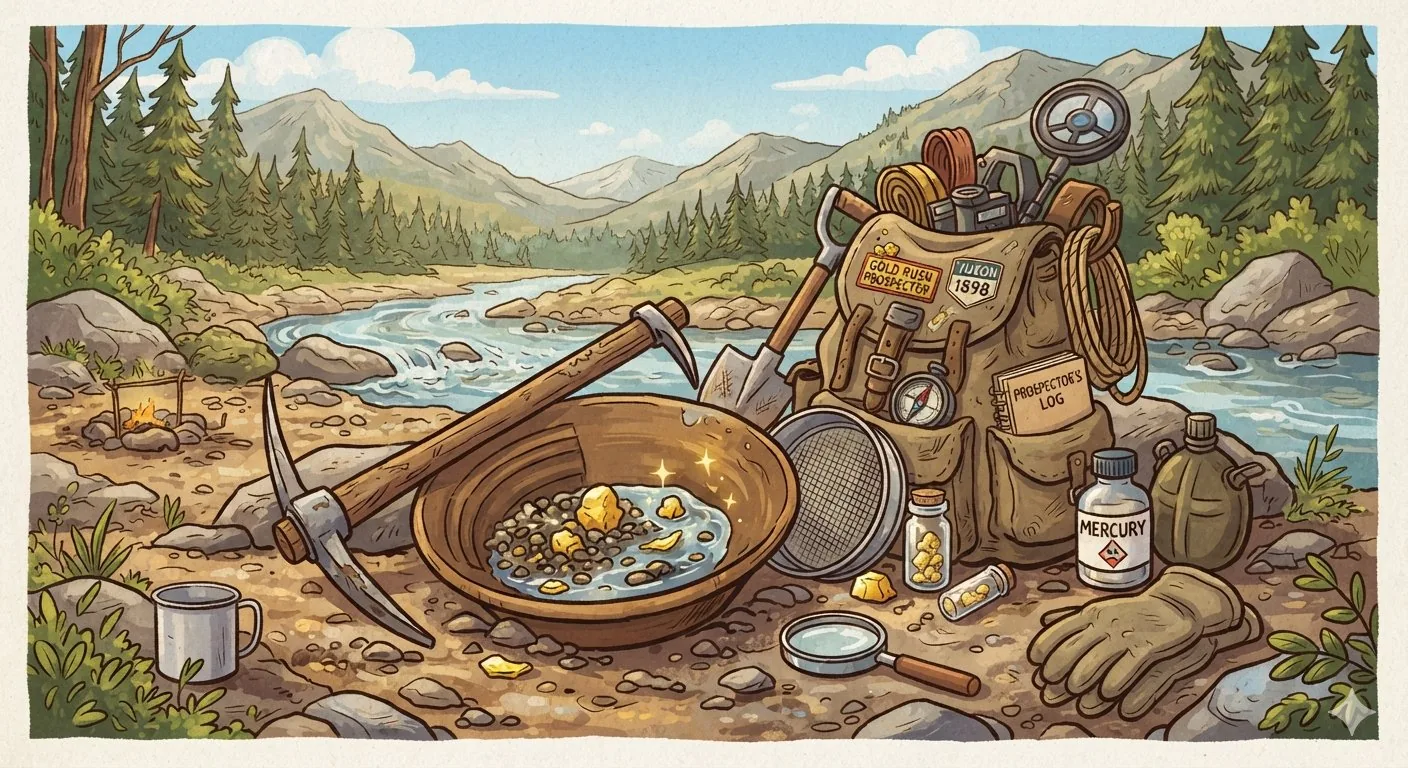
We were somewhere around the edge of the Mojave when the gear began to take hold. I remember staring into the trunk of the vehicle — a low green sedan never engineered for this kind of abuse — and counting the tools I had somehow convinced myself I needed. Two gold pans. A classifier sieve. A snuffer bottle. A pick that could double as a murder weapon. A metal detector still zipped in its factory sleeve like a rifle in a violin case. And underneath it all, a fifty-pound bag of doubt.
This is the truth nobody tells you about gold prospecting: the gear will make you insane long before the gold ever does. You will buy things. You will buy things you do not understand and cannot pronounce. You will stand in the aggressive fluorescent light of a hardware store at 9 p.m. holding a plastic pan and feeling, for one glorious hallucinatory moment, like a 19th-century man of destiny. And then you will drive four hundred miles into a landscape that wants you dead, and you will discover that most of what you bought was theater.
So let us cut through the fog. What follows is a field manual for the gear-crazed — a taxonomy of the equipment that actually matters, grounded in the cold hard facts of geology and federal land law, and delivered without the sugarcoating you'll find in the glossy catalogs. Buckle in.
The Pan: Cheapest Tool, Deepest Truth
Start with the pan, because everyone does, because everyone should. The gold pan is the oldest continuously used piece of mining equipment on Earth, and it works on a principle so simple it borders on insulting: gold is heavy. Absurdly heavy. Gold has a specific gravity of roughly 19.3 — meaning it is more than nineteen times denser than water and around seven times denser than the ordinary sand and gravel it hides among, according to the U.S. Geological Survey's mineral characterizations. When you swirl a pan of sediment in water, that density does the sorting for you. The light junk washes over the lip. The gold sinks to the bottom and refuses to leave. It is physics as gravedigger.
A good pan costs less than a bad dinner. Modern plastic pans — usually green, blue, or black — beat the old steel ones because gold shows up better against dark plastic, they don't rust, and they come molded with riffles along one edge to trap the fine stuff. The National Park Service's Klondike Gold Rush historical materials document how the stampeders of 1897 hauled steel pans over the Chilkoot Pass because that's what existed. You have better options and no mountain of ice to climb. Count your blessings.
But here's the part the catalogs bury: the pan is not primarily a production tool. It is a sampling tool. You use it to find out whether a spot carries gold before you drag in the heavier artillery. A patient panner can process maybe a cubic yard of gravel a day if they're fanatical about it, which is roughly nothing. The pan tells you where to dig. The digging is done by other means.
Classifiers, Snuffer Bottles, and the Small Cruel Objects
Before that gravel ever hits your pan, it should hit a classifier — a sieve that sits atop your pan or a bucket and screens out the oversized rocks. The logic is brutal and correct: you cannot pan efficiently through fist-sized cobbles, and every rock you remove up front is a rock you're not fighting later. Classifiers come in mesh sizes measured by holes per inch. A stack running from coarse to fine lets you separate material into size fractions, which matters because gold of a given size tends to travel and settle with sediment of a comparable size.
Then there is the snuffer bottle — a small squeeze bottle with a narrow tube, used to suck up the tiny flakes and specks of "fine gold" from the bottom of your pan without losing them to clumsy fingers. It looks like something you'd find in a chemistry set for depressed children. It is, nonetheless, essential, because most of the gold you'll actually recover is not the fist-sized nugget of fantasy but flour-fine dust, the kind the USGS notes makes up the vast bulk of placer gold deposits — gold that has weathered out of hard rock and been carried, ground, and concentrated by moving water.
Add tweezers, a magnifying loupe, sample vials, and a small magnet to pull off the magnetite — the black iron sand that clings to your concentrates like a bad reputation. None of these cost much. All of them will vanish into the dirt if you don't keep them leashed to something.
The Sluice Box: Where Ambition Meets Water
When the pan proves a spot pays, you graduate to the sluice box — an angled trough with riffles along the bottom that you set in flowing water. Water carries the gravel through, the riffles create low-pressure eddies, and the heavy gold drops out and stays put while the lighter material flushes downstream. It is a pan that never stops working, a machine with no moving parts, running on nothing but the river's own momentum. The principle is identical to the massive sluices of the 1850s that the California State Parks historical record documents tearing through the Sierra Nevada foothills, only scaled down to something one person can carry on their back.
A modern sluice is aluminum, lightweight, and rigged with expanded metal, ribbed matting, or Miner's Moss to grab the fines. Setting it correctly is an art — too steep and the gold blows out the bottom, too shallow and it silts up and stops sorting. You want a smooth, even current running through at a good clip, and you want to check your riffles obsessively.
But here's where the madness meets the law, and you'd better be paying attention. A sluice box that diverts or disturbs the streambed can run afoul of environmental regulations, and rules vary wildly by state and by parcel. The Bureau of Land Management makes clear that recreational mining on public lands is generally allowed but is subject to surface-disturbance rules, and some methods require notices or permits. Know before you go. The river does not accept ignorance as a legal defense.
The Metal Detector: Electronics in the Church of Dirt
Now we come to the machine that turns ordinary humans into obsessives. The metal detector is where the hobby stops being 19th-century and becomes something stranger — a marriage of electromagnetic physics and pure gambling addiction. You sweep a coil over the ground, it generates a magnetic field, and when that field passes over metal, the metal generates its own field in response, which the machine detects and translates into a sound. A beep. A glorious, maddening beep that could mean a gold nugget or could mean a rusted shotgun shell from 1974.
There are two broad technologies you need to understand, and the difference is not marketing fluff. VLF — Very Low Frequency — detectors run a single frequency and are excellent at discriminating between types of metal, meaning they can tell you "probably iron trash" versus "probably good target." Pulse Induction — PI — machines fire rapid pulses and largely ignore ground mineralization, which makes them the weapon of choice in the heavily mineralized, iron-rich soils of gold country where a VLF machine would scream nonstop. The USGS Mineral Resources Program documentation on the geology of Western gold districts explains why those soils are so mineralized: gold occurs alongside iron oxides and other heavy minerals that make electronic prospecting a genuine technical challenge.
Frequency matters too. Higher frequencies — 45 kHz and up — are more sensitive to tiny gold. Lower frequencies see deeper but miss the small stuff. This is the eternal trade-off, and the reason serious detectorists own more than one machine, which is the first symptom of the disease.
Understand this before you spend a dime: a metal detector does not find gold. It finds metal. Ninety percent of what you dig will be junk — bullet casings, bottle caps, nails, the archaeological record of American carelessness. The gold is in the other ten percent, and only if you've done your geology homework first. A detector in a spot with no gold is a very expensive way to find bottle caps.
The Pick, the Scoop, and the Tools That Break First
The unglamorous gear is the gear that actually determines whether you survive the day. A proper prospecting pick — a rock pick with a pointed end and often a magnet embedded in the handle — is the single most-used tool in a nugget hunter's kit. You'll swing it thousands of times. Buy one that won't snap.
A plastic sand scoop, a garden trowel, a sturdy digging tool, and a "pinpointer" — a small handheld detector that helps you locate the exact spot of a target in a pile of loosened dirt — round out the working set. The pinpointer alone will save you an hour a day of frantic re-scanning, and after your third dig without one you will understand its worth in almost religious terms.
And you will need buckets. So many buckets. Nobody warns you about the buckets. Five-gallon plastic buckets are the true currency of prospecting, the mules that haul your gravel, your tools, your water, your regrets.
Dredges, Highbankers, and the Heavy Machinery of Obsession
Beyond the hand tools lies the equipment that separates weekend hobbyists from the truly afflicted. A highbanker is a sluice with a pump that feeds it water, letting you work material away from the streambank. A suction dredge is essentially an underwater vacuum — a floating engine that sucks gravel off a river bottom and runs it through a sluice.
Here the law stops being advisory and becomes a wall. Suction dredging is heavily restricted and, in many places, effectively banned. In California, the state instituted a long-running moratorium and permitting freeze on suction dredging in rivers and streams over concerns about mercury remobilization and harm to fish habitat, a saga documented across California Department of Fish and Wildlife regulatory materials. The mercury issue is no small thing — the USGS California Water Science Center has extensively studied how legacy mercury from historic hydraulic mining still contaminates Sierra Nevada watersheds, and disturbing those sediments can release it back into the ecosystem. If you're contemplating powered equipment in water, you must check state fish-and-game rules, BLM parcel rules, and any relevant water-quality permits before you unload the trailer. This is not the arena for improvisation.
The Gear That Keeps You Alive
Here is where I get deadly serious, because the desert and the mountains do not care about your gold. More prospectors are hurt by dehydration, exposure, and stupidity than by anything a claim-jumper ever did. The National Park Service issues repeated warnings about heat-related illness in exactly the arid Western terrain where much of America's gold hides — and their guidance is blunt: carry more water than you think you need, avoid the peak-heat hours, and never underestimate how fast a beautiful day turns lethal.
Your survival kit is non-negotiable: at least one gallon of water per person per day and preferably more, sun protection, a wide-brim hat, sturdy boots, a first-aid kit, and a way to communicate or navigate when your cell signal dies — which it will. The federal Ready.gov guidance on wilderness preparedness stresses always telling someone your route and expected return, because a lone prospector who doesn't come back is a search-and-rescue statistic waiting to happen. Snake gaiters in rattlesnake country, gloves for the digging, and a headlamp for when your optimism outlasts the daylight.
This is also where a well-built app earns its place in your pack. The Gold Prospector iOS app was designed to consolidate the reconnaissance work — mapping known gold-bearing districts, letting you log and pin your samples so you can track which spots actually paid, and helping you understand the geology beneath your boots before you haul a single bucket. It won't swing the pick for you. But it will keep you from wasting a tank of gas and a day of daylight on ground that never had a color in it. In a hobby where the single greatest cost is time spent in the wrong place, knowing where is worth more than any coil or riffle you can buy.
Knowing Where You Stand: Claims, Rules, and the Law of the Land
No amount of gear matters if you're standing on the wrong dirt. Public lands administered by the BLM and the U.S. Forest Service are, broadly, open to recreational prospecting and mineral entry under the General Mining Law of 1872 — a piece of legislation older than most of the towns near where you'll be digging. But "broadly open" contains a thousand exceptions. Wilderness areas, developed recreation sites, and lands withdrawn from mineral entry are off-limits. Existing mining claims belong to someone else, and jumping one is both illegal and an excellent way to get shot in the more remote reaches of gold country.
National Park lands are a hard no — the NPS generally prohibits recreational mineral collection and metal detecting within park boundaries, and the penalties are real. Before you dig anywhere, verify the land status. Federal claim records are searchable, and the difference between "legal recreational site" and "someone's active claim" is the difference between a good day and a court date.
The Final Reckoning: What You Actually Need
So here it is, stripped of the mania. If you are just starting, buy a pan, a classifier, a snuffer bottle, and a decent pick, and spend the rest of your money on gas to get somewhere the geology is real. Master the pan before you touch anything electronic. When you've proven you can read a stream and find color, then — and only then — consider a sluice or a detector, and buy the machine that matches your ground.
The gear is seductive because it feels like progress. It is not. Progress is knowledge — of geology, of water, of the law, of the land. The tools are just the instruments you play once you've learned the song. The old-timers who cleaned out the Mother Lode did it with steel pans and mule-hauled sluices and an almost supernatural understanding of where gold wanted to be. They read the rivers. You can read them too, with better plastic and better data and a phone in your pocket that knows more about the local geology than any '49er ever dreamed.
The gold is still out there. The USGS confirms that substantial gold remains in the historic districts — the old boys were thorough but not perfect, and every flood reshuffles the deck. What separates the finders from the fantasists isn't the size of the gear pile. It's knowing which tool to reach for, when, and where. Now stop reading, check your water supply, and go.
Sources & Citations
- U.S. Geological Survey — Homepage and Mineral Resources — https://www.usgs.gov/
- USGS — "Prospecting for Gold in the United States" — https://pubs.usgs.gov/gip/prospect1/prospectgip.html
- USGS Mineral Resources Program — https://www.usgs.gov/programs/mineral-resources-program
- USGS California Water Science Center — Mercury Studies — https://www.usgs.gov/centers/california-water-science-center
- BLM — Recreational Mining — https://www.blm.gov/programs/energy-and-minerals/mining-and-minerals/recreational-mining
- BLM — Mining and Minerals / General Mining Law — https://www.blm.gov/programs/energy-and-minerals/mining-and-minerals/about
- U.S. Forest Service — Minerals and Geology Management — https://www.fs.usda.gov/managing-land/minerals
- National Park Service — Klondike Gold Rush National Historical Park — https://www.nps.gov/klgo/index.htm
- NPS — Mining in the National Parks — https://www.nps.gov/subjects/mining/mining-in-the-national-parks.htm
- NPS — Heat Safety — https://www.nps.gov/subjects/heat/index.htm
- California State Parks — Gold Rush History — https://www.parks.ca.gov/?page_id=1079
- California Department of Fish and Wildlife — Suction Dredge Permitting — https://wildlife.ca.gov/Conservation/Laws-and-Regulations/Suction-Dredge-Permitting
- Ready.gov — Wilderness and Emergency Preparedness — https://www.ready.gov/